When rain is too much of a good thing
As I am known to use horticultural puns, I must say, there is a fungus among us … and he’s not a fun-gi. I have a million of them, but I will save those for another time.
But all this wonderful rain can and has turned into too much of a good thing, both for nitrogen washing out of our yellowing leafed plants, to the literal fungus among us. Lots of questions on both coming in this week.
So how much is too much when it comes to plants? Just like every attorney and politician say, it all depends. Right plant, right place. Plants that did great in our last five years of drought, might be struggling now. But most turfgrass still looks verdant spring green.
The important issues to address: what needs some care in these too wet conditions and what will be fine once moisture levels stabilize. But weather, especially in our area, doesn’t ever balance out, does it?
So, let’s start with a simple too-much-rain condition that can affect a multitude of plants. General yellowing, and I mean general. The entire leaf is starting to look washed out and not the vibrant green it once was.
We have three major plant nutrients: nitrogen, phosphorus and potassium. Those are the three numerical values you see on any bag or bottle of fertilizer: N-P-K. I always remind people of this little rhyme “up, down and all around.” That is what each of these elements are generally responsible for. Up is for the nitrogen, what makes the leaves green; down is for phosphorus, that is for the root system (and how good fruit/flower are); and finally, all around, that is for potassium for the overall health of the plant.
Both phosphorus and potassium are stable in soil, and there are several reasons why too much is really bad. But nitrogen, it washes out easily, and boom, yellow leaves, pale turf appear. Good news though, in this case, a little fertilizer (like a water-soluble crystals type) will green the leaves right back up. But that is if it the whole leaf is yellow.
If you have yellowing leaves, say on a pin oak tree, or blueberry, or red maple. AND the yellow leaf is accompanied by bright green veins, that isn’t a water issue. This is a nutrient deficiency disorder called chlorosis.
Now if you do quick “research” (that is what people say to me after a 30-second google), it will say chlorosis, specifically iron chlorosis is due to iron deficiency, and they run out to get an iron fertilizer. But guess what? That isn’t the problem.
We have plenty of iron (or in the case of the red maples, magnesium) in the soil here, it is just bound up and inaccessible to the iron-loving plant, because of our very high pH (alkalinity) due to all the limestone in our area.
To correct chlorosis, we need a soil acidifier, like elemental sulfur. This is not an instant fix, but a long one, usually lasting two years.
So, understanding plant signs and symptoms isn’t always as simple as it may seem. That is why you have me. So, on to the fungus among us.
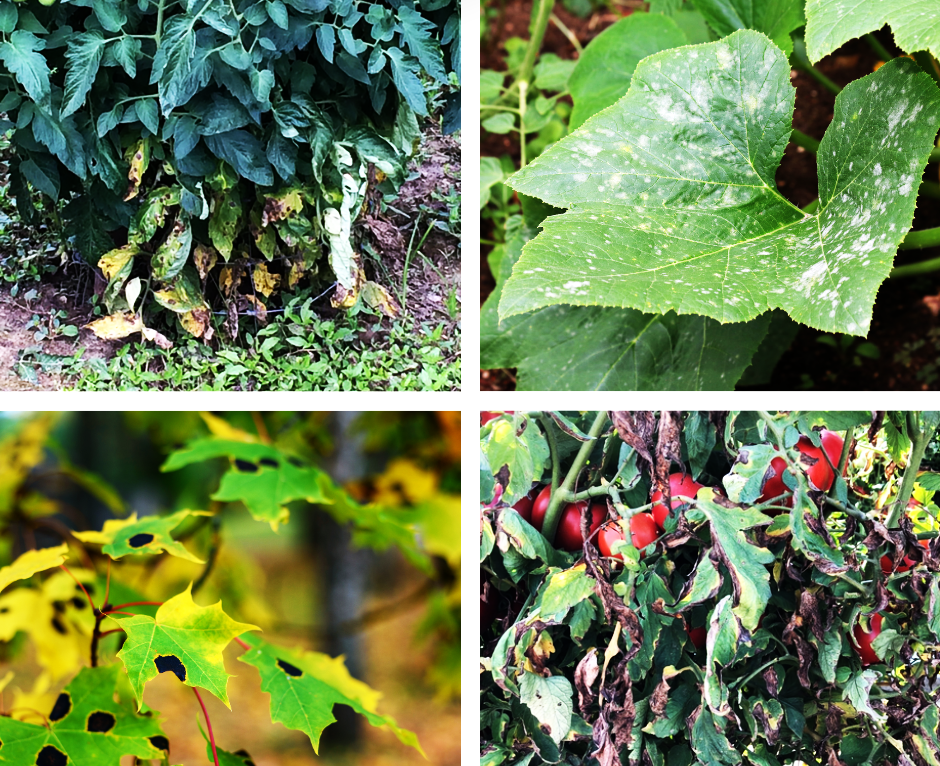
There are many fungal diseases in our gardens. And it may seem they are contagious from one plant to another. Take powdery mildew, this fungal pathogen makes some vegetables and shrubs look like you took a bottle of baby powder and sprinkled it all over the leaves.
It is on the lilac, then you see it is on the cucumbers, roses and pumpkin leaves. But the amazing thing is, they are all different diseases caused by different pathogens. They just show up at the same time because of the disease triangle: enough time, with the specific pathogen present, at the right temperature creates a cauldron of fungi to develop.
The good news is that many fungi are somewhat cosmetic issues. Take tar spot of maple, particularly silver maple. And this name could not be more correct. The circular, coal black colored patches that are slightly raised and look abraded, as though you hired the sloppiest driveway sealer company. But good news, no treatment needed.
But then there are the fungi that do interfere to some degree to plant health. And, if not attended to, if the disease triangle weather continues, will spread. And that is what has started happening this year.
The biggest question I am answering right now is “what is wrong with my tomatoes?” to which I reply, let me guess, are the lower leaves of your tomatoes turning yellow and have little spots on them, then they are drying up and falling off? And 10 out of 10 the answer has been yes. This is the fungal disorder, early blight of tomato.
And it’s not the tomato’s fault. After all, tomatoes are native to Peru, where it isn’t cool and not necessarily wet. And we add to the problem if we try to be “that” gardener. You know the gardener who will do anything to get the first tomato in the neighborhood?
And so, they think by planting on that one warm day in mid-April when you are still deciding if you can wear shorts, they are planting their tomatoes. But then, it gets cool again. And this year, it’s really cool, rainy, and then it rains again. A perfect setting for early blight.
For all plant issues, whether insect or disease, there are both non-chemical and chemical strategies available. The University of Illinois Extension supports and promotes the Integrated Pest Management (IPM, for short). This means use the least impactful control, that gets enough positive results.
In the case of early blight, the simple and best practice control starts with hand picking off any leaves that are affected and discarding them far from the plant. There is a new bud in the spot where the leaf stem meets the plant stem just waiting to come out as soon as the old leaf is removed.
On the chemical side, there are many broad-based fungicides available. Be sure to identify what fungus you have and be sure to read and follow all labelled instructions. The problem with fungicides is people think that if they spray affected leaves it can “cure” them. Nope.
Affected leaves do not heal, but by using fungicide you prevent new leaves from becoming infected. And to prevent fungus at all, you would have to pre-spray before the fungal spores and conditions are present.
But how do we know what the weather will be? It is a tough call. Also, fungicides are usually liquid, and fungal issues occur in, wet weather. So many times, it is hard to keep the fungicide on the plant long enough before it washes off again. That is why I start with the hand-picking method.