Storm results: Correct tree planting and after-care matter
I probably shouldn’t admit this, but I am a last-minute-Mary when it comes to my columns many times. It isn’t for lack of trying or procrastination, just busy. And many times, it pays off for you the reader. You truly get the most late-breaking gardening news. As is the case, tonight.
Wednesday (June 10) provided what I and other winter-lovers detest about summer — super high temps, plus that shirt-soaking humidity — a true tempest in the teapot. And as it did, that combination created a squall line that blasted through much of the Will County region like a herd of bison.
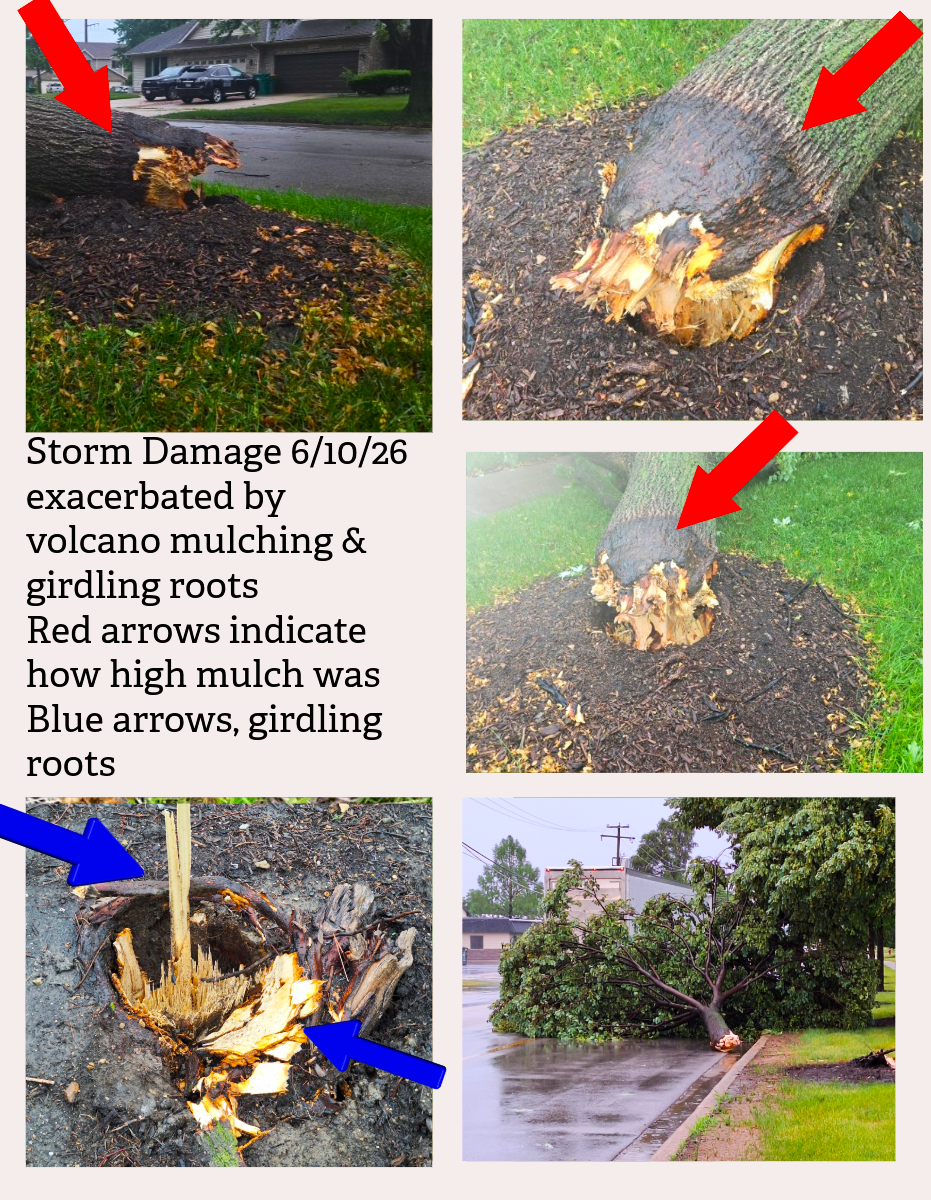
The pictures included in this column were taken literally minutes ago by myself, and one of my Ace Master Gardener volunteers, Carol Juszkiewicz. Mine are from New Lenox, in parkways of some monster warehouses. Carol’s are from a Plainfield-area neighborhood.
Both are sadly ideal and tragic examples of poor tree planting and aftercare. The best part about trees is also the worst part, ideally they are planted small and grow to an incredible investment for the homeowner, local nature, and when it is time to sell … cha-ching!
It is said that a single mature shade tree can add $10,000 value to a home. No small change, indeed. But lose that tree before a sale, whether by storm or a recommendation of an ill-advised home stager that says everyone wants a “clean look” these days, losing a mature shade tree in the front yard, take $6,000 to $9,000 off that house value now.
So getting trees, and keeping them, is a fantastic investment. Not to mention the buffering value against noisy neighbors and traffic, and the capacity of a tree’s vast root system to suck up a deluge of rainwater.
And the tragedy is, that both of the “don’ts” I am focusing on — don’t do any damage early on in the tree’s life; no, it is usually after years and years of growth. And it doesn’t have to even occur as a result of storm damage. Many people will call me and say their tree was fine last year, and never came back, or worse, half or a third came back this year.
Also true is when someone asks me if their trees were subject to some type of vandalism because it looked like someone hit the trees and broke them off at soil line. Again, no.
That is why what I witnessed a few hours ago, and really with the high-volume winds and severity of storms, we all see on too-regular a basis. It is true that no tree can withstand tornadoes and derechos, but some can better than others.
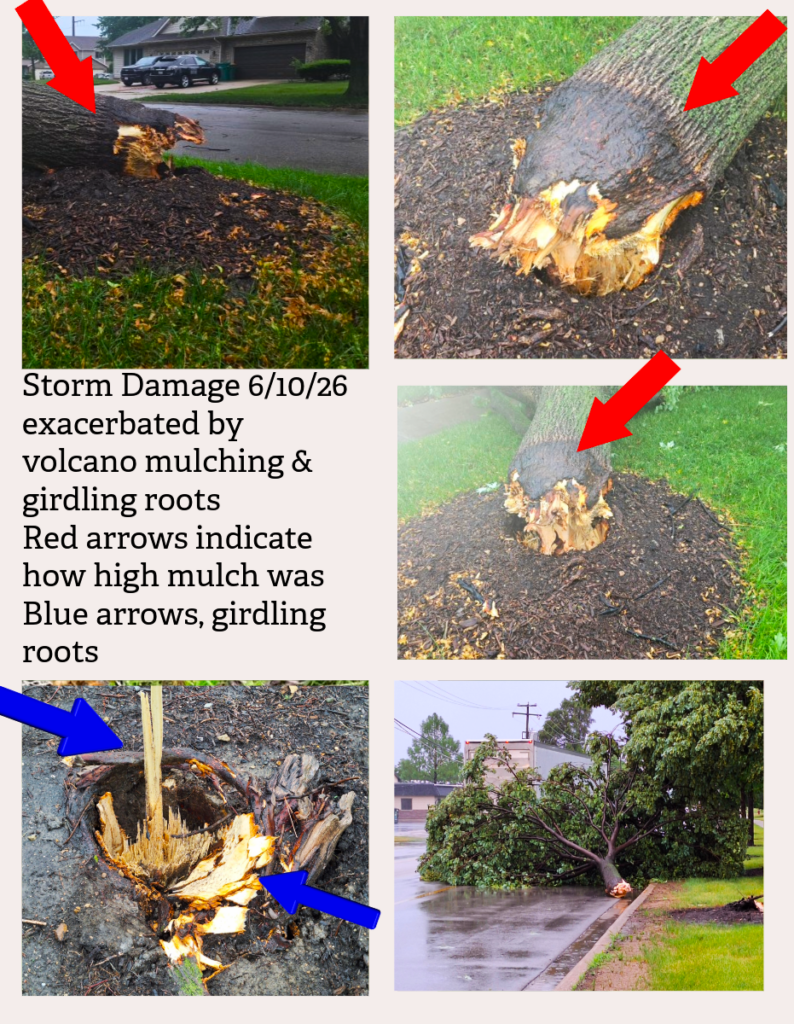
But it is moreover, what we do to trees unknowingly trying to do the best, we actually are doing the worst — both in planting and the dreaded over-mulching, also known as volcano mulching. These photos tell the whole story.
First, let’s address the girdling roots of the tree damage I found in New Lenox. If you look closely at the shredded twisted cavity/stump of the wind-extracted tree, it tells a real story. And no, not a fairytale, but a horror story. This poor tree never had a chance, and I am actually surprised its adjacent 20 brother and sister trees, didn’t suffer the same fate — yet.
Let’s start when buying a tree — whether it is in a small pot in a paper sleeve at a big box store (great trees can be found there — seriously), or whether you went big time and went to a nursery for a balled and burlapped or caged older tree, you have to examine the roots. Yes YOU, it is your tree.
Roots of all plants, when grown in a container long enough, will hit the container and start to circle. You probably just saw this when you were planting your annual flowers this year and had difficulty getting them out of that cell pack. I am always preaching to kids and adults to tickle the roots, meaning take any roots that are going around the plant in a circle forming a tight mat and you need to pull those roots away so they circle no longer.
Similarly, in tree planting, no roots should be seen winding around the root ball or trunk, because roots continue to grow in the circle. Roots (not unlike me, sadly) get fatter and chunkier as they grow. These roots eventually start strangling the tree. Literally.
You can see this everywhere unfortunately, particularly with municipally planted trees, but may I suggest you go out in your own personal arboretum and check the tree at the trunk. Do you see any thick roots riding above the soil encircling the trunk — maybe even cutting into it? Yep, girdling roots.
The problem needed to be addressed at planting time, cut away any girdling roots and position roots outward and downward. What happened today is the girdling roots, make the fulcrum (weight bearing point) of this fully-leafed gorgeous maple, rip away with the strong winds. I gazed into the gaping hole where you could still see the girdling roots.
Just don’t let it happen to your next tree.
Still looking at those photos and adding the ones from Plainfield Carol took, I want you to notice the other tragedy — of the worst tree aftercare that is done more than correct care — volcano mulching or over-mulching.
Look how both trees broke right at the base, then follow up the tree … see that grizzly green-brown area? It kind of reminds me of a farmer/gardener tan, but it is the area where mulch was piled up high – no, higher, no, even higher — sometimes 2 feet or more, and it rotted the base of the tree, making it such an easy target for wind damage.
Just don’t do it. Mulching should only be max 2 to 3 inches at the base of a tree and as wide out as you would like (the tree would like it a lot if you would extend that non-turf mulch to almost the drip line of the tree.) Ideally, with no mulch up against the trunk itself.
Interestingly, as I am always observing horticulture planting, growing, dying, etc. as I travel through our verdant county, and as God has blessed me with an extraordinary memory — so far — I see and note the changes.
Those parkway trees in New Lenox, they had been volcano mulched after planting for about three years. Then apparently a really smart landscaper noticed, and sent their crew to “de-mulch” to a reasonable level.
It is never too late to try. Let’s start now.