Butter not miss this one, local dairy gets a fair shake
By Sandy Vasko
Today we talk about one of my favorite vices. No, not that one – it’s a food vice — butter. It must run in the family, because my great grandmother, Katerina, won a medal for her butter making abilities back in Sweden.
A friend recently chastised me for using too much butter in my cooking. I told him there is no such thing as too much butter. So, let’s slide into history and talk about this delicious food.
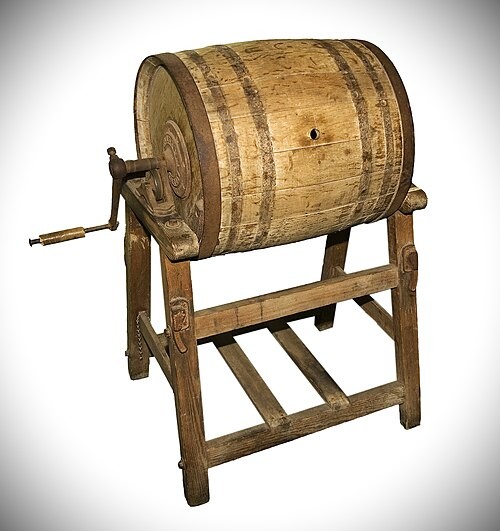
I think the first thing I need to explain is how butter was made back in the day: Raw milk was soured, either by putting it into a wooden churn that still had bacteria in it from the last batch, or more usually adding a bit of “starter” from the last batch of sour milk.
When the milk thickened into a sort of yogurt it was put into a churn and churned until the fat particles clung together as a solid. The liquid “buttermilk” was poured off for drinking and cooking purposes; then the butter was pressed and pounded to remove as much liquid as possible. Lastly, salt was added to help preserve it.
The prairies of Will County were ideal for raising dairy herds, and early settlers knew it. Not only was the milk produced from those cows extra rich in butterfat, but also, they produced a greater quantity of it than in other places. Soon, more butter and milk were produced on the farms than local families could use.
One way of preserving milk without refrigeration is to condense it and put it in cans, and that was what the first dairy men did. We read on November 23, 1864, in the Wilmington Independent:
“A Milk condensing establishment is about being started here, provided a sufficient quantity of milk can at present be secured to warrant the enterprise. No manufactory could be of more lasting benefit to our farmers than this. Farmers, send in your offers to supply to Rev. Mr. De Wolf, and secure the establishment of a milk depot here. Milk may be sent in any time during the day, and no extra work by way of hurry or early rising is asked.”
Buyers from the big cities of Chicago and St. Louis also heard about the famous dairy herds in Wilmington. They were looking for butter to ship directly to the markets. Wilmington farmers obliged them by churning the butter at home and bringing it into the local buyer. We read on June 19, 1866, in the Joliet Signal:
“Forty-five tons of butter – the Wilmington Independent says that 90,000 pounds of butter were shipped from Wilmington for the week ending June the 9th. Our neighboring young city must be a slippery place these days!”
One problem with this set-up was that the butter from the various suppliers was not all of the same quality or freshness. Sometimes the buyers rejected the butter because too much salt had been added or too little. Sometimes, the heat turned it rancid before it could be taken into town. The solution was simple: A butter factory must be built that would accept the raw milk and turn out a good, even quality of butter.
Finding men who wanted to invest in such an establishment wasn’t easy. It wasn’t until 1876 that Edward Allen, the man who brought the canal to Wilmington, found a St. Louis investor. We read: “E. Allen, Esq., informs us that Mr. Teasdale, of St. Louis, and himself, will establish a creamery or butter factory in this city during the coming spring. It will be located on Main Street, between Lafayette and River streets, and consume an average amount of 2,500 lbs. of milk daily.”
By 1878, the City of Wilmington purchased a canal boat to bring milk to the butter factory in town from the farms up and down the Kankakee.
In New Lenox in 1876, the same thing was happening. We read: “A recent visit to the butter factory of this village, suggested a brief notice of the institution. It is under the careful and gentlemanly management of Messrs. D. M. Snow and J. B. Salisbury. The milk, which is furnished by the farmers, is first conducted into a large weigh can and thence into vats in a room kept at a proper temperature where it remains till ready to be churned. The churning is done by a large revolving rectangular churn, driven by horsepower, in which the butter comes to time in a hurry. It is not necessary to speak of the quality of the product of the factory which is contracted to Munroe & Son of Joliet at a large price.”
In the end, there was a creamery, or better put, a butter factory in many of the small towns and villages. They relied on local farmers to bring in the milk, and on local distributers such as grocers or wholesale shippers to distribute and sell the product.
That seemed to work for a while, but in Beecher something happened. We read: “Eight of the milk shippers and probably more in the near future will quit the Beecher Creamery Company. To forsake the creamery would greatly decrease business in town, dairy products, especially butter would lower in prices. The shippers are therefore kindly requested to patronize the home factory. The Creamery is more accommodating in many ways. They have also helped Beecher and vicinity in many things which should cause the patrons to stay with them instead of starting a stampede.”
I have no further information about why the milk shippers quit Beecher.
It’s an old story: By 1900, technology invented better ways of churning butter in bigger and better factories. The little creameries went out of business one by one. Soon, farmers were taking their milk cans to the depot to ship them to the factory in the city.
By the way, you can make your own butter using a lidded jar and warm heavy cream. Let the cream come to room temperature, pour in the jar, put the lid on tight and simply shake. You will soon see little spots of yellow appear, and soon those will stick together to form a nice large lump. For best taste, remove the lump and put it in a bowl. Press on it with a flat spatula or large spoon until the milk no longer runs out. Home made butter and fresh bread, nothing better.
Sandy Vasko serves on the Board of Directors of the Will County Historical Museum and Research Center and is Collections and Research manager.