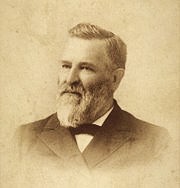
Robert Waterman, Will County’s gift to California
By Sandy Vasko
Wilmington and California share very few things. One, of course, is the famous Route 66 that is celebrating its 100th year this year. However, most people would be hard pressed to think of something else. But look far enough back in history, and we discover that we shared Robert Whitney Waterman, 17th Governor of California.
Waterman was born in 1826 in Fairfield, New York, to a family of eight children. He was a hard worker from an early age. At the age of 13, in 1839, he moved to Newbury, Illinois, to join a brother as a clerk. He eventually moved to Geneva, where he clerked and was postmaster.
In 1850, he sold his assets, left his wife and child, and headed west to join another brother prospecting for gold. The story goes that he befriended Brigham Young on the way. After one year of finding nothing, Waterman returned to his family in Illinois, who by then had settled in Wilmington.
While in Wilmington, Waterman prospered. In 1854 we have an ad that gives two of his business cards. The first tells us that he sold steamer tickets to Liverpool out of New York, and also money orders that would be good in England, Ireland and Scotland.
The second says the he is “Dealer in Dry Goods, Groceries, Hardware, Glass and Tin Ware, boots and Shoes, Ready-Made clothing, etc. The highest price paid for country produce.”
He was also publisher of one of Wilmington’s first newspapers, the Wilmington Herald.
Also, in 1854, he was instrumental in founding the Republican Party in Illinois, and in 1856, he was one of two Illinois delegates to the national convention of the Republican Party held in Bloomington, Illinois. The other was Abe Lincoln.
In the 1860, census he was listed as the third richest man in Wilmington, just behind William Small and Archibald McIntyre.
During the Civil War, his Empire Store became the civilian headquarters for war relief. He encouraged the ladies aid groups to put boxes in his place to collect everything a soldier needed, from warm socks to feathers, which would be made up into pillows and blankets for the Army hospitals.
Governor Yates appointed him to inspect the conditions at Bird’s Point, Missouri, hospital. Mr. Waterman then conducted regular inspections of military hospitals throughout the war. He did this using his own money for transportation and lodging.
He eventually built up another dry goods store named Excelsior, and planted acres of fruit on the west side of the Kankakee. In 1872, we read this amusing incident concerning his fruit:
“Two fellows entered the grounds of R. W. Waterman, Esq., on Saturday night, and robbed him of all the peaches on one fine tree – not content with this, and giving their appetites whet up for fruit, they concluded to try grapes the next night, but R. W. was ‘around’ with a gun full of mustard seed and coarse salt. He got sight of them at last, and blazed away.
“He says it was fun just to see those ducks ‘Get up and git,’ each with a hand on the rear of his breeches, and howling as though they were half killed. All this is very nice, but we cannot but censure Mr. Waterman for not having loaded his shooting iron with buck shot, and fired to bring down his game. There is nothing in this wide world so mean as a fruit thief, and the man who brings one to grief should receive the thanks of the whole town.”
In 1873, Waterman sold out his holdings in Illinois and once again tried his hand at getting rich in California. In 1880, while residing in San Bernardino, Waterman discovered a silver mine a few miles north of Barstow, California, then called Grapevine. In 1881, he formed a mining partnership with John Porter called Waterman and Porter, with 3/4 of the interest owned by Waterman. A stamp mill settlement about four miles away was named Waterman.
The Southern Pacific Railroad came through Waterman in 1882, and 100 men were employed at the mill and mine. The mine produced 40,000 tons of ore ($1.7 million worth) before it closed in 1887 after silver prices declined.
In 1886, Waterman was elected Lieutenant Governor and became Governor upon the death of Governor Washington Bartlett. His nickname was “Old Honesty,” because he would not tolerate drunkenness, overspending, nor dishonesty, and vowed to run the state as a business. He chastised the Legislature for having 228 clerks when only 35 were authorized.
He served out the remainder of his term, but because of poor health, he refused to run again. He died on February 29, 1892, in San Diego.
Today, Waterman Avenue, Waterman Gardens and Waterman Canyon are still named for him in San Bernadino, as well as Waterman Road at the western margin of Barstow, south of State Route 58 and North of the Mojave River.
Sandy Vasko is past director of the Will County Historical Museum and Research Center, and now serves on the Board of Directors and Collections and Research Chair.
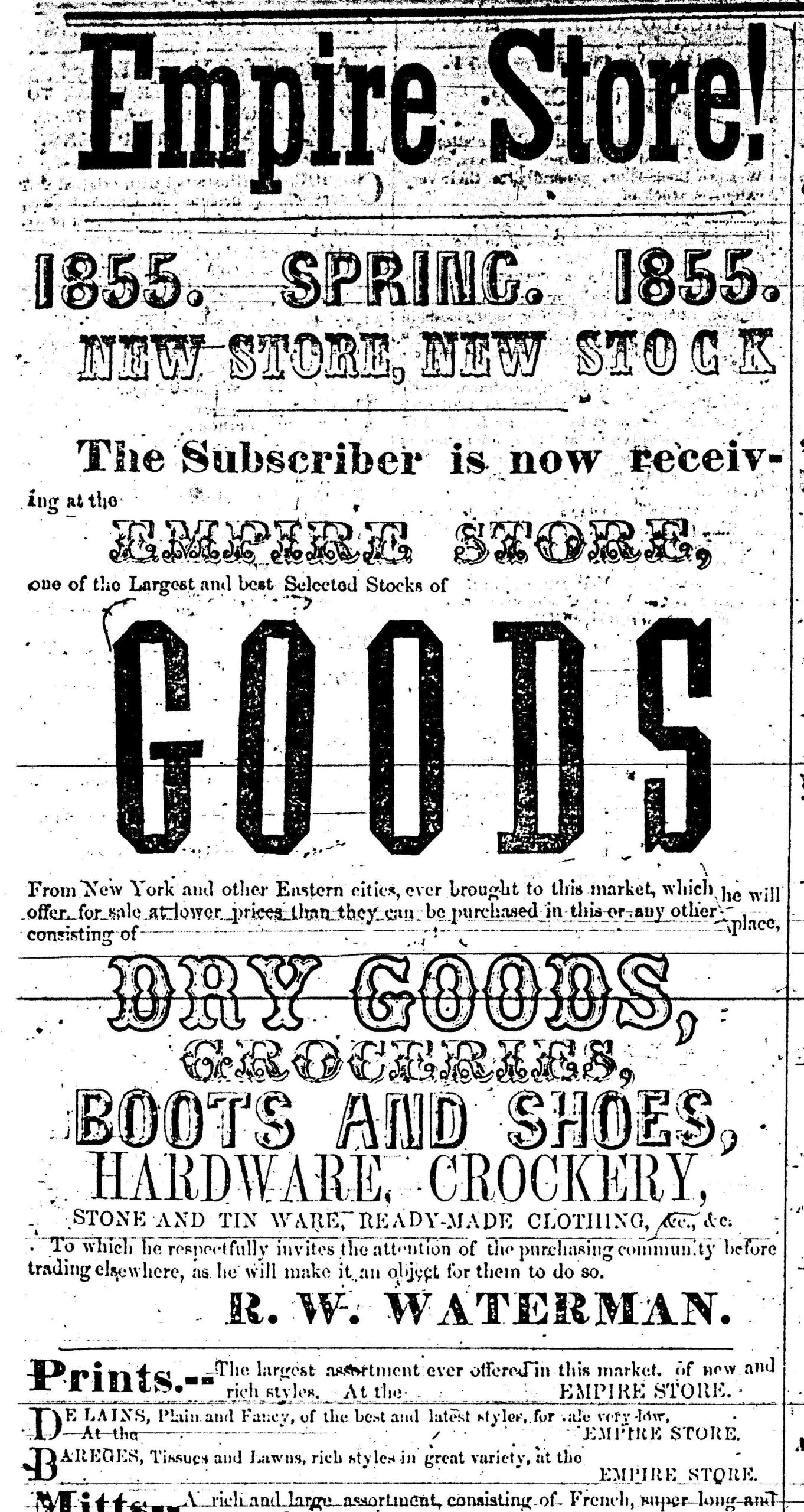
A flier from one of Robert Waterman’s stores