Buy Some Bones for Your Yard Now
I have to admit it, for as much as I preach to you about not digging around the garden too early, even though it is so tempting. I, too, start poking around, but not digging, nor tilling, nor planting. But looking at my bones.
If you know me, nowhere on my well-insulated body, are there any obvious bones visible. Nope. I am talking about the bones of the garden — trees. And for the most part, gardeners never have enough trees.
No, most gardeners are charmed by the literal low growing fruit … and flowers. Those succulent green beans, those fragrant, showy flowers attracting butterflies. But what about your bones? Not human, but the bones of your garden. The trees and shrubs that silently create the architectural bones of your personal Eden.
The problem is that except during new construction, or updating a whole landscape, gardeners often bypass the whole tree and shrub area in the garden center. But they shouldn’t.
Trees and shrubs provide so much more than structure. They absorb sound, decreasing the road and neighborhood noise. They set boundaries, which are hopefully more aesthetic than physically necessary. Remember Robert Frost’s quote? “Fences make good neighbors.” My addition to that would be, “and living fences are even better.”
If you are a gardener who wants to support wildlife, trees and shrubs perform many duties — they structurally support places for birds to make nests and rear their young. They provide food for wildlife — from birds to squirrels, and yes, even pollinators.
Tree and shrub pollen is some of the first available pollen for bees and other pollinators. You see that pussy willow your great grandma planted. After the adorable, fuzzy catkins are produced, they blow up into huge pollen-covered balls, heavy with bees.
Sure you see the crab apple in bloom, or that beautiful redbud, but all trees produce pollen. Just most trees don’t have showy flowers. Actually most people can’t recognize tree flowers. But they are there and extremely useful.
Tree and shrubs leaves are also valuable to many of our butterfly and moth species. Its not just about the flowers. Oaks, willows and cherries support the highest numbers of these butterflies and moths.
And remember, if you want to support butterflies and moths, the adults are only half the story: Planting the plants that are the larval food source (think baby nursery) are the key to supporting the whole lifecycle.
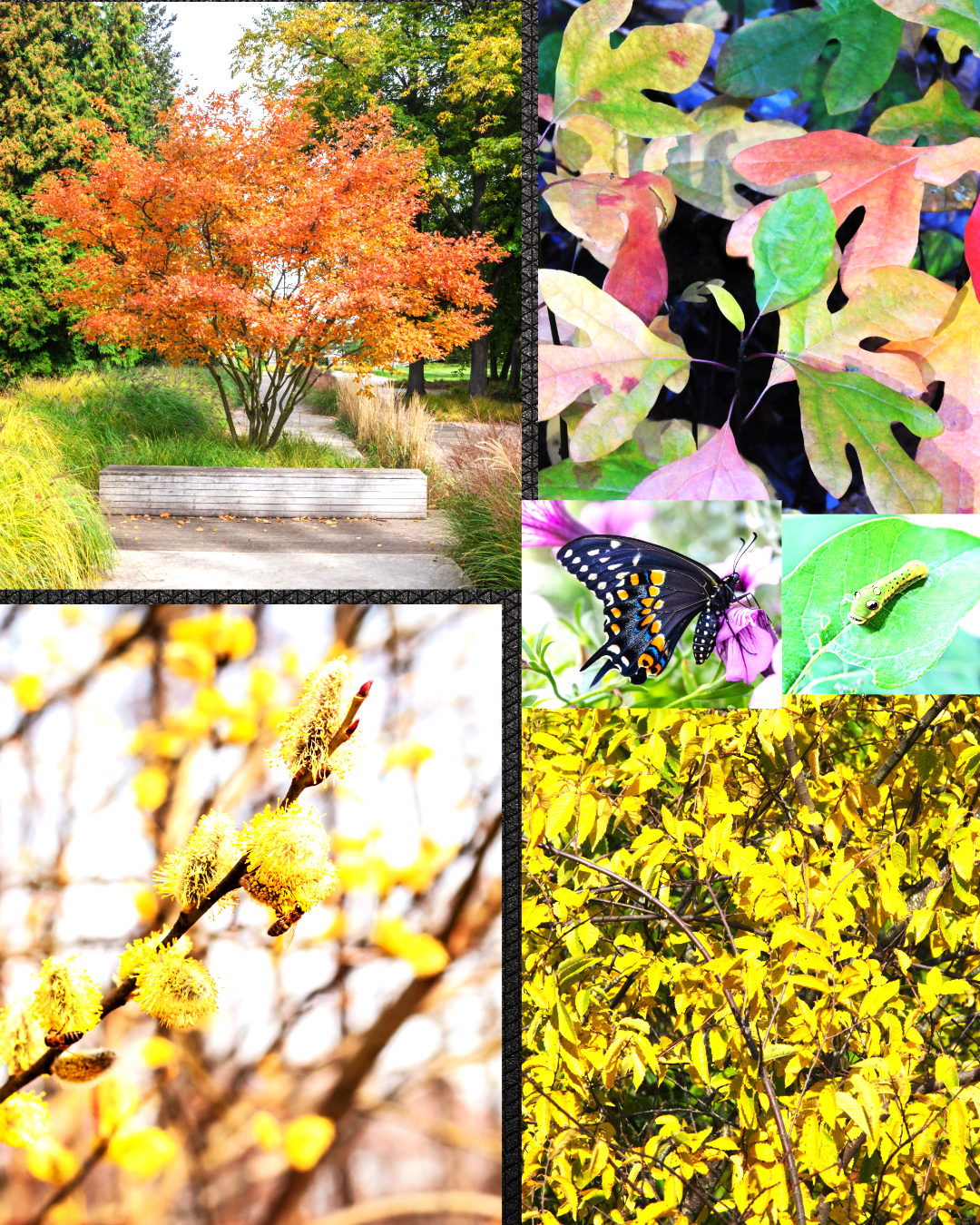
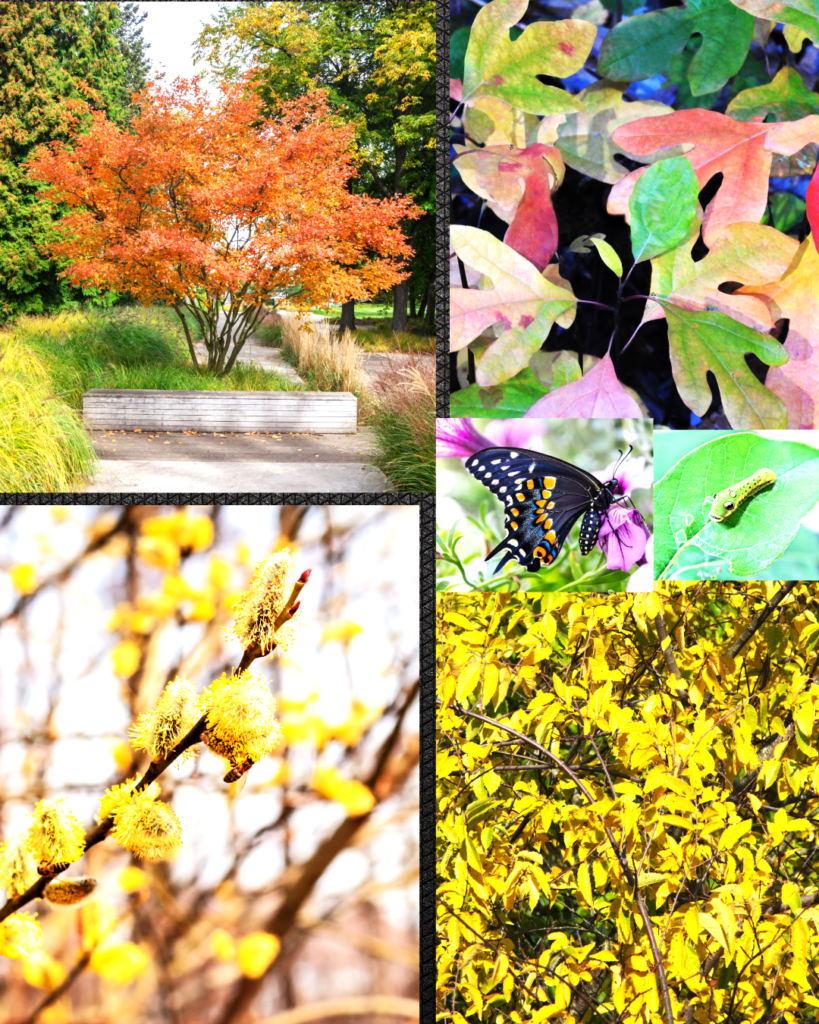
The Spicebush Swallowtail, a magnificent butterfly uses spicebush and sassafras as their place to lay eggs and for their caterpillars to eat. Those are the only plants they use for baby food. If you want them, you need to plant what is on their diet.
I have a host (pun intended) of trees and shrubs that are larval food sources for butterflies and moths. You can find a fairly complete list here from University of Minnesota: https://ncipmhort.cfans.umn.edu/sites/ncipmhort.cfans.umn.edu/files/2021-10/2020%20Butterfly%20Gardening%20Table%202.pdf.
In addition to acting as a nursery, and food source, trees and shrubs perform one of the most important safety features for birds. Security. When a predator is near, it is the easiest escape route for shelter are trees and shrubs. It is difficult for a hawk or cat to access birds easily among the solid scaffold of trees and shrubs many branches.
You can up your bird security system by planting trees and shrubs that are thorned. There was a time when even for us humans, planting thorny bushes in front of basement windows could get you a discount on your home insurance.
Evergreens are also great year-round protection and security, for us, too. Evergreens provide that living year-round landscape block to create privacy and allow for winter interest when the rest of the garden is down to the bare bones.
Landscape wise, do you ever visit a garden where it just looks right. Then you look at yours and feel something is missing? I know what the answer is many times — the mid-layer. We have some trees, then we have what I call “roundie moundies:” loads of perennial plants that are usually one to four feet tall, but nothing in the middle.
Shrubs are the answer here. So many shrubs offer versatility in size, many new hybrids are sized for the smaller yard, like mine. They can have beautiful fall color and interesting barks. Their seeds and berries provide great winter nutrition.
So if there are all these benefits to adding more trees and shrubs to existing landscapes, why don’t we? Lack of information. University of Illinois Extension has your back here. We have websites that let you select trees and shrubs by a wide variety of characteristics https://web.extension.illinois.edu/shrubselector/ https://web.extension.illinois.edu/treeselector/.
If technology isn’t your thing, just reach out to me at the office and we can US Mail you some handouts. [email protected] or 815 727 9296.
So, then you pick out some great trees and shrubs. Now the other problem is lack of access. Where can I find a blue beech, a serviceberry, or a sasafrass?
Often garden and big box centers don’t offer a lot of real estate to the tree and shrub areas. So, you have to do some digging. You can do an online search by putting in terms like “northern Illinois” “buy sassafras tree” and nurseries you may have not heard of have them.
And don’t forget, I am your local University of Illinois resource for all things horticulture and nature. I have had many great discussions assisting gardeners on tree and shrub selection.
The first question I ask isn’t what tree or shrub is it. I ask about their site. Our trees and shrubs are usually widely adaptable. But every plant has its perfect place. And with trees and shrubs, since they are usually Ron Popiel “set it and forget it.”
You are not moving or dividing them. First evaluate your site. Sunny, shady, other trees over the area, new construction, wet, dry. Then go buy some new bones. You will be glad you did.