Perennial vegetables (Part 2): Rhubarb and horseradish
I often refer to the old adage, “What was old is new again.” I sometimes wonder if I am just giving myself a pep talk since, I am, well … old.
But realize it is more about the cycles that nature teaches us. And it applies to so much more — fashion (have you seen the “new” bell bottoms … new?), school methodologies (old math, new math, old new math) and politics … I am never going there.
But the subject of today’s column are arguably as tart and spicy as politics can sometimes get. I am talking about our two other perennial vegetables — rhubarb and horseradish.
Vegetables that were popular over a hundred years ago are experiencing a renaissance with so many people of all ages interested in cooking and growing again.
Rhubarb … vegetable or fruit? Ah, is this another tomato debate? Yes, it is. Botanically, rhubarb (the edible part) is a plant stalk, classifying it as a vegetable. But in the kitchen, it is used as a fruit.
Tomatoes, ah, the age-old debate that makes people run from studying botany. Tomatoes are the flip side: Tomatoes, botanically speaking, are fruit, the part we eat is a fertilized ovary of a tomato plant’s flower, this is the definition of a fruit. But due to its savory nature culinarily, they are classified as a vegetable.
Fortunately, no one thinks of horseradish being some fruit, as it is a root crop vegetable, just like a carrot. But I am sometimes asked if horseradish is an herb because of its savory, hot, one-of-a-kind flavor, but no. Herbs are leaves of plants; spices are any other part of a plant. And even though horseradish is used as a flavoring, think of it as a feral, spicy carrot. Did you know that Illinois is the number one producer of horseradish in the country?
Rhubarb is the more conservative plant. Horseradish is a little wild … as in spreading. Both have similar growing needs. Because they are perennial, selecting a site and significant soil preparation are needed.
Both need full sun (six to eight hours), although horseradish can tolerate some shade; they thrive in well-drained, fertile soil rich in organic material (compost). Once you have your site chosen and prepared, that is where the similarity of rhubarb and horseradish cultural care ends. Rhubarb stays in a clump; horseradish will eventually start moving, so I recommend anticipating that move by installing somewhat of a horseradish “corral.”
I took at 5-gallon bucket and cut off the bottom so drainage would not be impacted; I then sunk it into the ground leaving about 6 inches above soil line. That kept my horseradish robust, but not robust-ing all over my lawn.
There are two horseradish types, “common” and “Bohemian.” Improved Bohemian and Bohemian form the basis of the current industry. “Common” types have broad, crinkled leaves and are considered to have superior quality, while “Bohemian” types have narrow smooth leaves, offering somewhat lower quality, but better disease resistance.
Horseradish needs a climate where the fall and winter are fairly cold. The stout taproots don’t develop until cold weather has encouraged the plant to begin to store starch. The best roots are those that have endured several frosts.
Planting horseradish is usually done in the spring as soon as the ground can be worked, although I received slips (cuttings of rhubarb with root and leaf) mid-summer from a friend, and this hardy vegetable took off well even in the warm summer.
Plant horseradish where the crown is at, or just above the soil line. Space the horseradish 12 inches apart. Horseradish is quite drought-tolerant once established, but if it experiences drought stress, the flavor can become weak and roots small.
After growth starts, to have the largest, smooth strong roots, dig around the plant to remove all additional leaf shoots except the ones at the top. After reaching 12 inches tall, many dig around the base to uncover the upper part of the root and carefully remove all the lateral branches so the plant puts its energy into one main root.
Newly planted spring horseradish usually needs one year to build up before harvest. Horseradish is harvested either in the fall after frost has killed the leaves, or early spring before growth starts again. After the roots are dug, the main root is used in the kitchen and the offshoots are replanted. One-year-old roots have the most flavor. Older roots will be woody, hollow, or pithy. They are not good for harvest, but can be used to start new plants.
Rhubarb is also typically planted in the spring. Plant the roots where the crown is 2 inches below the soil line. Do not harvest rhubarb in the first year, as it needs all the foliage possible to build a strong root system. As I always say, think of leaves as the solar panels that, through the amazing power of photosynthesis, allow us to eat sunshine.
Stalks can be harvested in the second year for a couple weeks and for eight to 10 weeks, in the third year and beyond. You still want to maintain a large number of leaves, so don’t over harvest, because the leaves are the energy-gatherer to keep the crown strong.
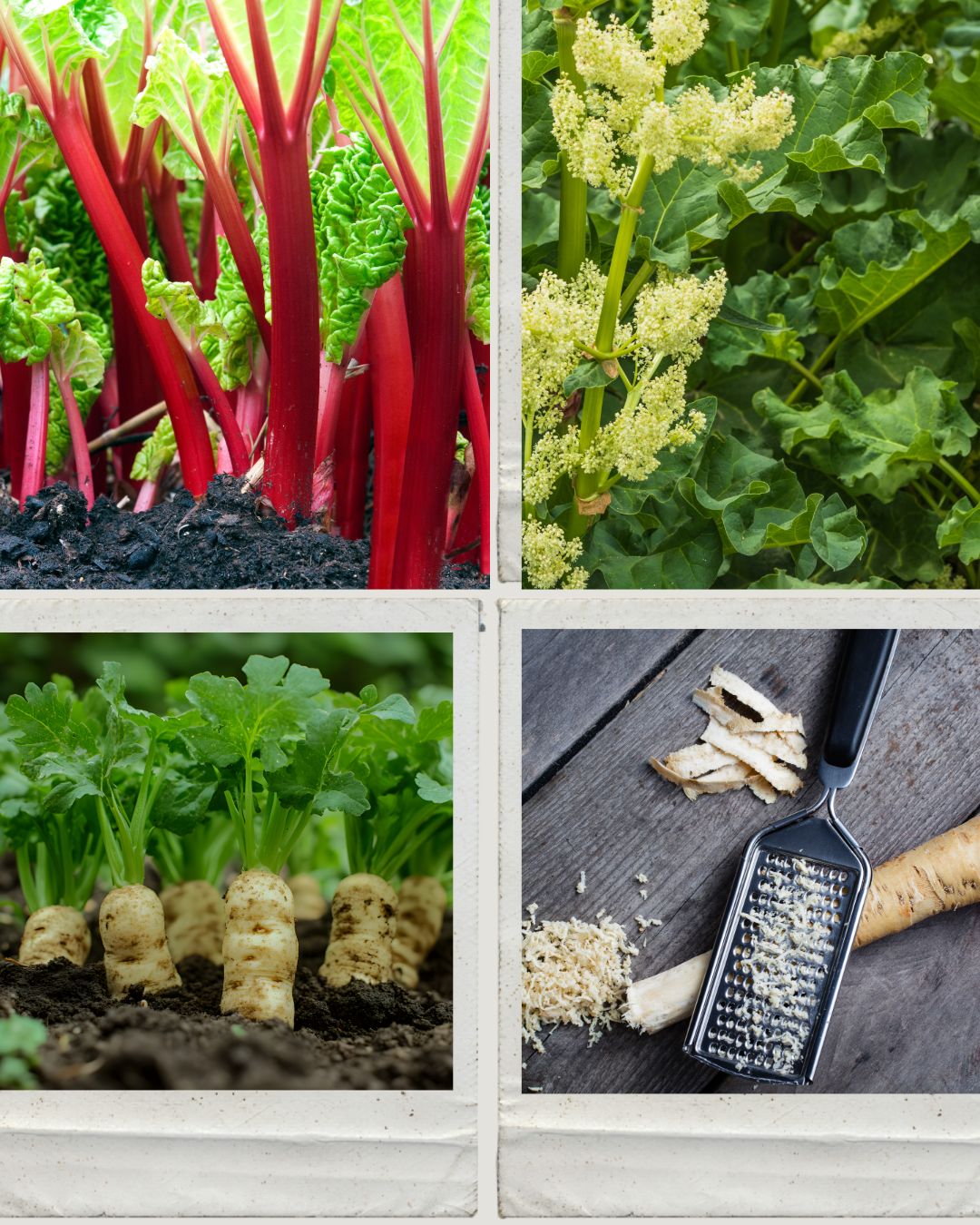
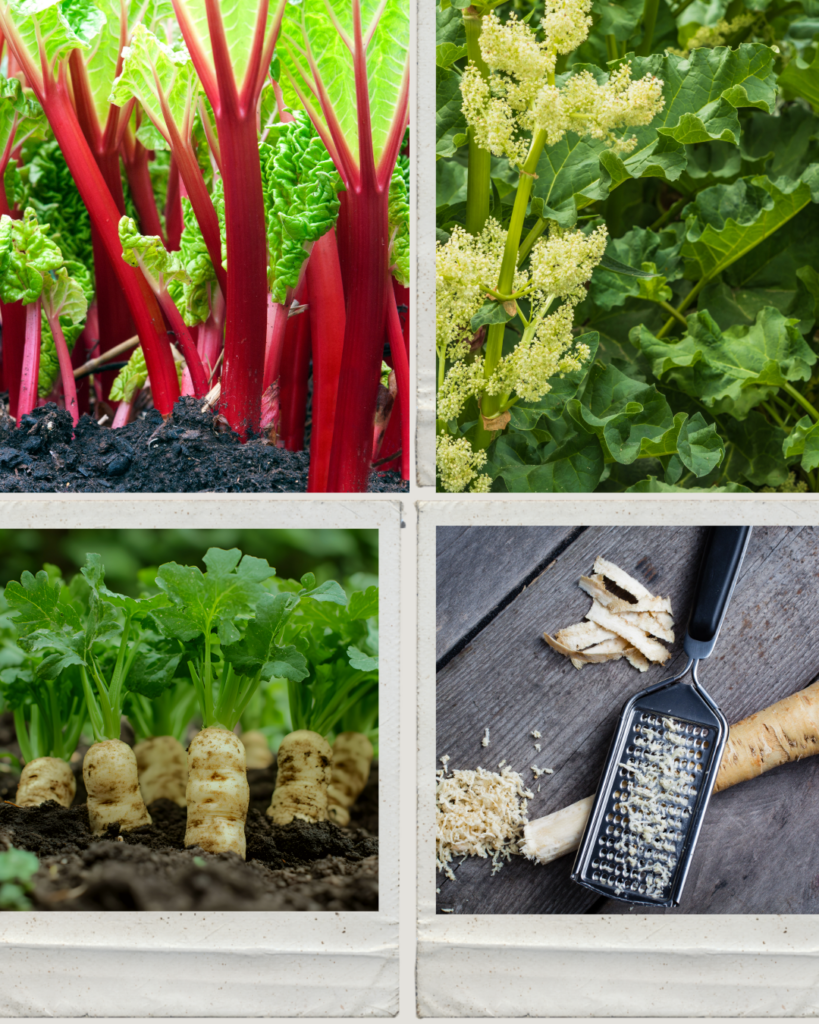
I often get calls and emails from rhubarb growers in mid-spring wondering what has sprung forth looking like a cream-colored candelabra in the center of their rhubarb? That is just the seed stalk. Remove seed stalks as soon as they appear, as they will sap energy from the leaf production.
Speaking of leaves, rhubarb has a curious and important feature. The leaves contain the poisonous, high levels of oxalic acid. No worries usually, because we discard the leaves and just eat the stalk.
That is, as long as there isn’t a frost after the plant is up in early spring. If there is a frost, the oxalic acid gets pulled into the leaf stalk (petioles), the part we eat.
Simple fix, if there is a frost, cut the rhubarb to the ground and discard, and it will regrow.