Prune now … Apple, cherry, or peach pie later: Winter Fruit Tree Care
Do you hear them? They are calling you. If you have fruit trees, that is. They are asking for some attention while you still have time before the gardener’s to-do list heats up.
February is an ideal time for fruit tree pruning and some preventive disease treatment (if you have stone fruit particularly). Also, it is good to prune, well … naked. Let me explain.
First, before your neighbors call the police because you took my last statement literally, what I mean by pruning naked is not about what you are wearing, or not wearing, but rather, what the tree isn’t wearing. Pruning in winter when the trees have no leaves is an ideal way to see the physical branching structure of the tree.
It is not as much about the bigger concern of people when in the growing season, pruning wounds can “bleed” (leak sap). That bleeding is usually harmless to the tree. Sure, you can find insects and wildlife attracted to the wet, open cut when sap is flowing, but it is of little concern.
And scientific research has proven that the old practice of applying a wound sealer to any pruning cut, is actually deleterious to the tree. It actually inhibits the natural healing the tree does itself. So, pruning paint is never recommended anymore.
But pruning on a nice winter day, especially with fruit trees, is preferred. And to get started, the old adage about directions for when to prune — “Prune when the saw is sharp” — still applies. Pruning could be done anytime with a sharp cutting tool to create a clean cut, but we don’t grow fruit trees or lilacs for the leaves, so timing of pruning is more selective.
You prune a lilac in winter, you have just cut off the following season’s beautiful, fragrant flowers. You prune the wrong branch on a fruit tree (the spurs where the fruit is borne), you will be buying your fruit pies at the store instead of out of your own kitchen.
And if you don’t prune certain energy-sucking, non-producing branches like suckers (both root and crown), they can draw a great deal of the energy that should be going to fruit production. But it is slightly tricky, as I found out the hard way.
I was a brand new fresh, Master Gardener, filled with all this new knowledge, but you know what they say, too much of a good thing, can be bad. So, when I looked at our 40-year-old Johnathan apple tree, I was shocked to see so many water sprouts. So, with saw in hand, I cut out all of them … all 30 of them.
Only during the growing season did I learn that if you take out more than a third of those suckers at one time, it stimulates the tree to make more. Which was disastrous for this old tree. Learn first, cut later.
So just what are the goals of fruit tree pruning? To make the tree more productive. But what you do depends on the age of the tree. If the tree is young, you may not need to prune much; at this point your goal is trying to create a solid foundation for years and years and pounds and pounds of delicious fruit later.
You do this by topping the saplings to create more scaffold spur-bearing branches and also create wide angles using branch spacers.
The wide-angled branches (and pruning young fruit) will prevent the worst scenario for a fruit tree. When the fruit tree is in a heavy bearing year and has too narrow branch angles (which makes them weak) and too much fruit, often disaster ensues.
You might have seen it. Mid-summer, overloaded large branches can’t bear the weight, and the branch rips right off the trunk. Proactive pruning avoids this.
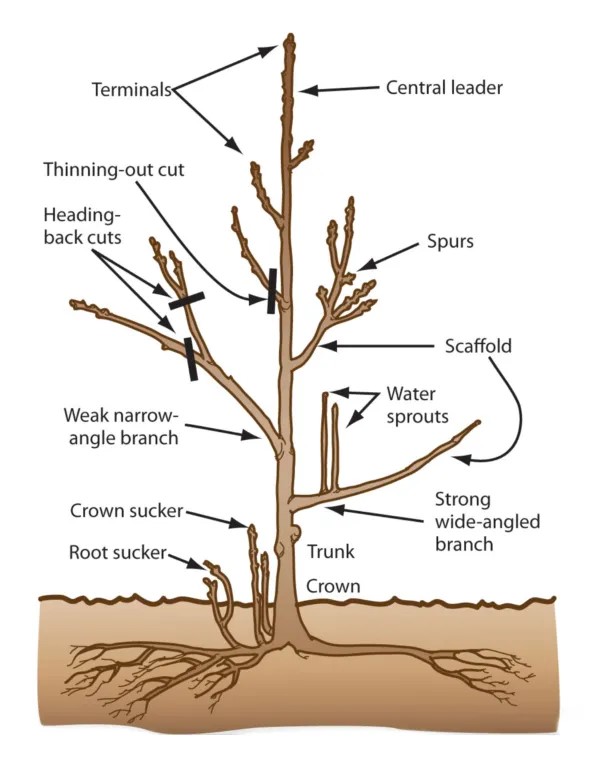
On older fruit-bearing trees, the main pruning concerns are cutting out anything dead; cutting out any branch that is growing to the center of the tree (as it will eventually cross and create a rubbing injury); removing one-third of the water sprouts (so by the third year, they will be gone and you aren’t stimulating the tree to make more); and removing suckers that are coming from the roots or crown. (See diagram).
Before you begin, it is important to familiarize yourself with the most important branch of any tree fruit, the spur-bearing branches. They are short, squat, gently curved little branches. These are the branches where flowers and fruit are produced. Unless they are damaged, they should be kept.
Since you are already getting up close and personal to your fruit trees when pruning, this allows you to check for any evidence of tree health issues and insects overwintering.
Before you start pulling off anything that you think is an insect winter palace, wait and contact me if you don’t know specifically what the structure is. Some of our most beautiful beneficial pollinators, like the Cecropia moth, overwinter as cocoons on fruit trees. Their cocoon looks like a hairy brown paper bag and is quite large. You would leave that.
Also, if your trees have what appears to be a hard green/grey color structure that looks like coral, don’t start picking at it and digging into the bark to remove — that is lichen — a symbiotic (lives together with the tree in harmony) organism. Totally fine to leave alone, and trying to remove it harms your tree’s armor — the bark.
You could also commonly run across longitudinal, frightening-looking, long cracks on the trunk. Do not be alarmed. These are frost cracks (also known as sunscald). If you have ever poured a hot liquid into a cold glass container, and the glass cracks, you now know what frost cracks are. On super cold, yet sunny days, the inside of the tree heats up and expands, but the bark remains cold, the bark bursts.
Frost cracks will heal themselves; they do not need treatment with the exception of making sure water isn’t getting trapped at the bottom of the split. This could start wood rot. The solution is to open the area where the water is collecting.
University of Minnesota has a great fruit tree pruning guide you can download here: https://mntca.umn.edu/sites/mntca.umn.edu/files/files/media/pruning_fruit_trees_johnson_2.27.2020_1.pdf.
If you don’t have internet access, just call the Will County Extension office at 815-727-9296 and we can mail you a hard copy. And always, you can reach out to me at [email protected] with any gardening and nature questions you have.