Flying pom poms and other winter avian adaptations
Well, Mother Nature has decided to let us out of the mid-winter freezer for now and turned up the thermostat, or has she?
As I write this column, it is a springlike 45 degrees at 8 a.m., but by tonight, there is supposed to be a windchill of 15 below. I love Midwest weather (seriously). It is like surfing with a thermostat.
With these wild weather fluctuations, and also because we haven’t had much “real” winter in the last few years, I have had several questions in the last couple weeks about wildlife, particularly our beloved songbirds, and their ability to tolerate not only the cold, but the super-quick changes in our weather.
As I have mentioned previously, besides gardening, birds are one of my favorite hobbies … watching them, feeding them, planting for them. And it does seem cruel, doesn’t it, to see them at the feeders on those icy, heavy snow, below zero days. But Mother Nature, and evolution have a plan. Even our smallest winter birds, like the nuthatch (0.7 oz.), junco (1.1 oz.) or black-capped chickadee (0.4 oz) are well adapted to the wintry weather.
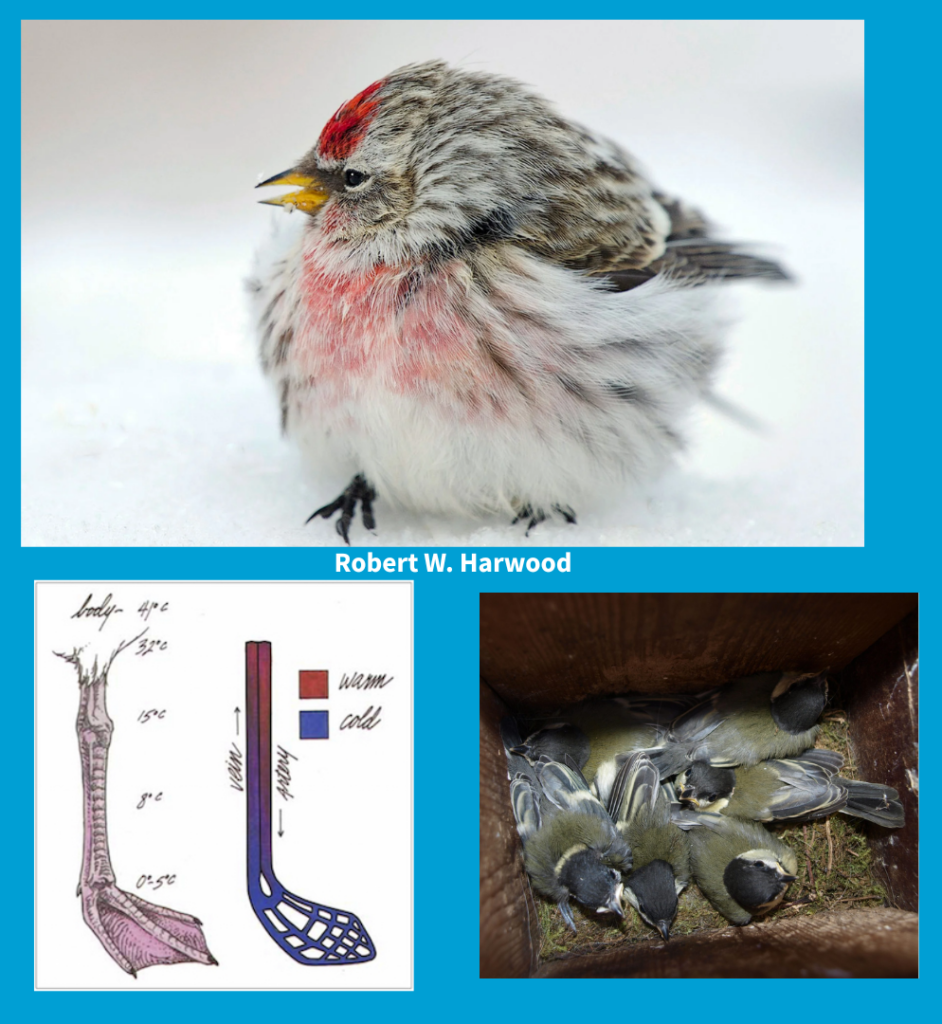
You may have noticed how puffed-up all of the wild birds look when the temperatures take a nosedive. They start looking like more like little round fluffy pom poms. It is intentional, and the technical name for this physical reaction is called piloerection.
There is a tiny muscle at the base of every hair follicle in mammals and feather contract in birds called the erector pili. A feather contract is the mechanism of that causes the tiny muscle to contract to pull the feathers up. And guess what? We also have this in humans. Have you ever had goose bumps or the hair on the back of your head stand up? Yes, same phenomenon.
For us, this is a leftover of our much earlier evolution that humans no longer need, but other mammals still have a need for. I am sure you have seen a cat puff up their fur when afraid. When the puff up, they appear bigger than they actually are. Bigger to who they see as a threat.
Here, in birds, it is a different reason. A very practical one — Insulation. When the birds’ feathers stand up, their body heat can get trapped in between these air layers, between the puffed up feathers, creating greater warmth for them. Our songbirds’ average temperature is 105 degrees.
You also notice when they are puffed up, less of their leg is exposed, like us wearing a longer coat when it is really cold. Many a time, concerned bird lovers will reach out to me with fears that birds would freeze to the branches or feeders; or birds in water would become trapped, but no. Birds have the coolest — well actually — warmest circulatory adaptation in their legs and feet.
Birds have an amazing web-like circulatory system of arteries and veins in their feet. The technical name is Rete Mirabile, which is Latin for “wonderful net.” This net-like circulatory arrangement is present in ruminants (goats, cattle and antelope) for brain cooling, in marine mammals for diving, managing blood flow to certain muscles, and in birds, it is for temperature regulation.
This circulatory web is engineered so the veins are so close together, the arteries that carry warm blood from their heart actually warms the veins that are carrying cold blood from their feet. Simultaneously, the warm arterial blood going down to the feet is cooled slightly by the cold blood coming up from their feet, so that the blood that flows through the arteries to the feet isn’t all that warm. I like to think of it like the old nursery rhyme — where the porridge was not too hot, not too cold — just right!
Speaking of old rhymes, you know the one about birds of a feather flock together? Although that has many social meanings, it is somewhat true of winter adaptations for birds, too, except that it should be changed to birds of any feather flock together. In particularly bitter freezing weather, birds of many species will come together in a hollow cavity of a tree, a barn, or even a specially constructed bird house, called a winter roost.
I held a class on the winter bird adaptations, and we made winter roosts. They look like a regular rectangular bird house, but the entrance hole is at the bottom instead of the top as is the case in traditional bird houses. Remember, heat rises, so the entrance at the base helps to retain the heat.
Also, roost houses usually have pegs or dowels for multiple layers, and sizes of birds could maximize the capacity; conserving heat by becoming one big body of heat instead of individuals just trying to conserve.
Additional physiological advantages include birds having low amounts of fluid in the cells of their feet, so less fluid less heat loss. Also, bird metabolism, including circulation, is high, so the blood doesn’t stay long in the coldest area.
I just have to say it again, Ain’t nature grand?
These adaptations are so successful that our wild birds seem to thrive in our wild and mild winters. But there are additional things we can do to help them endure whatever winter Mother Nature decides to unleash.
As far as winter bird feeding, high-energy fat foods like suet, nuts, and high-fat seeds are important winter bird food. The added bonus in providing these is you can maximize some of the most stunning of our birds at our backyard feeders: the woodpecker family, downy, hairy, red-headed, Northern Flicker and Yellow-bellied sapsuckers. Also, nuthatches (the food is right in their name), chickadees and blue jays flock to peanuts.
It is said that more important than any food, providing fresh, clean water to birds will draw them from farther than any seed or suet. Providing open, fresh water in the winter is even more important, if you can.
Many people comment that birds don’t need water in snowy winters, they can just eat the snow or ice. This isn’t really accurate. Yes, you will see birds eat snow and ice when there is no open water access, but consuming these frozen waters can drop their body temperatures down to dangerous levels.
There are many options for heated bird baths; some people even use a heated dog bowl. Or even providing warm indoor water repeatedly into a metal garbage can lid can offer winter hydration.