
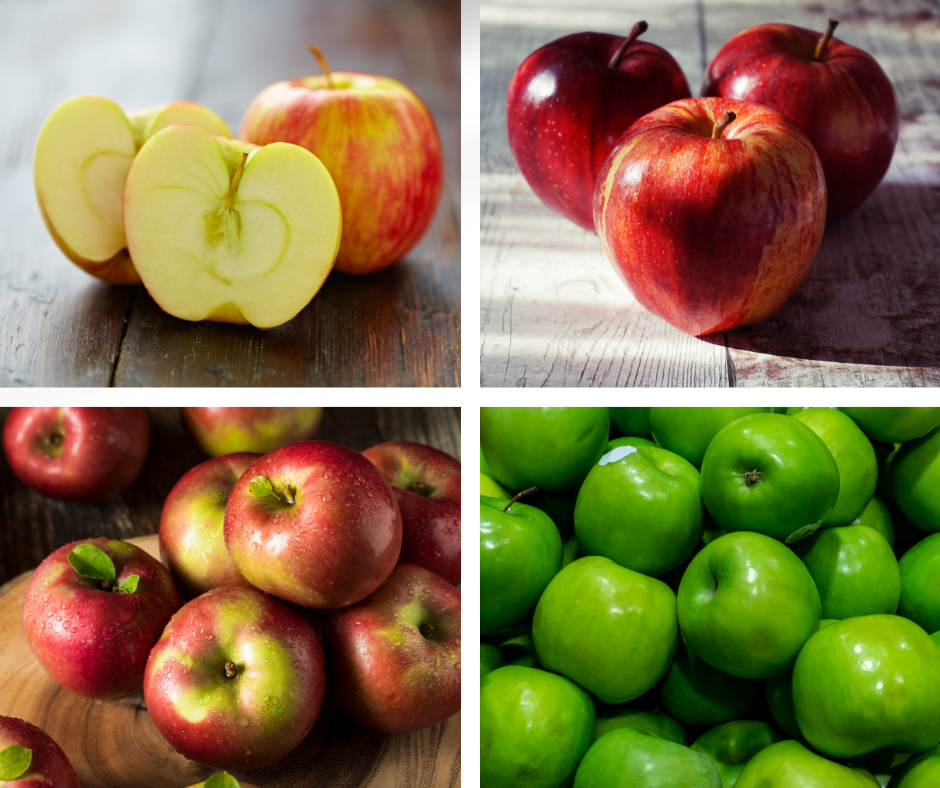
The $17 Million Apple we eat all the time
Ah, October … my favorite. Not only because the weather is supposed to be cooler (focus on “supposed to be”), but it ushers in some of my favorite flavors.
Yes, I am a pumpkin spice girl, but my love for the cinnamon, nutmeg, clove spice mix that has worldwide fame now isn’t the only thing … it is also apple season.
And like some people savor different fine wines, or cheese, I challenge myself to try every different kind of apple each season.
Do you? There are some amazing and not so amazing different flavor profiles of apples.
Do you? There are some amazing and not so amazing different flavor profiles of apples.
The winner across the board for most people is the Honeycrisp apple. Or it used to be. Do you notice a difference in the taste and texture of the Honeycrisp the last couple of years? Not as crisp or flavorful. The story of the Honeycrisp is an amazing one, a jackpot for the University of Minnesota who developed it .. a $16.5 million.
The Honeycrisp apple was developed by the University of Minnesota’s plant breeding team of Drs. James Luby and David Bedford, and introduced in 1991. Developing a new apple isn’t a short-term project.
There are lots of apples developed over the years, but Honeycrisp, it had something different. According to Dr. Luby, “It had this amazing texture in your mouth — an explosive crunch, and then the juice filled your mouth.” (https://rb.gy/92v1na)
And I have to agree, there is nothing like that super crisp — the tart and sweet flavor combo of the Honeycrisp is unique and has taken the world by storm. But just what causes that amazing, juicy crunch of the Honeycrisp.
It is all botany.
It is all botany.
Inside plant cells, there is a structure called a vacuole. Think of it as a pretty big storage tank. These cells can store water, nutrients or even waste products. The Honeycrisp apple has very large vacuoles filled with a sugar water.
Additionally, they have sturdy, strong cell walls and a stiff middle cell structure called a lamella. The function of the lamella in plant cells is the glue that holds the cells together.
Additionally, they have sturdy, strong cell walls and a stiff middle cell structure called a lamella. The function of the lamella in plant cells is the glue that holds the cells together.
Combine the large fluid filled vacuoles, with the strong cell walls, you have a flavor bomb waiting to go off. And when you take that first (and every) bite, these two combined botanical structures give Honeycrisp that one-of-a-kind burst of flavor that the Honeycrisp is known for.
And while University of Minnesota had its patent on the Honeycrisp (also known as Honeycrunch in Europe), this singular fruit development made over $16.5 million for the University of Minnesota. But all that success does not come easy. Actually, just growing a fruit tree is a slow process.
I have often disappointed eager home growers who want to start an orchard. Many people tell me they can’t wait to make pies and applesauce the year they plant that apple tree seedling. The reality I have to share is that it will be seven to 10 years before they will achieve a substantial crop to make even one pie or one jar of applesauce.
From what seems like forever to get those first apple crops, ends up with big rewards many times over with years and years and years of tremendous ever increasing bushel baskets of apples. Similarly, creating new plant varieties, particularly fruit trees, can take decades to develop. Dr. Luby called process of cross-pollinating apple flowers by hand the “kind of dating and mating service.”
And it can be painstaking. After hand-pollination, growing the seeds and then grafting them onto rootstock still takes several years for trees to begin to bear fruit. You know you can’t rush Mother Nature. Then once you think you have the right combination of plant characteristics, then the next step is cloning that variety.
And all this breeding, hand-pollinating, growing, grafting and cloning, isn’t a simple linear event. There are many not so great apples that come from this long process that end up in the compost bin because, for whatever reason, they don’t make the cut.
Even with the tremendous, unequaled success of the Honeycrisp, the University of Minnesota has been breeding apples since 1908, only 27 new apple varieties have come from that Agricultural Station.
Once again, as I learn the story of our food, where it comes from, how agriculture science makes those best selections, how long it take for these better plants to come to fruition, I have to say I appreciate each food product and its producer a little more.
Once the Honeycrisp was patented and out for sale, it quickly became the Minnesota State Fruit in 2006. Did you know Illinois also has a state fruit; and that it is an apple. It is called Gold Rush, and sadly, by my small unofficial taste test, the Gold Rush is no Honeycrisp.
But I don’t think it is the apple itself that caused low ratings. I think the availability and marketing. It was extremely difficult to even find our state apple, and when I did, they didn’t have that just-picked look. I will be sure to give them a try again.
The Honeycrisp did even more than just make a tremendous profit for the University of Minnesota. It helped to revive a tired, declining apple growing industry, particularly for small to medium apple operations.
The Honeycrisp, still today, gleans a premium price because of its unique characteristics.
The Honeycrisp, still today, gleans a premium price because of its unique characteristics.
So, is the Honeycrisp the ideal fruit success story? You know that old adage, if it seems to good to be true, it usually is. As it is here.
Many people noticed in the last few years that the characteristics of their favorite apple were missing. The Honeycrisps seemed smaller, even with mealy flesh.
Many people noticed in the last few years that the characteristics of their favorite apple were missing. The Honeycrisps seemed smaller, even with mealy flesh.
Where the Honeycrisp thrives spectacularly in the Minnesota environment. It did not do so well in the heart of apple growing country — the state of Washington. These growers found the trees to be more temperamental and the fruit more fragile, and didn’t ship as well.
Honeycrisps are best when grown here — in the Midwest — but isn’t everything?
Events
July 2026
Jul 13 2026
10:00 am - 11:00 am
Coffee with Cappel July 13
Jul 30 2026
2:00 pm - 7:00 pm
Village of Manhattan Blood Drive
Jul 31 2026
7:00 am - 8:15 am
Free Vet’s Breakfasts at Arrowhead
August 2026
Aug 05 2026
6:00 pm - 7:00 pm
Kankakee Valley Civil War Round Table Meetings
Aug 07 2026
7:00 am - 8:15 am
Free Vet’s Breakfasts @ Midtown-Manhattan
Aug 15 2026
12:00 pm - 5:00 pm
Molloy State Farm Appreciation Day
Aug 28 2026
7:00 am - 8:15 am
Free Vet’s Breakfasts at Arrowhead
September 2026
Sep 02 2026
6:00 pm - 7:00 pm
Kankakee Valley Civil War Round Table Meetings
Sep 04 2026
7:00 am - 8:15 am
Free Vet’s Breakfasts @ Midtown-Manhattan
Sep 25 2026
7:00 am - 8:15 am
Free Vet’s Breakfasts at Arrowhead
October 2026
Oct 02 2026
7:00 am - 8:15 am
Free Vet’s Breakfasts @ Midtown-Manhattan
No event found!
Total Events: 260