Time to recognize our late-summer friends
Finally! Mother Nature has flipped the switch from that boiling cauldron of summer to below average cool last week. And you may notice, the garden is changing, too.
The containers need some haircuts to keep their best face forward till frost, some of the vegetables are giving their last gasp of production. You may also see some six- and eight-legged friends that you haven’t seen earlier this year.
Just with that first cabbage white butterfly hovering over your Brussel sprout and cabbage plants in spring, there is a season of insects, too. And many people aren’t familiar with just who they are and whether they fall into the beneficial or pest side, … or is it both?
Outside of all the insects that are on milkweed (particularly common milkweed) right now, there are other insects and relatives showing up on our flowers, and in our gardens and even on turf that need some explanation.
The webs on turf and evergreens late in the summer into fall are a common question I receive every year. It is as though magically overnight, what was usually dry grass is now covered in sparkly weavings of dewy webs.
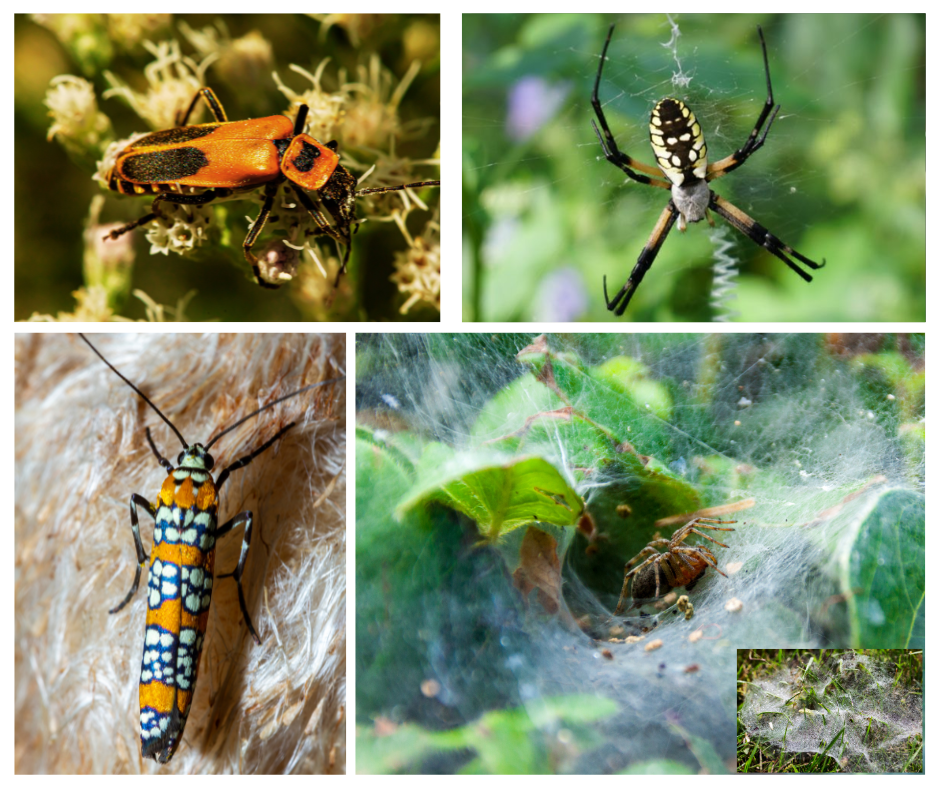
How did this happen? And more importantly, is it bad? Absolutely not. Welcome to the world of the funnel weaver spider. These jack-in-the-box (no not the one in Plainfield — although I could go for a half dozen of those tacos) … what was I saying? Oh, the jack-in-the-box taco spider sits just inside those filmy webs waiting for her next victim to walk on by. She scurries out and brings them into her lair. Never to be seen again.
They are harmless and non-venomous (as are all of our spiders, except the Brown Recluse and the Black Widow). The funnel weavers (family Agelenidaeare) weave these flattened webs with a hide and seek narrowed funnel opening, that if you get on eye level with the web (and of course, I do!) you can see the tan owner lying in wait.
The structure of the web serves many purposes — a trap for food, a shelter from the elements, and a place to mate, lay eggs and raise spiderlings. You can thank these innovative architects for controlling lots of landscape pests you never see.
What do you need to do about them? Absolutely nothing. If you can’t tolerate them, just a spray of water or sweep of the broom, but your loss. While we are on the arachnids (spiders), another sure sign of late summer is that fantastic orb-weaver web stretching across your tomato plants, porch or front door.
There are lots of orb weavers, but the classic garden spider is the yellow garden spider, or as we called them growing up, banana spiders. Not because they come from bananas, taste like bananas (not recommended), but named so because of the long bright yellow bands on either side of this spider’s abdomen.
You may also notice that these and many other orb weavers look like they have sewing machines or are into quilting with that vibrant white zig-zag stitch running down the web. This is called a stabilmentium.
Originally, researchers thought this thick, white silk was some type of structural stabilizer to the web. But further research indicates it performs other functions — distracting predators, attracting prey and as a visual prominence allowing the spider to be less noticed.
Did you know that spider silk is one of the strongest fibers known. On a weight-by-weight basis, some spider’s silk is stronger than the strongest steel. Not only strong, but incredibly elastic. The combination of these two qualities makes spider silk an incredibly tough material.
I know walking into these fall orb weaver webs isn’t anyone’s idea of a good time, just take a stick and roll them up, spider and all, and enter them into a witness relocation program to your vegetable garden.
Besides spiders, there are other late-summer insects that you may see but not know who they are. I have many favorite things, just like Oprah, but mine are nature. My absolute favorite pattern in nature are the wings of the Ailanthus Webworm Moth. This orange, cream and black speckled block wings look like a great women’s suit pattern from the 1950s.
No one knows they are moths though; keeping their wings tight to the body, people assume they are beetles. And when they fly, they look like wasps. But these beauties are a win-win for gardens.
First, as their name indicates Ailanthus webworm, their host food, or food that the caterpillars eat, is the invasive, very stinky, and super invasive Ailanthus altissima, the Tree of Heaven. This tree literally can grow in a sidewalk and spread far and wide.
The good news is this beautiful moth’s children (caterpillar stage) eats this awful tree. And as an added bonus, as an adult moth, is a great pollinator. What’s not to like?
The insect call I get the most questions about this time of year is the “reverse lightening bug,” as some people call it. This lightening bug-sized beetle has orange wing covers with black squares, just the opposite of the lightning bug that has black wing covers (called elytra).
Not quite as stylish a jacket, the soldier beetle also known as the Pennsylvania Leatherwing, (Chauliognathus pensylvanicus), or more commonly, the Goldenrod Soldier Beetle. The adult is a real pollen enthusiast, hanging out not only on goldenrod, but many other flowers.
The flowers not only provide food, but a dating site where they find mates, and how can I say this delicately — you can find them making more beetles often right out in the open on those flowers, too.
They do not bite or sting or cause any plant problems. Gardeners get concerned anytime they see large numbers of insects at one time, and come August, that is the case of these soldier beetles. But again, no need to do anything.
So as the summer winds down, still take time to savor the garden and appreciate all of these late-summer friends naturally helping your garden stay pest-free.