Fungus Among Us … in this hot steamy summer
Eww, ick! I am not just talking about how sweaty I am every day in this hot summer weather (and I am not even baling hay), but those are comments made by many people asking me just what are these bizarre things outside?
Smelly pink stalks with slimy ends? Berries that look like Sputnik? What is eating my hollyhocks? And most of all, what is all this dog vomit in my yard — I don’t even have a dog!
We can thank Mother Nature for just the right time and just the right temperature mixed with presence of spores to get another type of flowering: fungi and slime molds. Fortunately (and surprisingly) most of these are not harmful, just curiosities of nature. Chalk it up to Mother Nature’s wicked sense of humor.
They can be beautiful or unattractive, these fungi. But nothing takes the fungal cake like the slime molds. These curious other worldly-looking goopy, gooey, and even sometimes X-rated looking things can be thought of as the “flower” of fungi.
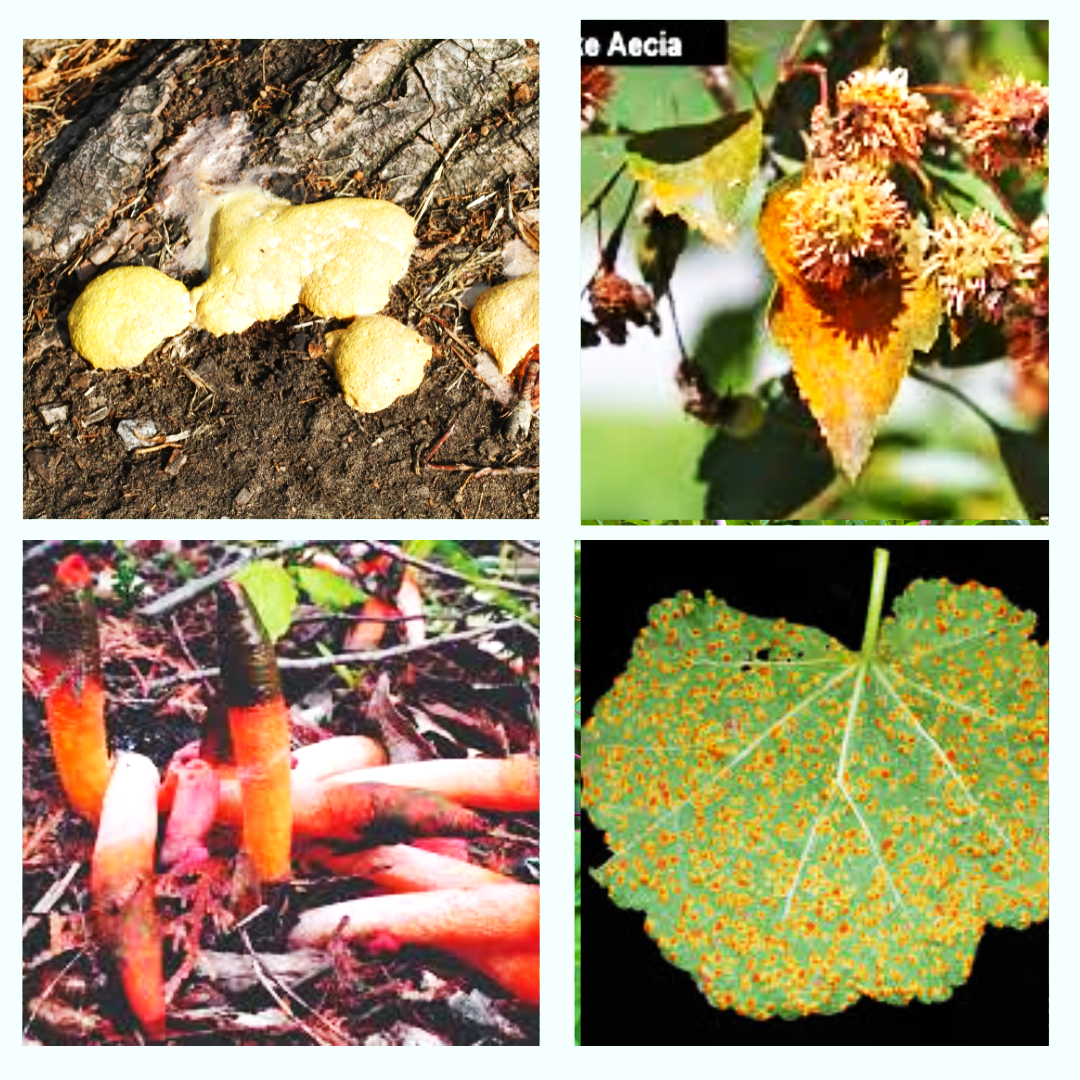
Let’s start with the oddest, and truly X-rated slime mold, the dog stinkhorn fungus (Mutinis caninus). Without them saying it, I know when I get calls on this one. Homeowners will say something foul has sprung up in their landscape. When I ask them to describe it, they hem and haw and then I know. I then ask if it looks somewhat like an excited, unneutered male dog’s “parts.” And the resounding response is, “That’s it!”
This malodorous mushroom is upright, pinkish, and torpedo-shaped, with a conical tip of slimy brown. Ick is right. If that is not enough, the slime’s rotten meat smell attracts flies as “spori-lators” (like pollinators but instead of pollen, spores).
Even stranger, is when homeowners innocently digging in their soil come across what looks to be almost exactly like a hardboiled egg, or as one homeowner suggested, an alien. These are the early phase of the dog stinkhorn fungus. These large, whitish-rubbery blobs appear just below the soil surface. The usual recommendations are to do nothing, or just remove and discard, when it comes to this particular slime mold.
The most common slime mold is the dog (or baby) vomit slime mold, official name Fugio septicai. This one looks like a dog or baby just threw up all over. It is usually seen as it is named — a large, flattened yellow to cream-colored splash on mulch. This slime mold starts as the gooey looking, yellow slime. As the dog vomit slime mold ages, it dries out and turns a light tan.
If you disturb it at this phase, a spore cloud puff will arise (not harmful); that is how fungi are spread, through spores, not seeds.
Again, you can leave this slime mold alone, as it is a natural process, or you can choose to speed up the process by raking it out and watering to aid in the decomposition process. Don’t be surprised if it resurrects a few times or appears in other areas.
Fungal issues are not limited to slime molds and mushrooms. Late summer, particularly when it is hot and humid, are perfect conditions for fungal issues to appear on landscape and vegetable plants.
The issue with fungal problems in plants is, if there is to be a treatment, ideally it should be done pro-actively, before the fungus appears. But how do you know if it is going to be a fungus-y year? You don’t.
For the most part, many of these fungal pathogens are cosmetic in nature, although anytime leaves are affected, photosynthesis is reduced. When leaves are heavily infested with fungus, they sometimes drop off the plant.
Right there is a clue to stopping the spread. Pick up any dead leaves that fall below the plant to avoid a good rain soil splash that will send those featherlight spores right back up to new foliage. Some gardeners (me included) even will pull fungal-affected leaves off the plant to decrease the inoculum that can spread.
One of the most common fungal issues in flowers is in hollyhocks. Hollyhock rust starts on the underside of those big, beautiful, scalloped leaves. To the naked eye, they appear to be dots at first, then rust-colored acne then (and this is the confusing part) the leaves develop holes — which usually has homeowners asking me, “What is eating my hollyhocks.” Nothing. The fungus caused the leave tissue to become fragile, and it breaks though.
If this is a constant problem year after year, here are some tips. First, mulch. I know I am a mulch fanatic, but it helps to keep the garden floor clean. If you start to see the telltale dots on the undersides of the leaves, pluck them before it spreads.
The other option is preventive spraying with an appropriate fungicide. Daconil (chlorothalonil) and many other fungicides labelled for flowers should be applied before rust season –late May. And follow label instructions on re-application. If you wait until you see the fungus, it is too late to prevent the problem.
Woody plants have their funguses, too. Hawthorn quince rust on Washington Hawthorn trees make the berries look like the Sputnik satellite, with their white fingers covered in rusty spores. What should you do? Nothing. It is again, mostly cosmetic.
The odd thing with the Apple-Cedar Rust group of diseases (of which hawthorn rust is one): They have two hosts. In the spring, if you see a Halloween-orange, jellylike blob in your juniper tree (yes that is an evergreen), that would be the time to spray the Hawthorn with a fungicide. Conversely, when in late summer (this year it is happening already), you see the hawthorn berries all blown up twice their size and full of rust, you would spray the junipers.
But did I say just your junipers? Uh-no. Rust can travel up to five miles. So, guess what? Not practical or worth spraying. Most woody plant fungi are cosmetic in nature. And on any deciduous plant, where the leaves fall off every year. It is kind of a nature do-over.
Just clean up the leaves. And you can put them in your compost bin. The heat of decomposition will kill the funguses.