Don’t be a ‘get off my lawn’ gardener
I know there a lot of jokes and memes out there about how to know when we are getting on in years by the first time we want to call out “Get off my lawn!”
That is a choice you have to make for yourselves. But I want to address a related line of thinking when gardeners want to exclude all insects/birds but the desirable ones they specifically want. Without knowing it, they end up causing harm to all nature, including their beloved choices.
We had been doing better, oddly, during the pandemic isolation period. People’s interest in their own personal landscape rose incredibly. And people were fascinated by the nature in their own back (and front) yards. The number of new gardeners, especially people that wanted to learn to grow some of their own food, skyrocketed.
And people were not so interested in the “kill-all, ask-questions-later” mentality. But rather, many people just wanted to learn all about what was out there. But as with all things, this, too, has changed. Oddly, as a result of a passion for nature … but only some nature.
I have had several questions about how to kill “everything” but monarch caterpillars on milkweed. On many social media insect/plant groups I belong to (no surprise, is it?) where I go to hone my identification skills, there is also an increase in questions how to kill all the “invasive” species on their plants just to protect one species.
Are there invasive species of plants, animals and diseases? Absolutely. But having a lot of an insect on a plant that you are not familiar with does not make it invasive. And there are even some native plants that are invasive. I cannot tell you the number of people who ask why they weren’t warned how invasive Common Milkweed can be in a home landscape. I tell them knowledge is power and suggest they instead choose one or more well-behaved native milkweeds instead.
Which brings me to this “get-off-my-lawn” insect mentality. Trying to pick off or pesticide-off (the worst choice) other insects, say off your milkweed for the sake of monarchs, isn’t practical, nor recommended. Nature has evolved together — all of it. And having diversity and balance is one of the greatest lessons. Milkweed, like most plants, is an incredibly diverse habitat for many insects.
The Monarch Joint Venture (MJV) — a partnership of federal and state agencies, non-governmental organizations, businesses and academic programs working together to protect the monarch migration across the United States — states that, “Planting large amounts of milkweed will help reduce the competition for milkweed between monarchs and other species as well as any competition for milkweed between monarch larvae. You can also try planting several patches of milkweed in different areas to help distribute the consumption between areas as a strategy over using pesticides.”
That is not to say applying pesticides or using other Integrated Pest Management (IPM) strategies should always be avoided. We would have little to eat if pests weren’t managed in some way on many of our food crops, whether using organic or other controls. The key is to know when and where treatment is necessary. Not just a “don’t hurt my monarchs” (a phrase actually heard 3 times just this month).
First, take a minute or two to learn and identify any potential “threat” insect you see. Besides myriad artificial intelligence apps for smart phones, remember, you have me here, as well as many field guides that can help identify insects and others.
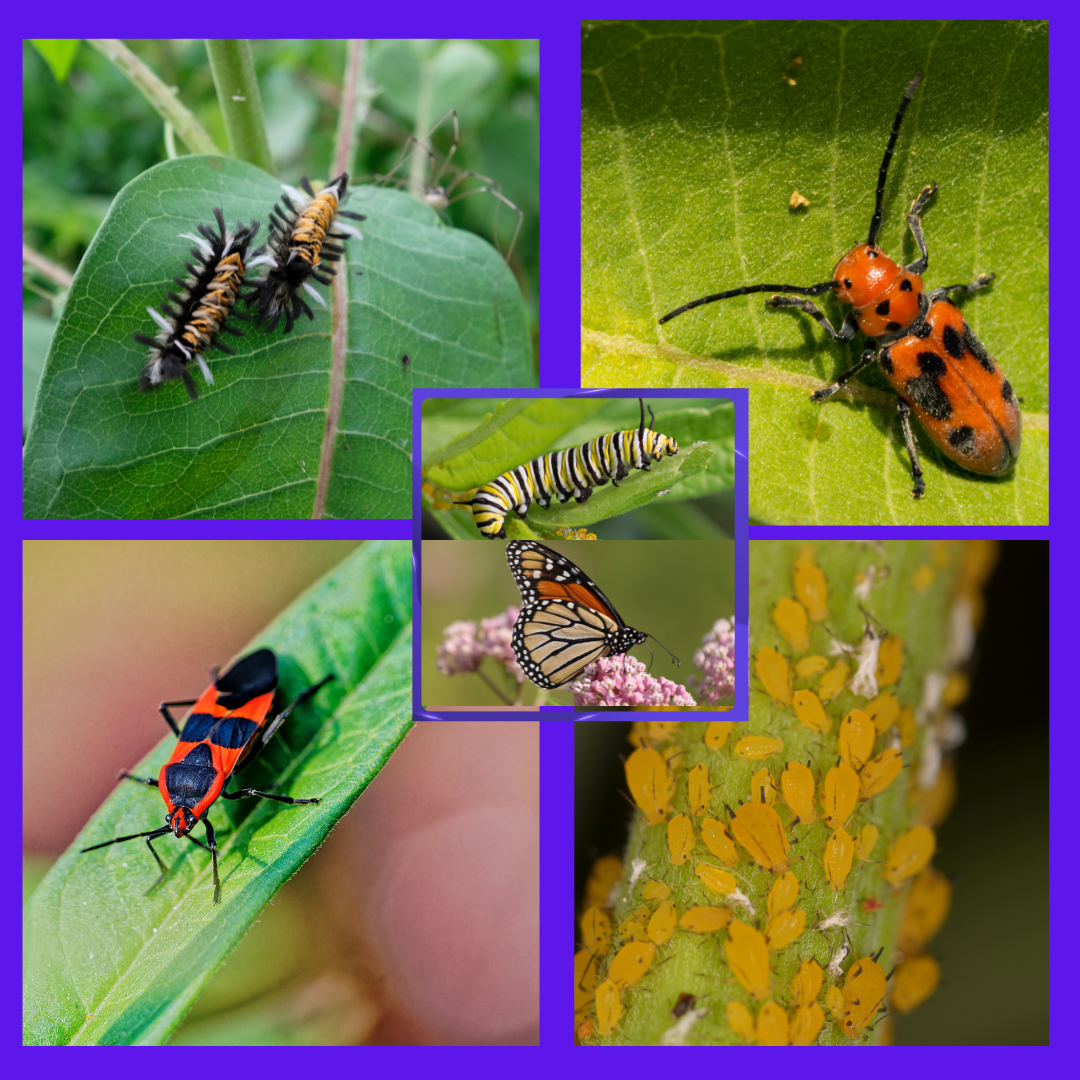
On milkweed, the top calls related to “other” insects are the orange, black and mostly white Milkweed Tussock Moth caterpillar (I call them Andy Rooney’s eyebrows), the large brightly colored longhorn antennaed milkweed beetles, the also brightly colored large, yet flatter milkweed bug, and the omnipresent oleander aphid (those are the pumpkin-colored ones).
What is in common here? All have milkweed in their name (except for the oleander aphid) and milkweed is part of their lifecycle, too, just like it is for the monarch. They, along with monarchs, evolved right along with milkweed. And Monarch Joint Venture points out that they eat milkweed, not monarchs.
But as I always say, your landscape is your personal Eden. You are the ruler, and for the most part, can do what you want. But try to keep in mind, that you and your landscape are part of the bigger picture, the natural world.
So, say you don’t have much space and can’t use Monarch Joint Venture’s idea of planting loads of milkweed to spread the insects out. There are other strategies besides reaching for the pesticide right away. And beneficials are the most sensitive to pesticides. If you think you are going to kill the uninvited and not harm monarchs, you can’t. But there are other earth-friendly strategies you can use.
For aphids, on any plant, a strong spray of water (not just once, but consistently) can blow aphids off of plants. You can also cut off highly aphid-populated — the most tender, new leaves — of plants and throw them in the compost.
As for the rest of the milkweed-needing insects, let nature be nature. And realize that the number one rule, if you want to have a butterfly garden, is no pesticide.
The mustard-and-black colored soldier beetles (they look like reverse lightning bug patterns) are soon to appear. Many people ask what to spray them so the butterflies and hummingbirds will have enough to eat.
Again, no spray. And learn that these soldier beetles are also great pollinators, even if they don’t have brightly colored fanciful wings. You planted, so they are coming. You put out the invitation.
In nature there is no RSVP. Come one, come all!