Wild Birds in Winter: Do’s and don’ts
One of my favorite hobbies is birds, specifically birds in my backyard. Not only are they great natural insect control during the summer, but in winter, they provide countless hours of entertainment and wonder.
And taking care of them in winter is simple, right? Well … sort of. I did something for years that actually was harmful to my feathered friends.
I come from a family of “waste not, want not,” where we tried to find a use for everything. That included food scraps. The vegetables and fruits always go into the compost; my family was decades ahead of the composting movement.
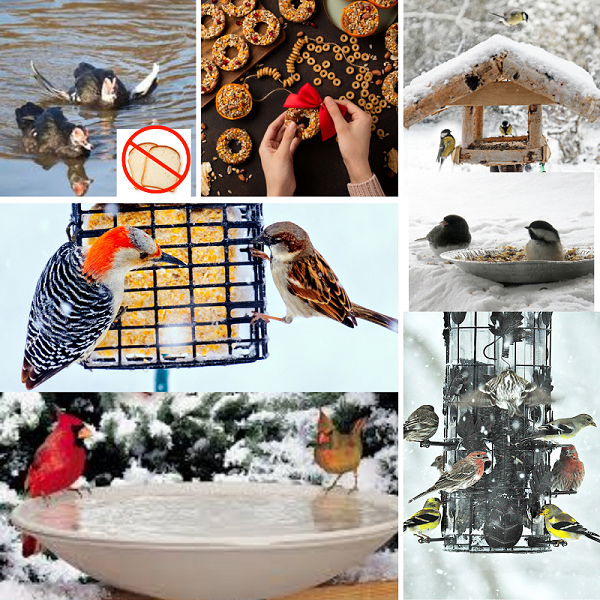
But we also had a purpose for those fats and carbs — naturally, we fed them to the birds. And the birds scarfed them up like a kid in a candy factory. So, they must have been great for them, right? Absolutely not. Particularly with bread.
It wasn’t until I was enrolled in a graduate class on Illinois birds that I first learned of “angel wings.” I am not talking about some holiday craft, but the devastating wing malformation some birds get as a result of consuming high-calorie, but nutritionally deficient foods.
According to National Geographic, angel wing, also known as “airplane wing,” is a condition where the last joint on the wing is distorted and causes the end feathers to stick out laterally – sideways — instead of lying flat against the body. This prevents the bird from flying. Angel wing can be reversed in ducklings, but is incurable in adults.”
I was shocked, as was my whole nature-loving, bird-feeding family. Some of whom would go to the bread discount store to buy numerous loaves to feed their birds — because they loved them so much, when in reality, it was doing just the opposite.
Angel wing affects mostly waterfowl, but the negative effects of feeding bread to birds affects all of our wild birds in negative ways. I have mentioned in previous columns the erroneous phrase attributed to our birds “eat like a bird.”
But when it comes to eating, that saying, “eat like a bird,” has come to mean a poor eater. On the contrary, wild birds typically eat enormous amounts relative to their size and species each day.
According to the Audubon Society, a Cooper’s Hawk, a medium-sized bird that hunts other birds, eats around 12 percent of its weight per day. So, if you weigh, say 150 pounds, that means you would be eating 18 pounds of food per day.
But the smaller the bird, the greater percent of body weight they need to eat. Our tiny, flittering chickadee eats 35 percent of its body weight per day.
If you were eating like that chickadee, a 150-pound person would have to consume 52 pounds of food every day.
So, feeding birds with those tiny little stomachs, empty calories like breads, is one of the worst things. They fill up on literal junk, and then don’t have room for the foods that will help to sustain them. Not to mention the less-desirable fur critters you will attract to your yard — mice, rats, raccoons, etc. — that would love your leftovers.
Stick to the foods that mimic what they would eat in nature — seeds and fats. You don’t have to go wild (like I do) providing many different seed types. I get a whole buffet for my birds from safflower for the cardinals, to thistle seed (it is not actual thistle) for goldfinches, then there are whole peanuts in shell (unsalted of course) for the blue jays, and suet for the woodpeckers and nuthatches.
If you want to feed just one seed type, oiler sunflower seed is your best bet. Most birds eat oilers. Definitely avoid those mixes, usually the less expensive ones. They contain filler seeds — milo and millet — that few of our wild birds eat, winter or summer.
Those little yellow round ball seeds of milo and millet aren’t desirable, and you can often see birds flicking those seeds out of feeders just to get at the sunflower seeds in that mix.
The other important part of winter care of wild birds is to provide fresh, clean water. Some experts suggest providing water can bring more birds to your yard than food. But what to do in winter?
There are numerous heated bird bath and de-icer options. Most people I know have purchased a heated dog bowl, which is inexpensive and works great. As for me, I go the least expensive — albeit, more laborious route — the unheated winter birdbath.
I have some old metal garbage can lids and pans, and a few leaky metal watering cans (remember how I told you my family doesn’t let things go to waste?) I fill the lids and pans with warm water, then I strategically stationed a shepherd’s crook, garden hook over them. I fill the leaky, old watering cans with warm water also, and they drip sufficiently to keep the water free of ice for hours.
Plus, the drip, drip, drip sound is said to be attractive to birds, knowing there is flowing water. The birds absolutely love it.
No discussion of backyard winter bird feeding is complete without hawk talk. Our birds of prey are hungry, too, and a backyard bird feeding set-up is an all-you-can-eat buffet to them. Remember, nature is not by invitation only.
But there are strategies that can make it harder for birds of prey to go shopping for their next meal. Hawks are big, and they need a clear path to fly, so use what you have for blockage and protection around your feeders.
If you can station your feeders in the middle of shrubs or behind a tree, it breaks that easy shopping for hawks. Also, after people put their Christmas trees on the curb, gather up a few and put them around your feeders. This is a quick hideaway protection for birds.
Bird feeders, heated bird baths and even seed and suet are great holiday gifts, too, for the whole family.