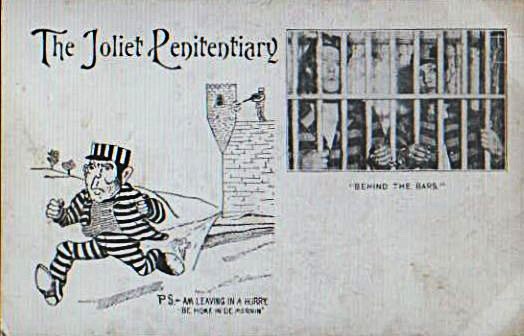
Joliet Pen escapes were common, until …
By Sandy Vasko
About 15 years ago, I happened to be in Lockport when the news came on the radio waves: A convict that was being transported to Stateville had escaped on 9th Street.
Later that night when I saw the evening news I realized how many law enforcement officers were involved in finding one handcuffed guy in a portable john. Today, we look at how escaped convicts were dealt with in the 19th century.
Early in the history of the Joliet Penitentiary on Collins Street, it was common for people to stay overnight in the commodious warden’s quarters. One has to wonder though about a person who would bring their valuables into a place where they put robbers.
The first escape I have on record is from March 1, 1859, from the Joliet Signal; it emphasizes this point: “We learn that a prisoner escaped from the new penitentiary near this city on Saturday night last. He made his escape by letting himself down through a window with a rope which he had secured by some means. Previous to his leaving he broke open the trunk of the lady of one of the prison contractors, and stole diamonds and jewelry to the amount of $1,000 ($36,900 today).”
In fact, visitors seem to have caused some security problems. Not that the guards weren’t up to it, no sir. The following from June of 1862 show what one man did, single-handedly: “Five desperate convicts took advantage of the passing out at the gate of some visitors, seized the guard, Mr. James Nolan, knocked him down with a hammer, wrested his musket from him, and scampered off. Mr. Nolan, notwithstanding his severe wounds, soon regained his feet, pursued and over took them, and shot two of them in the legs with his revolver, and after a desperate scuffle retook his musket from the third and captured him. The other two made off for the woods, but were pursued by guard Wm. O’Brien, and Mr. P. Riley, and captured without resistance.”
In fact, most of the early escapes ended that way; in 1866 we read: “A few days ago a number of the convicts at work in a stone quarry about a mile from the prison attempted to escape, and were fired upon by guards and one killed and another dangerously wounded – the others surrendered.”
On Christmas Day of 1866, five men escaped, not to be recaptured. Knowing the sanitation facilities of the day, this has to be the worst smelling escape I have read: “A few evenings since, five of the convicts escaped by getting into a sewer and creeping into liberty. Heavy iron bars, which protected the sewer both on the inside, where they entered, and on the outside, were they got out, had been sawed off and taken out by some persons outside of the walls, who no doubt were in collusion with the convicts.”
By 1867, the escapes were weekly, despite heroic measures by the guards. Even here the Civil War had an effect. From the Joliet Signal: “It has of late become a common occurrence for convicts to escape from the penitentiary near this city (Joliet). Scarcely a week passes that we do not hear of a stampede
“On Wednesday last about a dozen, including the notorious burglar, Jim Wilson, escaped. Seven were recaptured, but the balance including Wilson, are yet at large.
“The warden and guards, it is said, are not to blame for these frequent escapes of convicts. Since the close of the war, the penitentiary has been filled by a class of prisoners that have no fear of bayonets or rifles. Indeed many of them care no more about being shot at than they do to engage in labor. Perhaps such a hardened and experienced set of desperadoes were never collected in a prison before. At all events, the luxury of being warden or a guard is not a desirable one.”
Another effect of the Civil War was a backlash against Negroes. Many blamed them for the loss of a friend or family member, as if it was they, while in bondage, that started the war. Others, who wanted to be in with the politically correct swung the other way. The following entry shows that struggle: “Commissioner Reid, it is said, sees that nigger convicts in the penitentiary have the easiest time of any. Hence he allows them all manner of privileges, and regales them not on ‘possum fat,’ but on the fat of the land. Last Sunday week, five of these favorites of Radicalism were kindly permitted to go outside the walls of the prison to get a fresh ‘breff’ and no sooner outside than they ‘cut for tall timber.’ They were pursued and two were recaptured, but the others made good their escape.”
Another incident later in the month showed that the Warden was lenient to all men: “Three convicts escaped from the penitentiary on last Saturday. It is said they were permitted to dress in citizen’s clothes and visit the city, but failed to return. The convicts are certainly treated with great consideration by John Reid and company. When they get tired of the penitentiary, all they have to do is to give leg bail.”
Mr. Reid was investigated by the State, was found to be corrupt, and removed from Wardenship. By 1869, escapes had slowed down to a trickle.
Sandy Vasko is Research and Collections Manager at the Will County Historical Museum & Research Center.