Animal epidemics, nothing new under the sun
By Sandy Vasko
A friend of mine recently had one of her chickens die. In the past, a chicken dying for no apparent reason was not really a cause for concern. But now, thoughts of the bird flu now rampant in the Midwest, came to her mind.
Should she have it tested? How should she dispose of the body? What should she do with the rest of her flock? Animal epidemics are nothing new. Set the way back machine for the fall of 1914.
On October 30, 1914, we read in the Wilmington Advocate this one simple sentence: “Hog cholera is creating some havoc among the porkers in Custer and Wesley.”
Well, hog cholera had been seen before, it could be dealt with. However, was it really cholera?
We ask because two weeks later the Advocate tried to quell fears of another dread animal disease: “There appears to be no reason for general alarm over a prospect of a spread of the ‘foot and mouth disease’ in the human race. Some physicians entertain the opinion that the disease is communicable to mankind; others entertain the contrary view.
“However, it is well to be cautious and take no chances. In the cities the sterilization of milk would seem to be the only safeguard necessary. The government agricultural department has already advocated this as a precautionary measure. We do not know much about the plague yet. It would seem that in view of the fact that it has been prevalent in Plainfield and Wheatland townships, and that the persons who have come in contact with it have not suffered from contagion, that there is no need for apprehension. However, the physicians are investigating and it is well to be on the safe side.”
One week later on November 20, 1914, we read: “Two federal veterinarians, one from Louisiana and one from Chicago, shot 20 head of cattle and 67 hogs at the farm of Clayton Smith, south of Plainfield, on Monday, completely destroying the first herd infected with the foot and mouth disease in Plainfield Township. Tuesday the federal men went to the farms of Frank Stewart in Wheatland and Fred Lauterbach near Plainfield where they killed herds of cattle and after hauling them into ditches dug on the farms, then covering the carcasses with lime and dirt.
“At the scene of the killing on the Smith farm there were only Mr. S. and his immediate family, and the two federal veterinarians. Before leaving the scene of the killing, each man was covered with a rubber blanket, except his head, and his entire body and clothing subjected to the fumes of formaldehyde for three minutes, and then his entire shoes swabbed over with a solution of mercuric chloride. The disease has also made its appearance in Kankakee, but as yet we have had no signs of it in this immediate neighborhood.”
By February 1915 we read: “Under the quarantine regulations farmers are not allowed to move stock, grain, milk, and in fact anything on the farm without a permission has been given by an inspector. The first of the week State Inspector Dr. Hazzard (from Wilmington) inspected the farm of Mr. Roderick, near Blodgett, and finding no disease there he gave permission to move stock and grain from his farm.”
The following warning was also posted: “William Godel will only accept corn at his elevator from farmers presenting a permission from the inspectors showing that his farm had been inspected, and this permit must be presented at the elevator.”
And finally on the last page we read: “Another outbreak of the foot and mouth disease was discovered by Federal Inspector Dr. H. L. Gurney Saturday morning last on the Hiram Goodwin farm north of town. The cattle, twenty-six in number, and thirteen hogs had been affected with the malady for nearly two weeks before reported by the farm attendants to George Nail, the manager. Monday the animals were appraised at $1,800 (about $58,300 today). The cattle and hogs will be slaughtered and buried in the trenches on Monday.”
This note of caution was also printed: “The farmers who made shipments of milk over the Santa Fe and Chicago & Alton railroad had on the platforms Monday, at Romeo, from which place they make shipments, more than two hundred cans of milk which the companies refused to ship.”
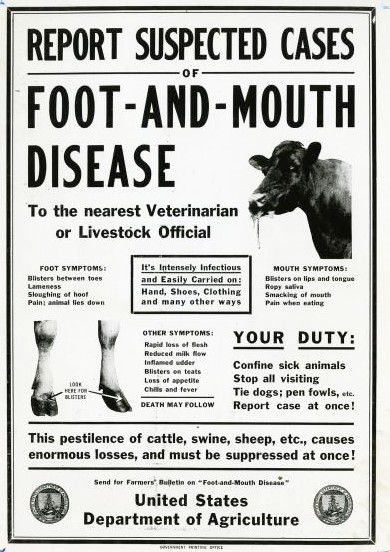
By late summer of 1915 hoof and mouth had pretty much been eradicated in this area. A Department of Agriculture bulletin came out giving the following advice to farmers: “Every person can help by keeping away from stricken animals. Do not go to see them out of curiosity, and do not permit other members of your household to visit the premises on which such animals are confined. Keep your dogs, cats, chickens, and other domestic animals at home, and keep other people and their animals away from stock and barns.”
Some breathed a sigh of relief, but in November of that year we read: “In the past two weeks farmers in Custer have lost several valuable horses from some fatal disease, thought to be ‘milk sickness.’ A certain weed (white snake root) which has grown in that vicinity for many years is thought to be the cause of the disease which is fatal to horses but not to cattle. Cows may eat the weed and not die, but those who use the milk or even butter from these bovines will, nine cases out of ten, lose their lives.”
Well, if it wasn’t one darn thing it was another.
Sandy Vasko is Researcher and Collections Manager at the Will County Historical Museum and Research Center.