The Fake Murder of Mary Cook
By Sandy Vasko
Today, we present a murder mystery for those of you who are fans of detective stories. It comes from George Woodruff’s book, “The History of Will County, 1873.” George tells a good story, so I find no reason to change it.
“On Thursday, April 30, 1858, some boys, ranging about Hickory Creek near where it enters the Des Planes, came upon the body of a female, partly covered with dirt and stones, lying in a gully about one mile south of the city. It was so much decayed that the features were unrecognizable.
“The boys gave the authorities notice of what they had found, and the proper officers and many citizens went to the spot. The unanimous conclusion of all who saw the body was that she had been murdered. There was a deep wound in the temple and another in the breast. The hands and feet had been cut entirely off, and were found near the body. An inquest was called, and a verdict was found, in which the public belief was expressed that a foul murder had been committed. Who could it be? and by whom had the deed been done? were the questions on everybody’s lips. The public were not long held in suspense.
“On Saturday, a woman residing in the outskirts of the city, having heard of the discovery, came forward (after the inquest) and informed the Marshal, J. C. Van Auken, that her daughter, a girl of sixteen, had mysteriously disappeared some three weeks previous. The body was taken up again and another inquest was held, at which the woman testified positively that the body was that of her daughter, Mary Cook.
“Other persons expressed the same belief. The mother also stated that, at the time of her daughter’s disappearance, she was enceinte, having fallen a prey to the wiles of a man named David Richardson. One of the physicians who examined the body gave a professional statement
in respect to it, which confirmed that of the mother. The mystery was made plain. Our city had been made the theater of a most foul murder, perpetrated to conceal a crime hardly less diabolical. The public voice was unanimous that the foul perpetrator must be found and brought to justice. “Richardson was found and arrested on Sunday morning. He had not been long a resident of the city, but, so far as anyone here knew, he had borne a good character, and everyone was surprised to find that he was guilty of so foul a crime.
“But that a crime had been committed, there was no room for doubt, and it seemed equally clear that he was the perpetrator. The Signal (a Joliet newspaper) said, in its issue of the same week:
‘We will not prejudge the case; but a young and unprotected girl has been seduced and ruined by a demon in human shape, and murdered to hide her betrayer’s guilt. If there is any virtue in law, let it be applied now.’ The Signal spoke the voice of the public, which was almost ready to string Richardson up to a lamp-post. Indeed, it seemed at one time as though our city would be disgraced by an application of lynch law.
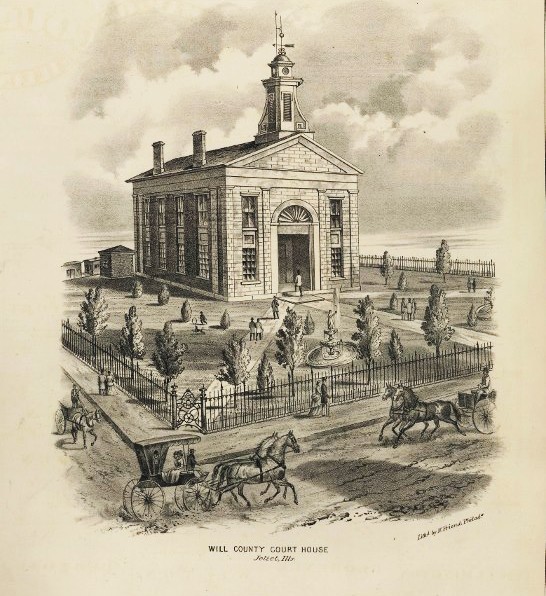
“Two days were consumed by the examination of Richardson. The Court House was crowded. State’s Attorney Bartleson, assisted by Streeter, conducted on the part of the people, with E. C. Fellows for the prisoner. The former testimony of Mrs. Cook and others was brought forward, and the same facts reproduced. The old woman swore positively as to the body being that of her daughter, and the doctor repeated his professional statement.
“Meanwhile the sharp counsel of the prisoner had adopted a theory for the defense. The body had been again examined by four other physicians who came into court and swore positively that the body was that of a woman, and that it had been used to promote the purposes of science, and was partially dissected. They affirmed that the body was that of a much older and larger person than
the missing Mary Cook.
“This testimony produced a ripple in the current of public opinion which had been flowing so strongly in one direction. Was this so, or was this a cunningly devised scheme of Fellows’ to get the villain clear? For a little, the question hung in great doubt, each side having earnest advocates. When this suspense was at its height and had become truly painful, relief came.
“In walked Constable John Roberts with a veiled lady upon his arm. The whisper ran around the court-room, ‘another witness.’ She drew aside her veil, and it was indeed another witness, and no less a person than the murdered girl herself, the young and interesting Mary Cook, alive and
well!
“It only remains to say that it was soon discovered that the body was that of a Mrs. Schemmerhorn, a woman about twice the size of Mary Cook, who had died a few weeks before, and who was the wife of a man who tended the lower lock.
“The body had been, resurrected by someone for the purposes of dissection, as had been alleged by some of the medical gentlemen at the examination; some of whom well knew that they were speaking the truth. Old Mrs. Cook had trumped up her story to get black-mail out of Richardson.
“The affair furnished one more warning against hasty judgments founded on circumstances
alone. The doctor who gave the professional opinion has never been called to fill the chair of anatomy in Rush Medical College. The parties connected with the case have generally gone elsewhere, although one lingers about here still who is supposed to have had a hand in it.”
Note: In another history book, by Robert Stevens, Dr. Heise was the man who had the poor woman exhumed, dissected her for his medical knowledge, and ordered two fellows to put her back in her grave. However, he made the mistake of paying them first. They took her to where she was found, covered her with branches and bricks, and promptly hied themselves to the nearest saloon.
Sandy Vasko serves on the Board of Directors of the Will County Historical Museum and Research Center and is Collections and Research manager.