Viruses and vaccines in the 19th century
By Sandy Vasko
Health care is on the minds of many these days. The talk is about both how to pay for it and how to avoid disease by use of vaccinations.
It was also on the minds of the citizens in the 19th century. They feared outbreaks of cholera, typhus, small pox, diphtheria and malaria. Today we look at disease.
Although most diseases came to this area with the early pioneers, one was here before any white man saw the prairies of Will County. It was “shaking ague,” as the early settlers called it. It was a form of malaria spread by mosquito. Rarely deadly, it did put you out of commission for several weeks. The symptoms were high fever, with chills so severe that it caused you to shake uncontrollably.
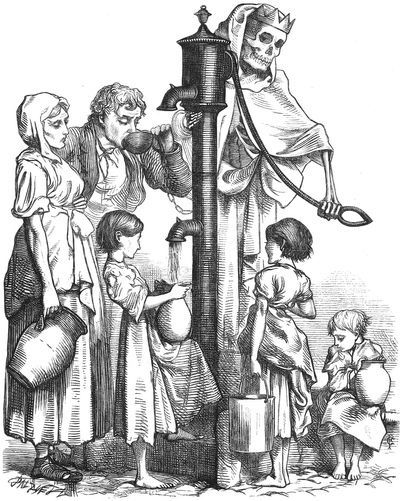
As people crowded into the area in the 1840s, they brought with them other diseases, the worst was cholera. Cholera is found in both human and animal waste. It is spread both by contaminated water and the common housefly. With poor sanitary facilities and the use of animals on an everyday basis, both on the farm and in the city, it spread like wild fire.
Cholera’s most serious symptom is diarrhea. You can quickly become dehydrated with kidney failure to follow. Contaminated ground water can easily contaminate the shallow wells they had at the time, and even cisterns, if the outhouse was located too close to the house.
In the January 16, 1849, Joliet Signal advice was given as how to protect yourself from the deadly disease: “Protection from Cholera – A very simple protections is recommended by a medical writer, who says much of the cholera in 1838 and 1833 could have been avoided. The weakened state of the stomach predisposes it to cholera. The cure is decidedly obtained by eating freely of common salt at our meals, that it is believed that three-fourths of the cases which would otherwise occur, may be prevented by this simple addition to our food.”
We do not know if anyone followed this advice, but in the cholera epidemic of 1858, one out of every two people in Will County died.
Then there was small pox. This disease was prevalent all over Europe. The native populations of the Americas had no immunity to the disease. It wiped out entire tribes during the 17th and 18th century. But in the white man’s case, an immunity had built up so the disease was only fatal in 20 percent of the cases. And it was found that if you had contracted “cow pox” from milking your animals, that prevented you from contracting small pox.
This lead Edward Jenner to develop the first vaccine used to prevent disease. He inoculated people with the cowpox virus, with the result that they became immune to the small pox disease. But the vaccine was not always fresh, and it failed to work with a large part of the population. Sometimes you had to get 2 or 3 vaccinations. This disease managed to hold on for quite a while before the last case of it was cured in the 1940s.
On June 7, 1881, the Joliet Signal reported the following: “In view of the fact that cases of small-pox have been reported at Elwood and Homer, in this county, and four mild cases, members of the same family, have appeared in this city, and the prevailing fears that it may spread further, we give from a circular issued by the Illinois Board of Health, the following rules that should be strictly observed in all cases to prevent the spread of the dreadful malady:
“’Whenever it is known that any person is sick with the small pox, isolation of the individual should be resorted to at once, and everyone in the house vaccinated or re-vaccinated in every case, no matter how mild the disease may appear. The room selected for the sick should be large, easily ventilated and as far from the living and sleeping apartment of other members of the family as it is possible to have it. All articles, not absolutely needed and drapery in the room should be removed.
“’A free circulation of air from without should be admitted by day and night, for there is no better disinfectant than pure air. All discharges from the nose and mouth should be received on rags and immediately burned, and the same precaution should be observed with the crusts as they fall off. Vessels should be kept partially filled with a solution of copperas, or any other disinfectants, to receive the discharges from the bowels and kidneys which should be buried.at least one hundred feet from the well or spring.
“’All spoons, dishes, etc., used in the sick room, should be placed in boiling water before being used by well persons. Cleanliness in everything is of the utmost importance. But one or two persons should be employed in the sick room, and their intercourse with other members of the family and the public restricted as much as possible. In the event that it becomes necessary for the attendant to go out of the sick room a change of clothing should be made.
“’Physicians and nurses should never put on an overcoat or cloak in the sick room, to be removed afterward, perhaps, among the healthy, for the air of the infected room may be confined about his or her person, to be liberated when great mischief may be done. No inmates of the house should venture into any public assemblage or crowded building during the continuance of the disease or after its termination, until permission is given by the attending physician.
“’No dogs or cats should be permitted to enter the room of the patient, or better still, not allowed in the house at all. No letters should be sent directly from the patient, and all mail matter sent from the house should be subjected to a heat of at least 250 degrees F.
“’In the event of death, the clothing in which the body is attired should be sprinkled with strong carbolic acid, and the body placed in an air tight coffin; and it should remain in the sick room until taken away for burial.
“’No funeral should be allowed at the house or church, and no more persons permitted to go to the cemetery than is necessary to inter the corpse.’”
Sandy Vasko serves on the Board of Directors of the Will County Historical Museum & Research Center as Collections & Research Chair.