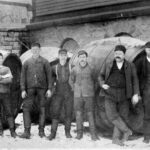
Only the name remains, Jug Town
Editor’s Note: Sandy Vasko is taking some well-deserved time off. So we are re-running some of our favorite columns.
By Sandy Vasko
If you travel west on Lorenzo Road from I-55, you will come across a street named Jug Town Road. Most roads in this region lead to the town they are named after. But search as you might, you will not find Jug Town. However, if you go back in time to the mid-1850s, you would easily have found it. And that’s what we will do today.
You don’t have to be a farmer to know that to be successful, you must have good soil. The type of soil determines the crops you grow or the livestock you keep. When settlers first came to a place named Goose Lake, they knew one thing: The soil in the area was not good for farming. Bogs and swamps were everywhere, not to mention quicksand; good for the massive amounts of waterfowl to be found there, but not for much else. That is until 1855, when a man discovered a valuable commodity at the far west end of the lake – clay.
Perhaps in this day and age, that discovery would not mean much, but in the mid-19th century, it meant a lot. Clay is the main ingredient in pottery. And pottery was an absolute necessity in the household. Pottery vessels held everything from water to sauerkraut, from sausages preserved in their own fat to homemade cherry wine. In the kitchen, clay vessels were used to store butter and milk, to bake bread, beans, stews, and much more. On the farm, clay tiles were laid to drain swamp land or line the well.
In late 1855, William White came to this area from Utica, New York, where his family was engaged in the pottery business. Together with Charles Walker, the firm of White and Company built a pottery works near the clay deposits. At their pottery works in Utica, the clay was mined elsewhere and delivered to the pottery, costing quite a bit of money for transportation. Here, there would be no delivery costs. We will see later that this was a fatal decision.
It was also about this time that a new use for pottery became popular. Clay field tiles to drain city sites had long been used. But it wasn’t until the mid-19th century that farmers learned that rich soils lay below marshy areas, and draining them meant a huge increase in production.
Two different sites produced both tiles and household pottery. But pottery works were only part of the community that lived there. There were two boarding houses and at least four homes to house the workers and their families. There was also a school house, a communal room or hall, and at least two stores. The 1860 census tells us that there were nine households there, with a total of 55 individuals.
The stoneware produced there consisted of minimally decorated, salt-glazed jars, bowls (milk pans) and jugs. All of them more or less made individually, by hand. Thus, any Jug Town Pottery you may find today varies in size, shape and decoration.
The process began by mining the clay from the banks of Goose Lake, then transporting it to the workshop site. It was dumped into “clay pits” to freeze over the winter. Passing through the freeze/thaw cycle great increased its workability. It was then passed through a mill to pulverize it, mixed with water to a proper consistency and then turned on wheels.
The tiles were made by extruding clay through dies. As the clay came through the extruder, it was cut with a wire to about 24” lengths. The tiles were dried, stacked into a kiln, then fired. After cooling, the tiles were stacked in the yard for transportation elsewhere. In the field, the tiles were joined together with collars, made slightly larger than the tiles.
The craftsmen who lived at Jug Town were highly skilled. They earned $42.50 ($1,400 today) per month, compared to average unskilled laborers who made only $3.50 ($115.00) per month. The less-skilled workers at the tile factory made $26.00 ($785) per month.
In the end, the firm of White and Walker went out of business; they were never able to pay back the $10,000 they originally borrowed to start the pottery works. They soon discovered than transporting heavy, bulky, breakable goods over poorly developed swampy roads to get to the I & M Canal was extremely costly. In addition, their remote location in the swamps of Goose Lake made marketing a problem. The partnership and pottery works were dissolved in 1866.
The 1874 plat of Grundy County shows two “old potteries” still on the map, but by 1890, they no longer appeared on the plat maps. By 1910, the majority of the buildings were in ruins, the foundations were removed and the land plowed over for planting. The large drying shed was still upright; it was divided in two and half moved to another farm site. The kilns lasted a bit longer.
In 1969, the State of Illinois purchased the site and other property to create Goose Lake Prairie State Natural Area. It is now on the National Register of Historic Places.
Sandy Vasko serves on the Board of Directors of the Will County Historical Museum & Research Center. She is the Collections and Research chair.

This map shows the location of the pottery works in relation to Goose Lake.