Let there be light, and there was
I live in the southern agricultural area of Will County. The other evening, when there was a low cloud cover, I looked to the north and the entire northern horizon was a pinkish color. I knew it couldn’t be the northern lights, and then it dawned on me. It was the light from all the holiday decorations emanating from more densely populated towns to the north.
For over 150 years, Will County has used electricity to light up the night. Today, we look at early attempts to harness what they didn’t quite understand.
The first mention of electric light I find is the following from October 7, 1879, in the Joliet Signal: “The experiments made last week towards lighting up the rolling mills (later called the steel mills) at night by means of the electric light, proved very successful. So clear and beautiful was the light manufactured that the finest print could be read in any part of the building. The light of day is scarcely more desirable. It is proposed to make this new method of lighting a permanent thing at the mills, the cost to be about $5,000 ($171,200 today).”
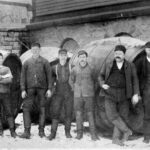
By 1883, the Lambert & Bishop Wire Fence Company, located between the Illinois & Michigan canal and the Chicago & Alton railroad, was using electricity extensively in its huge factory. A Joliet News reporter described the source of the power:
“In the barbed-wire department is located the giant Corliss engine (Allis) with a speed of 61 revolutions per minute, with 20-inch cylinder and 48-inch stroke, driving the ponderous machinery under a pressure of 70 pounds. Its main drive wheel is 22 feet in diameter, with a 48-inch surface. The drive belt, 48 inches wide and 100 feetlong, is the largest belt in the West, and some of our readers may have seen it on exhibition during the late Chicago Exposition. It generates so much electricity in its revolutions that, by holding the finger within several inches of it, the finger will be converted into a one candle electric light. Ex Sheriff ‘Shorty’ Noble runs this great engine.”
And while it seemed that electricity has been fully conquered, we read on August 3, 1894, in the Joliet Signal, “There was a mixture of fun and excitement at the corner of Chicago and Jefferson Streets this morning. A guy wire running from the top of a pole to the ground at the corner next to Harris Bros’ had become heavily charged with electricity – a fact that was discovered with exceeding haste when a man places his hand upon it in attempting to climb into his buggy. The man was thrown to the ground, his hand was slightly burned, and it was several minutes before he could fully understand what struck him.
“A crowd gathered, of course, and the wire became the object of a good deal of curiosity. Where it entered the moist pavement tiny curls of smoke could be seen ascending, showing that a strong current of electricity was passing through it. The pole on the opposite corner seemed charged, also, for two or three who leaned against it moved away quickly. This was caused by the strip fastened about the pole coming in contact with the wire rope holding the electric light in place. The trouble appears to be with a power wire of the street railway company falling upon a guy wire extending between the two poles, and this in turn communicating with the other wires.”
Over a decade later, a much worse accident happened. From December 23, 1904, in the Wilmington Advocate: “It is with a deep feeling of sadness that we chronicle the death of Alderman T. H. Donahoe, whose untimely and singular death occurred at an early hour this (Friday) morning, whilst bravely battling with the flames which threatened the destruction of the barn of Steinhart & Moore, he suddenly met his death by coming in contact with a deadly electric wire which had become burned and dangled to the ground. As he was attempting to cross the sidewalk, he touched the deadly wire and was thrown heavily to the ground. Tender hands lifted hip up and medical aid was quickly summoned but without avail. The deadly spark had done its work.”
In 1907, the Joliet Light & Power Company found itself in court with the Sanitary District of Chicago over the rights to the water in the Des Plaines river. The water was used, of course, to turn turbines that the city of Joliet depended upon the power. This fight for water rights continued throughout the first decade of the 20th century. It included the DuPage, Des Plaines, Kankakee and Fox rivers.
Water turbines were touted as the most reliable, but that wasn’t always the case. We read on August 5, 1910, in Wilmington Advocate: “Our city was in total darkness last Thursday evening until after 11 o’clock as far as electric lights were concerned. Low water was the cause compelling the electric light plant to close down.”
And later in November, “During the cold wave the local electric light plant and the paper mill had their troubles with anchor ice in their water wheels, and the homes had to be satisfied with dim lights for some of the time. It reminded one of the days when the tallow dips were in vogue.”
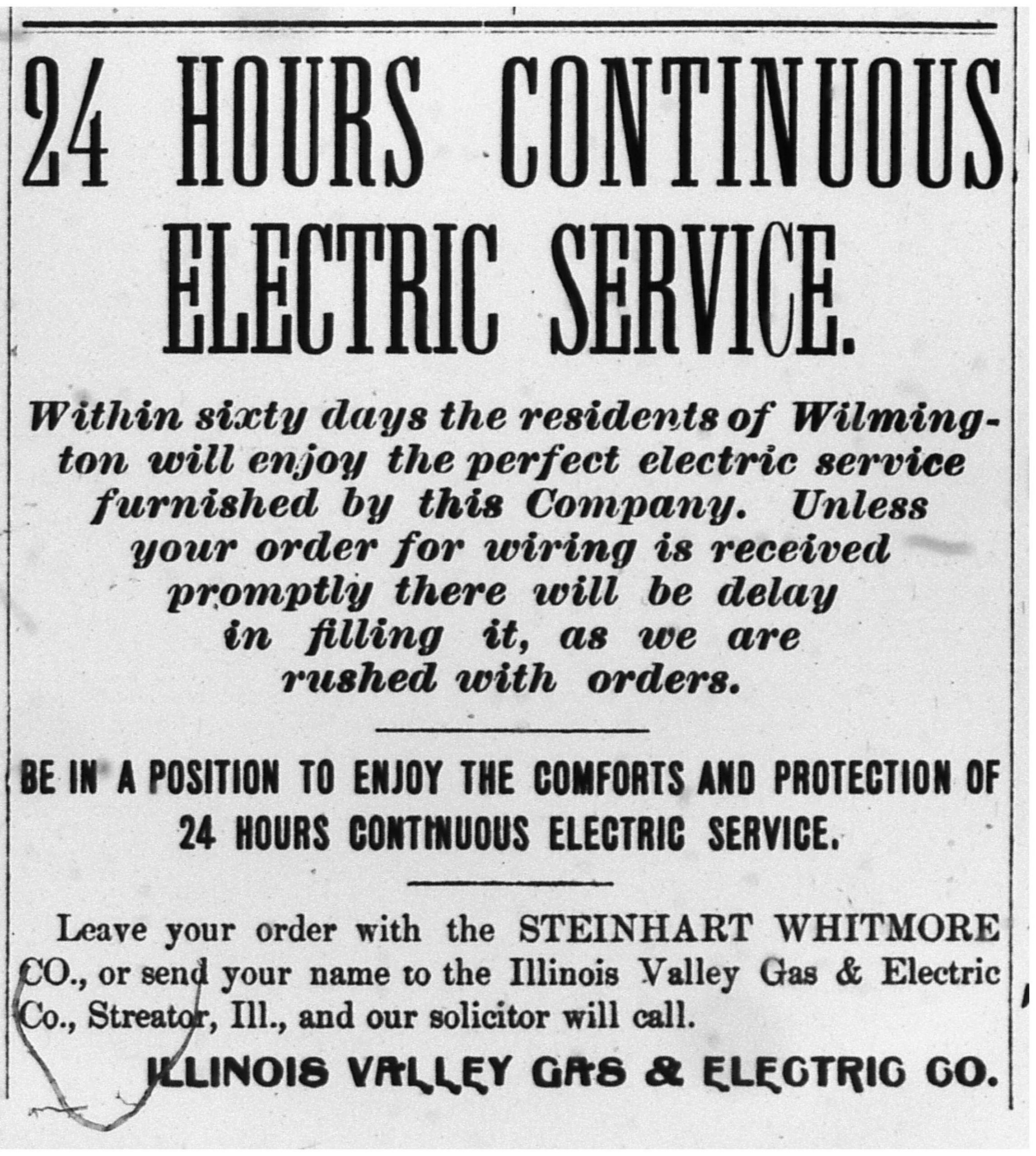
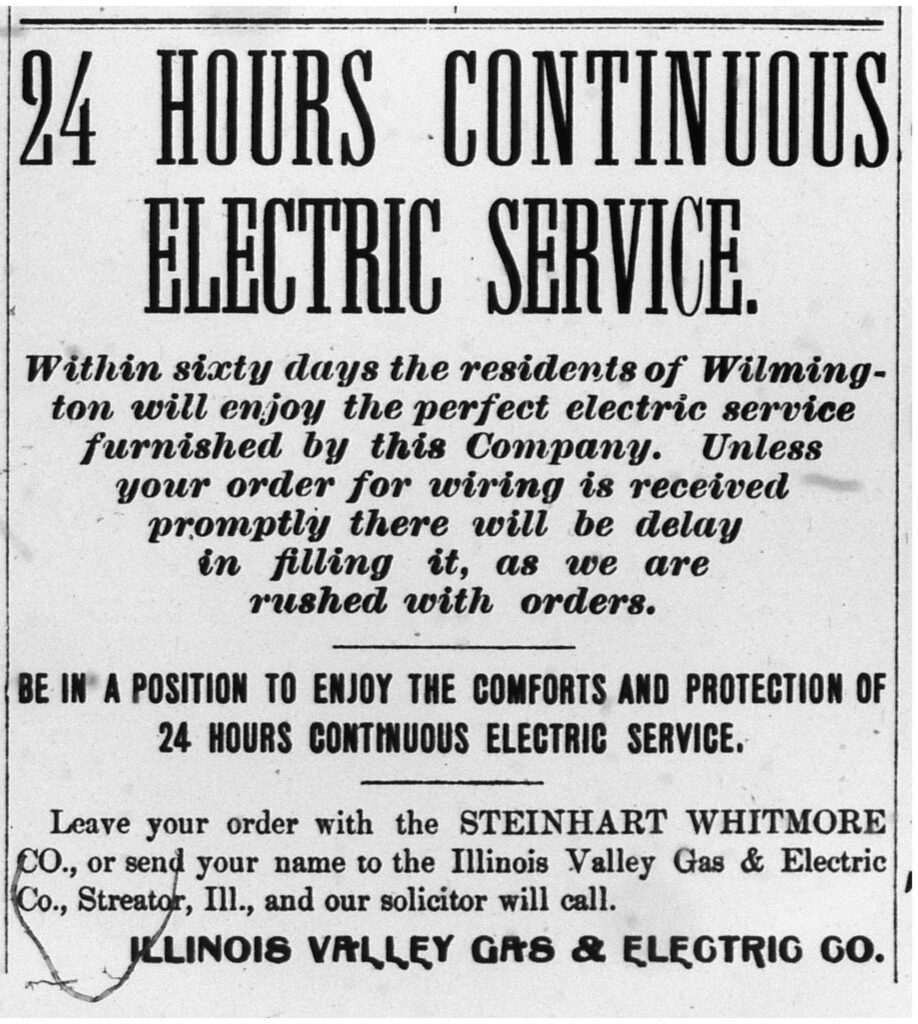
In an ad from February 1911, an attempt was made to calm the fears that the public might have over bringing electricity into their homes:
“Part of the electric lighting service which we offer our customers without extra cost is not generally known. Correct illumination is a science. It must be studied and mastered before the desired results can be obtained. We place expert illuminating engineering service at the command of every customer and prospective customer. Our object is not to install the most lamps. On the contrary, it is to give you the lighting you need with the fewest lamps properly arranged.”
As you put up and take down all those lights, remember that even they have a history worth remembering.
Happy New Year to all my gentle readers, and to the world in general.
Sandy Vasko serves on the Board of Directors for the Will County Historical Museum & Research Center, and is the lead researcher there.