Christmas in the 1870s, Part 1
By Sandy Vasko
Today we are going on a journey, not unlike Scrooge’s journey, to the past, the long past. Get aboard my time machine and together we will travel to the 1870s to find Christmas as it was celebrated then.
The 1870s was not a prosperous decade in Will County. During the early part of the decade, people were still recovering from the Civil War. An army of tramps, usually ex-soldiers who could not adjust to civilian life, were marching across the country – begging and stealing.
Many stores in the area stopped giving credit. Stores like the “Spot Cash” store, true to its name, would sell for cash only. The exception to this is stores that sold food items, like butchers and groceries. These items could not be kept on the shelf very long, so to sell them, even on credit, was preferable to throwing the merchandise away.
In an ad for Gorman’s store in downtown Joliet, we have a description of the kinds of foods sold at this time of year:
“We find French and American confectionery of the finest and purest kinds, sold in fancy boxes and lots and lots to suit; again, the sweet aroma arising from fresh Havana oranges, lemons, Malaga grapes, Catawba grapes, California pears, and other delicacies so rare at this season – indeed, Mr. Gorman has laid the richest gifts of the tropics at the feet of the Joliet people.
“We reluctantly turn from fruits to tempting bottled goods in the line of preserves, fruits and summer vegetables, reminding us that so far as the delicacies of summer are concerned, Gorman makes summer eternal. Stumbling over a large pile of boxes we stop to examine them and find choice table raisins, Muscatelles, in quarter, half and whole boxes, supplemented by rich new dates and figs, to say nothing of wild game of every known specie.”
But like Bob Cratchit, being poor did not mean there were no Christmas celebrations. Unlike today, spending money was not the point of the day.
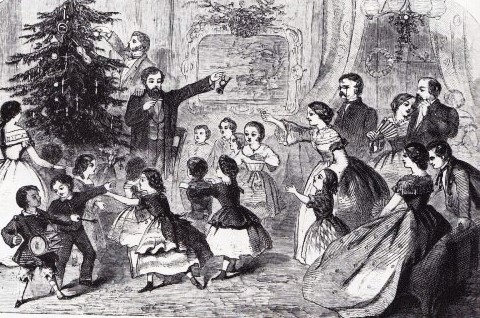
Decorations were simple. During this decade, most homes in Will County did not have a Christmas tree. Not because people could not afford them, but because pine trees, the traditional tree for Christmas, were not native to Will County. And there was no such thing as Christmas tree farms. It wasn’t until later in the decade that trees from Wisconsin and Michigan came down the I & M.
As a result, there were community trees, set up at the school house or church. This was true especially in the rural areas. The tree was not decorated with expensive glass balls, but instead with presents — small gifts for each child, an apple or orange, a pencil box or package of ribbons, a top or a ball. On Christmas Eve, the entire community would gather there for a program of singing and recitation.
In town, businesses would begin advertising their Christmas wares around December 15 with the admonition to “start shopping early to get the best selection.” As today, businesses would add evening hours, usually to 10 p.m., and most were open until noon on Christmas Day. However, none were open on Sunday, the Sabbath was still sacred.
The Christmas meal, usually eaten around noon, did usually feature a large bird of some sort. Turkeys were plentiful, and farmers started fattening them around November by feeding them oatmeal mixed with sweet milk. But since the refrigerator had not been invented yet, and ice boxes were very small, butchers were all open on Christmas Day until noon so that everyone could have a fresh bird for the table.
Venison and prairie chicken were also a popular item, but I have never read of pork being served at Christmas, even as a ham. Almost every table had fresh oysters, shipped live from Baltimore and other places on the east coast by train.
And as for the tradition of feeding the poor, it was alive and well in Will County even then. In Joliet a man named John Bissel, a Civil War veteran himself, was notorious for putting on a free Christmas feast at his restaurant. He especially sought out those ex-soldiers who were tramping the streets of the city. His friend, Frederick Hoffman, who had served with him in the war between the states, helped with the cooking.
The Joliet Sun describes the feast like this: “The tables were loaded with turkeys, chickens, venison, and roasts of all kinds, while oysters, fish sauerkraut – the favorite dish of the Teutons, and every delicacy of the season was spread in abundance. As it was without money and without price,” it was partaken of by a large number. The guests were waited upon attentively, and all seemed to enjoy the entertainment with delight.”
Gift giving was, of course, as important to the day as it is now. Stockings were hung on the mantle, but if a mantle was not available, the tradition held that the stocking be hung on the doorknob outside. And the usual contents of the stocking were an orange, apple, bag of nuts or, in some cases, it was filled with coal, yes real coal. Bad behavior was not rewarded or overlooked.
The gifts that children longed for were not much different from today. Dolls were, of course, always popular with the girls. In Joliet, there was one store that specialized in them. We have the description of the store, again from the Joliet Sun:
“Mrs. B. Allen’s, 13 Jefferson Street. Nowhere on earth has mortal eye ever gazed upon such an elaborate show of Holiday goods of every known description, especially dolls. It’s a perfect world of dolls – dolls little, dolls big, dolls fancy, dolls plain, no end of dolls, and among them we notice many very fine dolls, worth in the neighborhood of $50 each. Mrs. Allen’s ‘Doll’s Fair’ is attracting general notice, and the prize doll is a gem among its fellows – or sisters, rather, for we presume there are no dolls of the sterner sex – and should be seen by every person in the city.”
At this point gentle readers, we pause, but we will continue our look at the 1870s Christmases of long ago next time.
Sandy Vasko on the Board of Directors of the Will County Historical Museum & Research Center and lead researcher there.