How to dress for every occasion, 1881
By Sandy Vasko
In today’s society, how you dress is not as important as it used to be. My mother was a dress designer and dress maker, and I grew up with rules: no white shoes before Memorial Day, or after Labor Day. No mixing of patterns, such as a stripe blouse and a print skirt.
The school rules were that girls had to wear a dress with the hem no shorter than the knee and no longer than the calf. To prove it, we were required to kneel down, and if our skirt didn’t touch the floor, we were sent home.
Mom had made me a new outfit, unfortunately I was selected to kneel down. Needless to say, I was sent home. Mom was furious, she said something about fashion could not be dictated. The next day, she sent me in with a granny dress to the floor. Yep, you guessed it. I was sent home again.
Today, we go back even further than my high school years to marvel at the “fashion rules” of the day.
My reference for this material is a book called “Our Deportments or The Manners, Conduct and Dress of the Most Refined Society” published in Chicago in 1881.
In the section called “Dress” we read the following:
“Indifference and inattention to dress is a defect of character rather than virtue, and often denotes indolence and slovenliness.
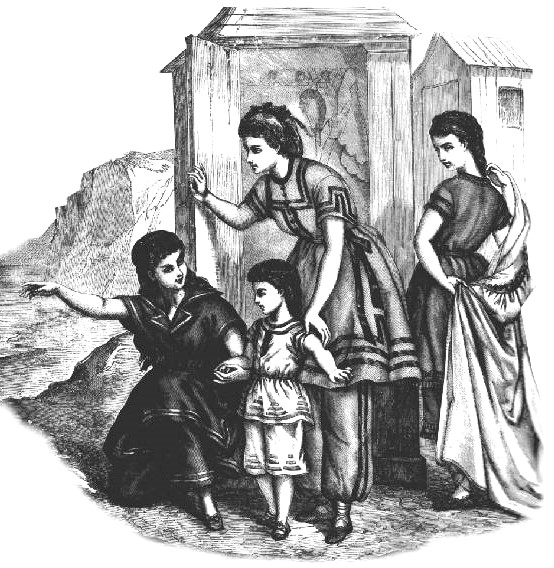
“Bathing Costume (swim suit) – Flannel is the best material for bathing costume, and gray is regarded as the most suitable color. It may be trimmed with bright worsted (wool) braid. The best form is the loose sack, belted in, and falling about midway between the knee and ankle; an oilskin cap to protect the hair from the water and merino wool socks to match the dress complete the costume.
“Traveling Dress – Comfort and protection from dust and dirt are the requirements of a traveling dress. When a lady is about making an extensive journey, a traveling suit is a great convenience, but for a short journey, a large linen overdress or duster may be put on over the ordinary dress in summer, and in winter a waterproof cloak may be used in the same way.
“For traveling costumes a variety of materials may be used, of soft, neutral tints, and smooth surface which does not retain the dust. These should be made up plainly and quite short. The underskirts should be colored, woolen in winter and linen in summer. The hat must be plainly trimmed and completely protected by a large veil.
“Velvet is unfit for a traveling hat, as it catches and retains the dust; collars and cuffs of plain linen. The hair should be put up in the plainest manner. A waterproof and warm woolen shawl is indispensable and may be rolled in a shawl strap when not needed.
“A satchel should be carried, in which may be kept a change of collars, cuffs, gloves, handkerchiefs, toilet articles, and towels. A traveling dress should be well supplied with pockets. The waterproof covering should have large pockets, and there should be one in the underskirt in which to carry such money and valuables as are not needed for immediate use.
“Dress for church – The dress for church should be plain, of dark, quiet colors, with no trimming or jewelry. It should, if fact, be the plainest of dresses, as church is not the place for display of fine clothes.
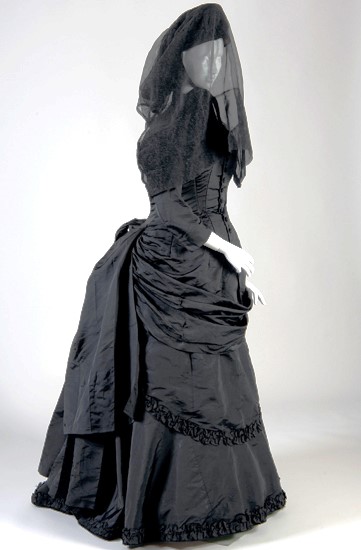
“Dress for Mourning (grieving over the death of a loved one) – Deep mourning requires the heaviest of black clinging material, with collar and cuffs of crape (a sheer wool material). Mourning garments should have little or no trimming; no flounces, ruffles or bows are allowable. If the dress is not custom made, then a long or square shawl of cashmere is worn. The bonnet is of black crape; a hat is inadmissible. The veil should have a heavy border; black gloves and black bordered handkerchief.
“Jewelry is strictly forbidden, and all pins, buckles, etc. must be black.
“The following rules have been given as to the length of time a mourning dress should be worn. The deepest mourning is that worn by a widow for her husband. It is worn for two years, sometimes longer. For the first year consists of solid black woolen goods, collar and duffs, a simple bonnet, and a long, thick, black veil. The second year, silk trimmed with crape, black lace collar and cuffs, and a shorter veil. In the last six months gray, violet and white are permitted. A widow should wear the hair perfectly plain and should always wear a bonnet, never a hat.
“The mourning for a father or mother is worn for one year. The mourning for the child is the same. Mourning for a grandparent is worn for six months, for a friend who leaves you an inheritance is the same as a grandparent.
“Mourning for a brother or sister is worn six months, an uncle or aunt for three months.
“Children under twelve who are in mourning should wear white in summer and gray in winter, with black trimmings, belt, sleeve ruffles and bonnet ribbons.”
If you visit the Will County Historical Museum and Research Center in Lockport, you will see a handmade mourning bonnet on display, along with some mourning jewelry.
Sandy Vasko on the Board of Directors of the Will County Historical Museum &Research Center and lead researcher there.
What a woman in mourning would wear in 1881