The mysterious case of Henry Belt
By Sandy Vasko
The story of the freedom-seekers is one that has been told in Will County for many years.These were people who truly were running away from slavery to seek freedom in Canada.
But the case of Henry Belt is not one of a run-away slave, but a typical one in the years prior to the Civil War. Set the way-back machine to the 1840s in Joliet, Illinois.
Our story comes from George Woodruff’s book, “Forty Years Ago,” based on a series of lectures he gave in 1874:
“We had, here in Joliet, a colored boy of the name of Henry Belt. He was a freeman, and had in his possession a paper issued by some clerk in Pennsylvania certifying to his freedom. Henry was a barber at the Exchange Hotel, and very popular, and had many friends despite the color of his skin.
“He was thus exposed to the eyes of a couple of professional slave hunters. They saw that he was a nice boy, and would be worth probably two or three thousand dollars in the St. Louis market. While one of them stayed to watch the game, the other went to Missouri to get some trumped up claim for a runaway slave answering to Henry’s description.
“They had him arrested, and he was taken before a justice of the peace, known to be a negro-hater, and by him he was quickly handed over to the men-stealers.
“But Henry had friends who would not allow this without a struggle to save him, and before they would get away with their prey a writ of habeas corpus was procured, and he was brought before the Circuit Judge for another investigation.
“All of this of course, produced great excitement. The feeling of indignation was not confined to Abolitionists. In fact, the efforts on his behalf were mainly made by those who would have scorned the name.
“The trial came off in the old jail. The court room was filled to overflowing with parties for and against the victim. The men-stealers produced their proof, and Henry showed his paper. But the judge was of the same stripe as the justice, and while he summed up the matter in a long opinion it became apparent how the matter would go; and when he concluded by deciding that the kidnappers should have their victim, there was great rejoicing on their part.
“They already began to count their chickens, and they turn round to take possession of the prize, when lo! Like the Irishman’s flea, he was not there! While all eyes had been intent upon the learned Judge, and all ears listening to his profound utterances, Henry’s friends had quietly taken possession of the stairway and the space between it and Henry, in the supposed custody of the sheriff, and he had been very quietly slipped through the crowd, and was gone!
“Great was the excitement when the fact was known. The kidnappers were raving. They found great difficulty in getting out of the Court House – everybody seemed to be in their way. When they finally got out, they and those of the crowd who sympathized made at once for the houses of the ’damned abolitionists,’ to search for their victim.
“Some admitted them – others kept them out, and demanded legal steps before they would submit to have their homes searched, which only made the kidnappers more certain that the prey was there.
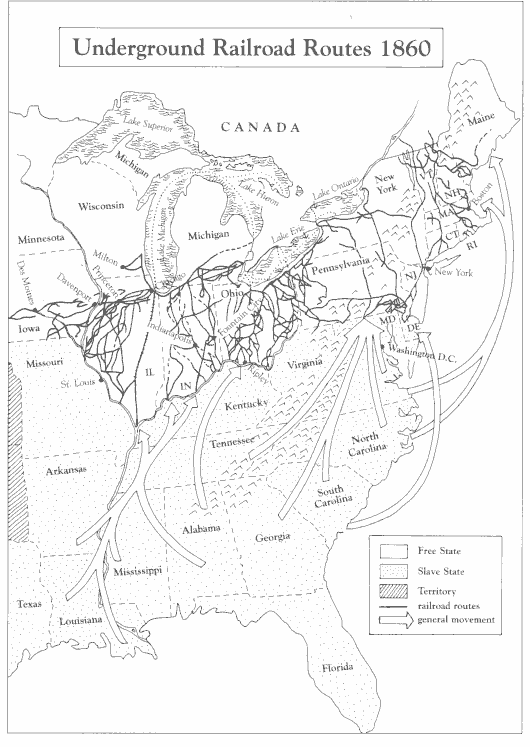
“I remember one humble house which the crowd threatened to pull down – but they didn’t. All this delay was favorable to the escape of Henry. Well, all the search was vain. Henry was nowhere to be found – never found; and after hanging around town for a few days the kidnappers gave up the job, believing that he had escaped by the mysterious means, the ‘underground railroad.
“The fact was, the abolitionists had nothing to do with Henry’s escape, and knew nothing about it. It was effected by different parties altogether, and Henry was concealed in the old wooden block on Chicago Street, which was not an abolition block. I guess Frank Mitchell, now of Wilmington could tell something about it.”
Franklin Mitchell, one of Wilmington’s earliest pioneers, was known for his “middle of the road” stance at first. But after seeing the injustice done to his fellow man, became one of those damned abolitionists and housed and conducted people on the Underground Railroad until the end of the Civil War.
On November 9, the Will County Historical Society will be sponsoring a brunch at the Lock & Mule in Lockport. The program by Kelly McLeod, genealogist and historian, will speak about the Underground Railway in the area, and the Lockport Cemetery that holds many of the early abolitionists. Tickets are $60 and will benefit the Society. For more information call 815-838-5080 or visit the Will County Museum Facebook page.
Sandy Vasko is Director of the Will County Historical Museum & Research Center and President of the Will County Historical Society.