Mr. Edison’s talking machine, it really talked!

By Sandy Vasko
Listening to other people’s voices is something we do day in and day out. One might think that nothing in that line has changed over the ages. But that’s not true. Think about it. Many of the voices we hear during the day come from some device – the radio, TV, videos on our phone, CDs, DVDs, etc., etc.
Set the way back machine to June 1878 when the only voices a person heard came from the mouths of real people.
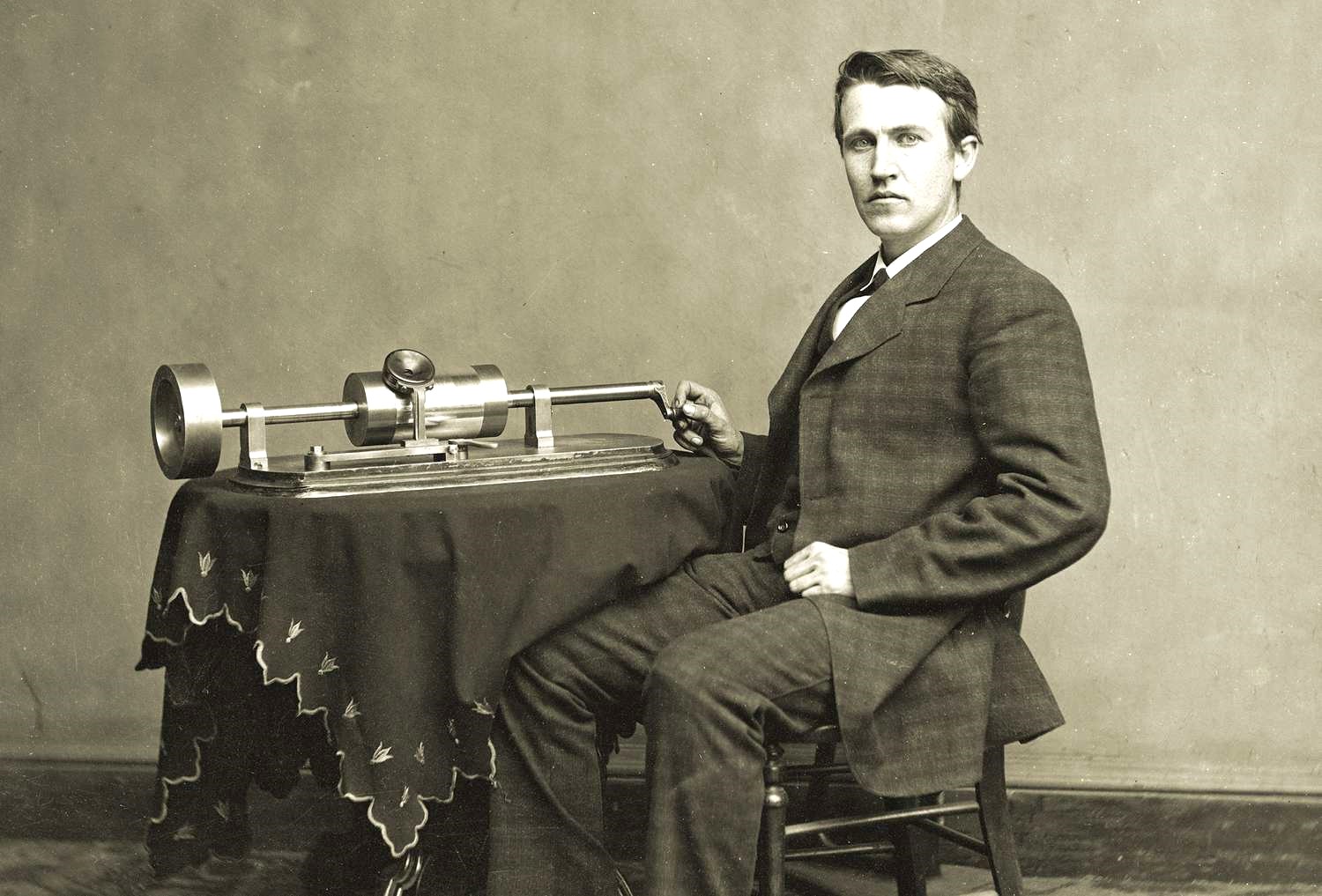
One of the front page articles in the Joliet Signal on June 11, 1878 was head lined “The Talking Machine.” It read, “One of Edison’s most wonderful of inventions, the phonograph, has been on exhibition at Chicago for a week, and gives utterance to human speech with great facility. The effective feature of it is a needle point attached to a thin, broad place, which vibrates when the tones of the human voice strike it through a funnel-shaped mouth piece.
“This vibration sets the little needle at work. It strikes and makes indentations on a cylinder which revolves against the point. The cylinder is enwrapped with tin foil, which receives and preserves the indentations.
“Words are spoken into the mouth piece. The vibrations of the voice upon the plate causes the needle to make indentations upon the cylinder, which is slowly being turned by means of a crank. The cylinder is then set back to the place of beginning, and the crank again turned. As the needle falls into the indentations, the vibrations are reproduced in the place, and the sound comes back through the funnel shaped mouthpiece in human speech.
“The words once given to the instrument may be reproduced after any interval of time has elapsed. Thus, the voices of friends may be preserved a century. Let them but speak into the instrument, and let it be placed away. At any time after by simply turning the crank the well-known accents will strike upon the ear and be repeated at pleasure.
“Two or three persons may speak into the funnel at once, and the tones may be distinctly reproduced, singing, laughter and whistling come from the instrument in pleasing fullness. If the indented cylinder be turned with great rapidity, the words will come quick and fast. If the cylinder be turned backward, the original speech will be uttered backward. In fact, there is no end to the wonders of the phonograph!”
Two weeks later we read in the Joliet Signal, “Opera House – Wednesday Evening, June 26th, 1878 – Edison’s Wonderful Phonograph – The talking machine. It talks, laughs, whistles, sings, etc. Crowds have gone to see it in Chicago, and 4,000 people in one day at Boston. The newspapers all talk about it. The people are wild with curiosity to see it. Exhibited under the auspices of the ‘Edison Speaking Phonograph Association, of the State of Illinois’ by E. B. Hamlin, General Manager. Admission 25 ($8.25) and 50 cents ($16.50). Reserved seats at Gorman’s without extra charge.”
In October of 1878, the High School Public Library Association announced a sure crowd pleaser of a program. We read, “A phonograph entertainment will be given at the school house this evening under the auspices of the High School Library Association. This meeting will be the first regular one of the season. Go and hear the phonograph by all means. It discounts a first-class echo, or a mocking bird just 200 per cent. Fact!”
Unfortunately, new technologies never come cheap. In this case we read a week later, “Quite a number of our citizens visited the phonograph, at Empire Hall, on Saturday, and were much interested. Still the venture of getting it here was a failure, financially.”
Edison went on improving that original model, eventually using large disks to record the vibration and then creating a way to mass produce those disks. Thus, the record was born. But along the way, there were many other technologies that did not stand the test of time.
We read in the Wilmington Advocate on January 18, 1907, “Can send voice by mail – Magnetic talking machines have been invented which will make records of speech and music – Amusement arcades throughout the country are to be equipped with a new device into which anyone can talk or sing and immediately hear his own voice reproduced. The apparatus which is to be used for this purpose is known as the Poulson telegraphone, a machine that makes a perfect reproduction of the human voice, instrumental music or any other sound and also records conversations carried on over telephone wires.
“In the machines the records are made on a circular sheet of thin steel by a magnetic needle. Anyone who wants to hear what his voice sounds like talks or sings into a transmitter attached to the recording magnets. He then places a receiver to his ear and at once has the unique experience of hearing the sound of his own voice reproduced without any of the buzzing that usually mars ‘talking machines.’ If he desires, he can secure the disk upon which his voice has been recorded and take it home in his pocket.
“If you want to send a vocal letter to a distance, talk into the nearest telegraphone, receive the record and mail it in the ordinary way. The recipient places it in another telegraphone or takes it to one of the arcades and hears his correspondent’s voice. He can then wipe out the record with a magnet and send his reply upon the same disk.”
The art of recording the sound of voices was truly on its way; now if we could only just shut them off.
Sandy Vasko is Director of the Will County Historical Museum & Research Center and President of the Will County Historical Society.”