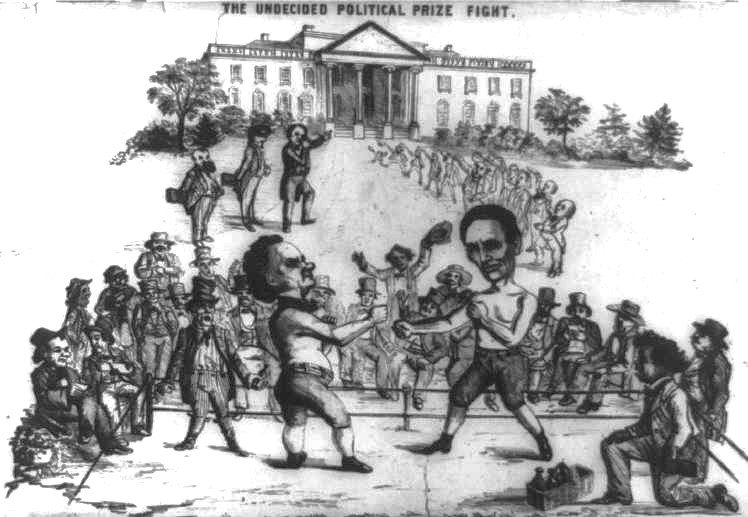
A county, and country, divided – the Election of 1860
By Sandy Vasko
Elections in this part of the country are usually hotly contested. But they don’t hold a candle to the election of 1860. Slavery and states’ rights were on the line. Not only was the country divided on the subject, but Will County was pretty much split down the middle.
Half were pro-slavery, or at least didn’t care one way or the other, and the other half believed that truly all men are created equal. However, the split was not equal in all parts of the county.
Wilmington was a hotbed for the antislavery movement, headed up by Col. Peter Stewart and his friends at the Wilmington Presbyterian Church. In the eastern part of the county, Crete and Monee were known for their Underground Railroad activities.
Joliet and Jackson Township were the centers for the pro-slavery movement. The Zarley’s in Joliet and Mr. Linebarger in Jackson were the leaders of the pro-slavery movement. They were staunch Democrats, supporters of slavery and well-respected citizens.
The Underground Railroad in Will County had been operating successfully for decades. It was so successful that sometimes it operated in full view and with the sanction of government officials, although in 1843, three men from Will County — Samuel Haven, Samuel Cushing and Peter Stewart — were indicted for harboring slaves.
Cal Zarley, editor and publisher of the Joliet Signal was livid! He predicted more of the same unlawful behavior if the Republicans were elected. In June, he wrote of the Republicans’ choice for a Presidential candidate, Abraham Lincoln.
“Not 1 in a 100 of the Republicans we meet with pretends to say that Lincoln is at all an available candidate, while all, except a few candidates for office, admit that he is no more qualified to be President of the United States than a professor of the Hebrew language.
“Here in Joliet, since the attempt to get up a Lincoln ratification meeting turned out such a failure, we have scarcely heard his name mentioned by a Republican, except with feelings of regret and disappointment that such a nincompoop has been forced upon them as a standard bearer.”
As the November election, neared both sides held mass meeting in every town and township. The Democrats pulled out the big guns when they met in Wilmington. They called on Judge Randall to speak. We read in the August 7, 1860 Joliet Signal:
“At a meeting in Wilmington, on Tuesday evening last, while Judge Randall was addressing the meeting, and recounting what Senator Douglas had done in obtaining a grant of land from Congress for building the Central Railroad, his eye fell upon Col. Peter Stewart, one of our oldest and most esteemed and respectable citizens. Seeing him in the crowd, the speaker paused and said, ‘Now, I desire to ask a question. Ten years ago, the prairies all round you, through which these railroads run, were wild and unpeopled. Suppose, at that day, that Stephen A. Douglas had come along here and said, ‘If you will make me President of the United States, I will put a railroad through this dreary prairie, and in ten years have it settled up, as you now see it settled.’ Col. Stewart, would you have made him President?’
“The old colonel impulsively answered, ‘I would have helped him all I could!’ The effect was electrical. A loud shout went up to the skies from the multitude, at the impulsive honesty of the veteran pioneer of this region.”
Whether or not this incident really happened is up for debate. It is hard to believe that Stewart would readily endorse the Democrat Douglas. Perhaps Col. Stewart was just carried away with the enthusiasm of the speaker.
Cal Zarley in Joliet was chief among the rumormongers. Two weeks before the election he wrote, “There will no longer be any confidence in the public credit; State stock will cease to be of any value; bank notes will not be worth the paper on which they are printed and in the consequent panic the laboring manufacturing and mercantile classes will be involved in one common ruin.
“Real estate will not realize more than a mere nominal value for some years to come, if Lincoln should be elected. It would therefore perhaps be as well for people who have payments still to make on their farms to calculate whether it will not be the wisest course to rest content with the loss of the money already paid and not risk anymore in investments in a country and under a government which, at best, must, be, for years, unstable and unsettled – liable to all the changes incident to civil war, contention and strife.”
On the day of the election, he wrote of potential dirty tricks by the Republicans. “Frauds! Frauds! Frauds! We understand that the Republicans have determined to poll enough illegal votes to save their county ticket. The towns of Frankfort, Homer and Lockport have been chosen as the field for their operations. We would ask the Democrats in those towns especially, to keep a sharp look out. Already the boast is being made that the Republican majorities in Frankfort and Homer will be double what they were two year ago. This cannot be the case unless the most glaring frauds are perpetrated. Watch the polls, Democrats, and see that there is no ballot-box stuffing or illegal voting.”
The results of the election are well-known. In Will County, Lincoln won 3,219 over 2,515 for Douglas. In Wilmington, the results were 181 to 158; Frankfort, 255 to 104; and in the six wards of Joliet, 477 to 911.
The majority of Douglas votes in Joliet could not overcome those for Lincoln in the rest of the county.
Sandy Vasko is Director of the Will County Historical Museum & Research Center and President of the Will County Historical Society.