Kill or keep? Will County wild things
By Sandy Vasko
Every once in a while, we hear of sightings of animals that have long since left our neck of the woods. When I was young, to hear of a coyote sighting was rare, Canada geese were still a marvel and people traveled long distances to see large flocks.
Today, all we have to do is go to the nearest golf course.
Other animals, the predators, are not so welcome. Stories of coyotes eating cats and small dogs not to mention chickens, or eagles swooping down on domestic animals, make the news frequently. I must say right now, I am on the side of the wild animals; they were here first. Of course, that argument did not work for the Native Americans, either.
Let’s go back to see how these predators were treated back in the day:
Our first example comes from the April 4, 1854 Joliet Signal: “Mr. B. Wells, of Wilmington, recently shot an eagle near that town, that measured eight feet and eight inches from tip to tip. It was of the gray species and the largest ever killed in this part of the country.”
Of course, these creatures make more of a sensation in urban areas. From the April 2, 1867, Joliet Signal: “A lynx in our city – On last Thursday morning one of these ferocious animals, the size of a large Newfoundland dog, was discovered on the premises of Col. Sanger on Scott Street. Being pursued by citizens residing in that locality, it crossed the street and leaped into the garden of Mrs. Little, where it was shot while attempting to enter the cellar of her dwelling. It was decidedly an ugly and dangerous looking customer. It had probably been chased into the city by hunters. This makes the second lynx that has been killed in this county within the past few days.”
Land-based creatures weren’t the only ones. From May 13, 1868, Wilmington Independent: “Erastus Willard has got the head of a sturgeon which was caught up in Horse Creek last week. It has a very ‘open’ countenance, being about the size of a butter tub.”
It’s true that not every one immediately killed the wild predators. We read in the May 26, 1868 Joliet Signal: “Mr. Jacob Brown, of Channahon, a few days ago, captured in the woods, east of that town, a large wild cat or lynx and three young ones. They are pretty pets, but rather dangerous for familiarity.”
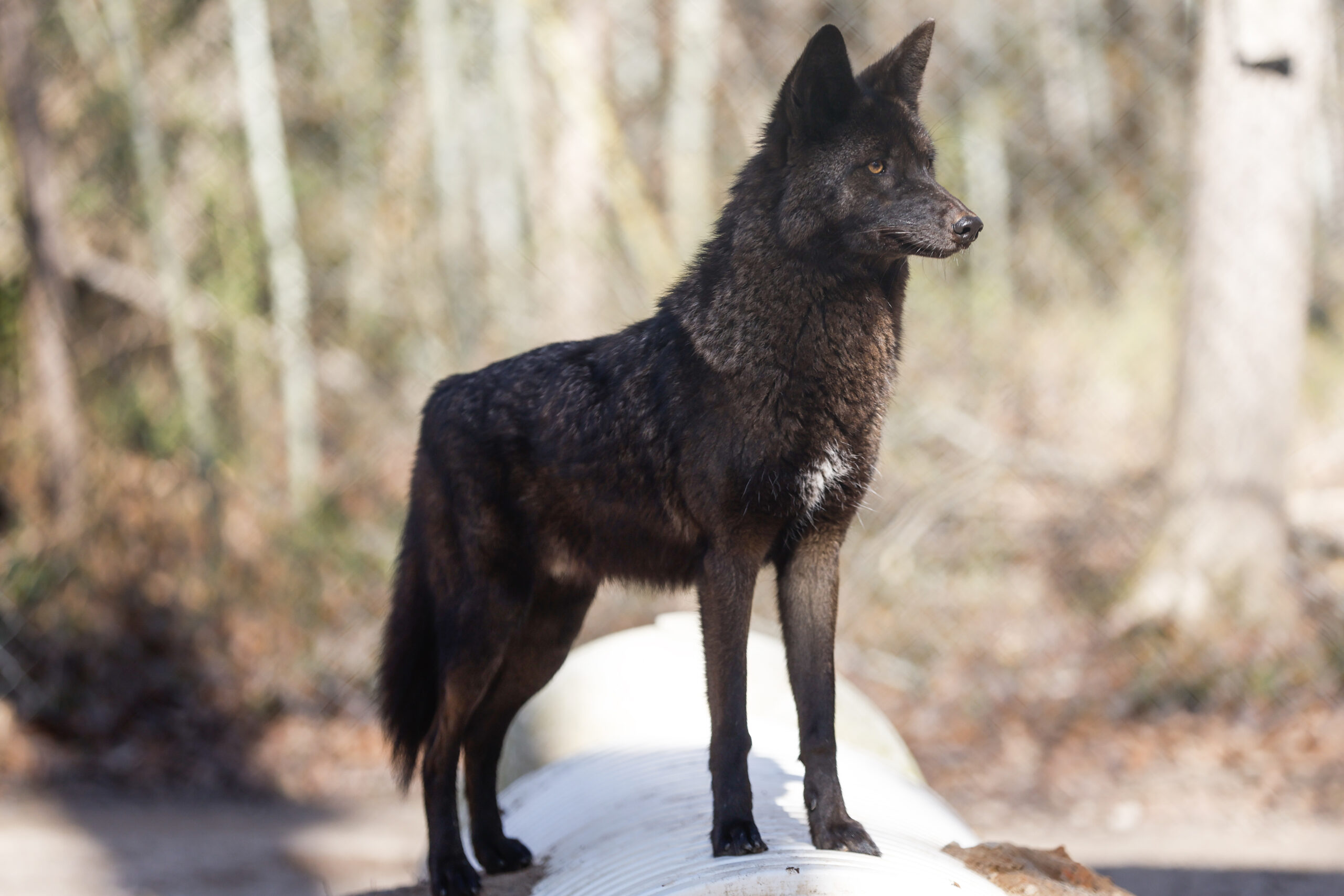
By 1872, an all-out war was declared on wolves. However, I believe that these were not wolves but coyotes. We read this tongue-in-cheek blurb: “Wolf scalps in Illinois bring $15 ($388) apiece, and some of the farmers are selling out sheep and stocking up in wolves.”
The following year, “A recent resolution instructing the county treasurer to pay five dollars per scalp for all wolf scalps taken from wolves killed in Grundy County was tabled by the board of supervisors, recently. The bounty now paid is $2 ($54) per scalp.”
From 1874, “The wolf race is not yet extinct in Will County. Our old friend, Mr. Henry Padley, while hunting in the woods near Joliet lake the other day, captured nine of these voracious rovers in the stump of an old tree which they had appropriated for a den. Mr. Padley reserved two of their wolfships for an experiment in domestication, destroying the rest.”
In an editorial in 1877, the wolf problem seemed worse than ever: “– The Will County Board of Supervisors, when it meets next week, should provide for the payment of a bounty for the scalps of all wolves killed in the county. Thousands of dollars’ worth of pigs, sheep, poultry, etc., are destroyed annually in the county by these ravenous beasts. In the towns of Channahon, Jackson, Troy and Wilton, their ravages have been most severely felt. In the former town one farmer informed us that he had lost hundreds of dollars’ worth of sheep and pigs, and several of his neighbors had suffered severe losses from the same cause. The adjoining county of Grundy pays a bounty for the destruction of wolves, and there is no just reason why one should not be provided in Will County for the same object.”
In 1879, we have the results of the last big “wolf hunt” in this part of the country: “The wolf hunt – though disagreeing on some minor points all reports unite in pronouncing the wolf hunt last week in the southwestern part of this county a failure so far as game was concerned. There were about 100 horsemen and about an equal number of foot men present. They formed a circle several miles in diameter and kept drawing together until all sides met – but nary wolf. One authority says for wolves were ‘raised,’ but they escaped owing to the scattered condition of the line.”
By 1894, the wolf population had thinned out, but one Will County citizen found at least one wolf useful. From March 23, 1894 – Joliet News:
“C. T. E. Austin, of Plainfield, has an 8-year-old wolf he uses as a watch dog. He is a good-sized black fellow and has teeth like the knives of a sausage grinder. The wolf is chained to a post in the barnyard and woe to the tramp who seeks shelter within his domain at the straw stack. The owner prizes his pet quite highly and has many interesting incidents to relate of how the animal conducts himself when strangers are around. Mr. Austin can romp with the savage fellow but when others appear, the wolf shows a row of long shining teeth and jumps the length of his chain.”
Sandy Vasko is Director of the Will County Historical Museum & Research Center and President of the Will County Historical Society.