Republicans vs. Dems, or rallying for a winner
By Sandy Vasko
The office of President of the United States and the topic of elections is never far from us. Whether it’s on TV, radio, your phone or social media, it surrounds us. Some say it doesn’t matter who is President; some get very involved.
So, in that spirit, let’s look at another election, this one a presidential one as well – the 1880 election.
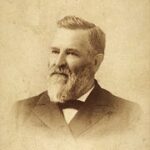
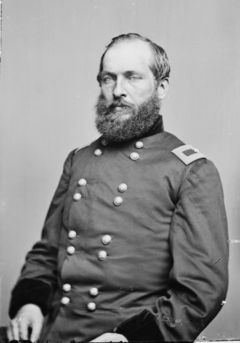
Our story starts with James Garfield, who is known to have visited Will County while he was a civilian. It seems that when a young man, Garfield attended and later became president of the Western Reserve Eclectic Institute (later named Hiram College) in Hiram, Ohio. A fellow professor was Prof. C. D. Wilbur, who married Nancy Merrill, the daughter of Moses Merrill, one of Wilmington’s earliest pioneers. Hence, the Will County connection.
James A. Garfield began his Civil War service in 1861 as a colonel with the 42nd Ohio Volunteer Infantry, quickly rising to brigadier general and leading his brigade to a decisive victory at the Battle of Middle Creek in Kentucky.
He then fought at the Battle of Shiloh and served as chief of staff for Major General Rosecrans, earning promotion to major general after distinguishing himself at the Battle of Chickamauga. Garfield then took his seat in the U.S. House of Representatives in late 1863, though he continued to serve in the Army until the war’s end.
In the early part of 1880, Garfield was talked into making a bid for the Republican nomination for the office of President. As soon as this was announced, Garfield Clubs sprang up all over this area. There were clubs in Wilmington, Wesley, Florence, Braidwood, Elwood, Joliet and more. The Democrats in the area were quick to point out Garfield’s involvement in the Crédit Mobilier of America scandal. The Republicans countered with Garfield’s outstanding war record and his friendship with Abraham Lincoln.
Editor Ed Conley of the Wilmington Advocate was a Civil War vet, but he could not abide corruption, so was staunchly writing against Garfield’s election. He did write on June 18, 1880: “Some ten or twelve years ago, General Garfield visited the family of John A. Ford and also Prof. Wilber, a co-professor, (then stopping at his father-in-law’s, Moses Merrill,) and while here lectured in the Presbyterian Church to a large and appreciative audience, many of whom recollect both him and his lecture.
“He expressed himself well pleased with the romantic beauties of the Kankakee Valley, and after a few days’ ramble hereabouts, like an overgrown boy, just out of school, he took his departure, promising to come again. Our latchstring is out, and our people would give him as hearty a welcome now as then.”
Moses Merrill lived on West Kankakee River Drive at its closest point to the river.
Several years ago, I had the occasion to visit the Garfield Presidential Library in Cleveland, Ohio. Going through Garfield’s journals from the end of the war on, I did not find a specific reference to Wilmington or to Moses Merrill. I did find that in 1868 he took a train trip from Chicago to Springfield, stopping at several towns along the way and that Prof. Wilbur met him at some point and continued on with him to Springfield.
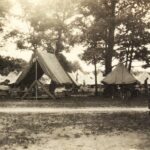
In October of 1880, Will County was selected for a huge countywide Republican rally in support of Garfield. It was decided to hold it in Wilmington. Editor Conley gave the following description: “The great Republican demonstration in this city was a very creditable affair to the enterprise of that party. At eight or nine o’clock our country cousins began to arrive, reminding one of a ‘circus day’ and music from the well-organized Miners’ band, of Braidwood, inspired our dissenting brethren with considerable enthusiasm. A little later brought the Garfield Club from Wesley, numbering fifty-six, in uniform, and the Rockville band arrived shortly afterward, followed by a fine drum corps from Kankakee.
“A column was then formed, and a line of march taken up to the depot. The 11:15 train brought the great mogul, John A. Logan, and a score, more or less, prominent Republicans, from Joliet. The Denver train from the south brought a club of about twenty from Dwight, and a colored club of about twenty-five from Braidwood. The grand procession was not perfected until two o’clock, and then the column moved through some of the principal streets and to the Island, where a stand had been erected. Probably a thousand strangers were in the city, and three-fourths of them were about the speaker’s stand.
“The swarthy orator left on the evening mail train for Chicago. The accommodation train came next, and with it the finest looking body of men in the line, numbering maybe, seventy-five, in really pretty uniforms. ‘Twas after eight when everything was ready for the march, and then the line moved triumphantly, making an attractive display, some five companies being in the column, counting ‘plain’ and ‘colored.’
“At about nine o’clock Empire Hall was filled to listen to the Hon. Owen G. Lovejoy. From the outer stairs of the hall Hon. Amos Savage, of the old Thirty-ninth Regiment, spoke to the crowd in the street. The song, “Marching Through Georgia,” was well received by the latter. The night wore round, and a half-past ten the column reformed and walked to the depot, where a special train was in waiting to take the Joliet fellows home. It was a grand success.”
Success indeed! The results in the November election testified to that. In Will County it was Garfield’s 5,776 to Hancock’s 3,803. Across the country, the results were much the same. Garfield was to be the new president!
Garfield was sworn in on March 4, 1881. He turned out to be a strong president who resisted political pressure. In foreign affairs, he tried to get leaders of all nations in both North and South America together for mutual support. But that meeting never happened, as on July 2, 1881, in a Washington railroad station, an embittered attorney, Charles J. Guiteau, who had sought a consular post, shot him.
He lingered for 80 days with a bullet somewhere in his body, but the doctors could not find it. Alexander Graham Bell, inventor of the telephone, tried unsuccessfully to find the bullet with an induction-balance electrical device that he had designed (the first metal detector), but the metal bedframe Garfield was lying on made the instrument malfunction. Because metal bedframes were relatively rare, the cause of the instrument’s deviation was unknown at the time.
On September 6, Garfield was taken to the New Jersey seaside. For a few days, he seemed to be recuperating, but on September 19, 1881, he died from an infection and internal hemorrhage.
Sandy Vasko is Director of the Will County Historical Museum& Research Center and President of the Will County Historical Society.