It’s that time of year, Chautauqua

If the above word is unfamiliar to you, it’s because the grand social movement that was Chautauqua died out about 100 years ago.
The Chautauqua movement was a cultural and social movement in the United States, originating in 1874 as a summer school for Sunday school teachers at Chautauqua Lake, New York. It evolved into a popular form of adult education and entertainment, spreading across the nation through tent revivals and independent institutions.
Although there were “camp meetings” as early as the 1870s in New Lenox, they were not true Chautauquas, but rather a religious revival meeting. The Chautauqua movement was rooted in the belief that education should be accessible to all, not just children, and that it should extend beyond formal schooling.
The movement became so popular that independent Chautauqua companies were formed that included not only lectures, but singing groups, dances and plays.
The first reference I have found in this area is from May 11, 1894 Joliet News: “A meeting of the executive committee of the Northern Illinois Grange Chautauqua was held last Saturday in a reception room of Labor Hall, all being present but one. Several masters of county granges were there. A. M. Strong was elected president and H. E. Baldwin secretary.
“After careful consideration of the time and place for the second annual gathering of the Chautauqua it was unanimously decided to accept the liberal proposition made by T. H. Riley for Riverview Park. The main reason for refusing to take New Lenox camp grounds again was the usual lame arrangements for railroad transportation. A street car line could have made it a very inviting spot.
“Riverview Park is located on the Lockport street car line about a mile north of the prison, on high ground commanding a fine view of the Des Plaines valley.”
It wasn’t until the first decade of the 20th century that the traveling companies started to visit our area. One of the first was the Red Path company. In 1915 the Red Path group visited Wilmington. They featured “Tahan” in real Indian costume telling his life story, “What I saw and did as a Savage.” The second day was Children’s Day; singers, dancers and magicians highlighted the entertainment.
The third day was Grand Opera Day, where a full opera was performed as well as a show called “Songs of the 60’s”. I am presuming that meant Civil War era. The fourth day was Bede Day, featuring the major speaker of the week, a congressman named Bede who was known for his sense of humor.
Appearing on all four days was according to the ad in the Wilmington Advocate, “Chautauqua Band Leader Also to Render Trombone Solos – Jaroslav Cimera, director of the Cimera Concert Band, to appear here Chautauqua week, has been trombone soloist in Innes’ Band, Sousa’s Band and Kryl’s Band. In addition to direction his band this summer, he will render trombone solos.” Admission price $2 for all four days.
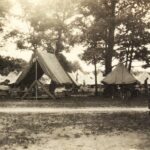
Many families chose to turn the event into a camping vacation. Food and beverage were always available on the grounds. In fact, ads for the Chautauqua read, “You owe it to your wife to give her a Chautauqua vacation from the year-round routine of home cares.”
And, “You owe it to yourself to get the recreation, the entertainment the inspiration, and the broadened horizon that comes with attending the Red Path Chautauqua.”
One can’t help but notice that while the attendees were all mainly middle-class white families, the entertainments were frequently minority groups.
In 1923 the black group The Virginia Jubilee Party, were listed as performing “Plantation songs, negro spirituals, camp meeting songs, darkie mimicry, negro lullabies, classic and sentimental songs of the Old South. They relive the plantation days of the Old South.”
Like vaudeville and other types of entertainment in the 1920s, the popularity of the Chautauqua waned. The automobile, the records, the movies all contributed to the demise of the institution. People no longer wanted to camp out, rather tourist camps and cabins sprang up.
The world had changed.
Sandy Vasko is Director of the Will County Historical Museum & Research Center and President of the Will County Historical Society.