Riding the C & A, always something new
By Sandy Vasko
Transportation in the earliest years of Will County consisted of horses and canal boats. By the 1850s, citizens were demanding that a railroad be built just like out east.
In 1854, the Chicago & Mississippi Railroad (later to be known as the Chicago & Alton) ran the first train through Will County to Springfield, on the exact same track commuter trains use today.
However, getting more people to ride on it was a whole different matter. In an effort to get more passengers, the C & A was always upgrading their services and equipment.
When the first train came through town, the cars were made of wood with wooden seats. There was no heat and no way to cool the air, except to open a window, which drew in all the smoke being emitted by the locomotive.
Those wooden cars were comparatively fragile; one little accident and the car was in splinters. On May 17, 1865, we read about a new innovation in the Wilmington Independent: “Iron Cars – The Chicago & Alton Railroad Company have just received one of two iron passenger coaches constructed for them in February last, by Charles S. Munn, and manufactured by Merrick, Hanna & Co., Rochester, Beaver County, Pennsylvania.
“This car is sixty-seated, beautifully finished and furnished, and is point of elegance and general appearances, is not excelled, if equaled by any passenger coach in the Northwest. It is constructed entirely of iron with the exception of doors, windows, and inside linings.”
It was true these new cars accommodated more passengers. They also held up better when in derailments and accidents. But in the heat of the summer, they turned into ovens, and in winter, into ice boxes. Soon, passengers refused to ride in them, and they were demoted to the status of cabooses. The railroads went back to cars made of wood.
Another problem railroads had was that of lighting the interior of the cars at night. One of the most popular ways to light your home was with a kerosene lamp. Even in the home, it was a dangerous way to obtain light. But in a moving, bouncing, jerking railway car, the fluid became so volatile that it would simply explode, setting passengers and interiors of car burning.
We read in March 4, 1868, in the Wilmington Independent: “The managers of the Chicago and Alton Railroad, with commendable discretion have ordered that the use of kerosene lamps in passenger coaches shall be discontinued and candles substituted.”
One month later we read: “Lard oil lamps are now used on the trains of the C. & A. & St. Louis Railroad they work well.”
Liquid lard does burn, but does not vaporize and explode. However, burning lard does give off a dark heavy smoke. Added to the smoke from the now coal burning locomotive, and it became a dirty way to travel.
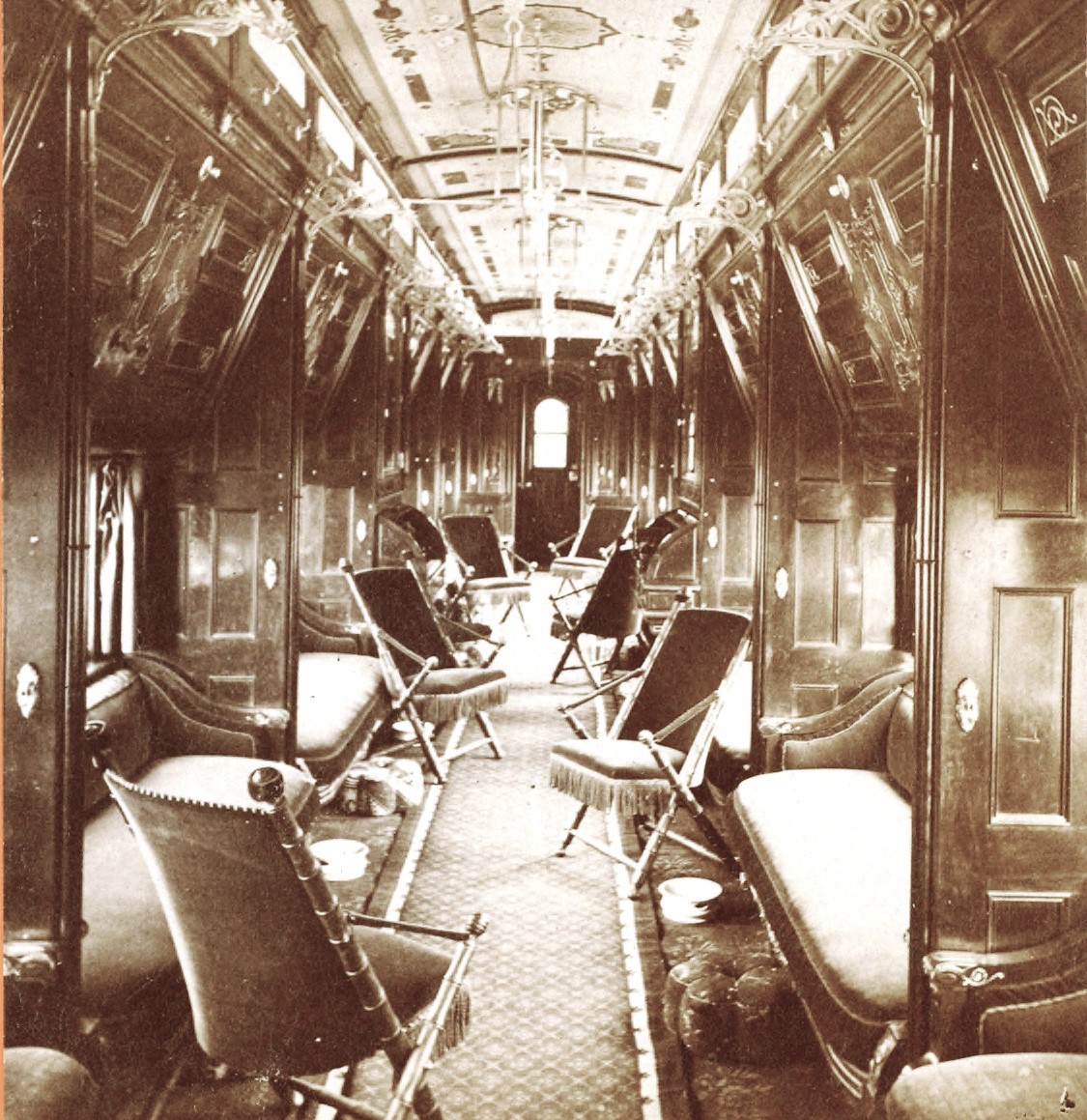
In an 1874, the C & A reported to the government they had purchased 12 Pullman Palace Sleeping Cars. These had a sort of sleeper sofa built into the walls of the car, with a folding chair next to it for sitting.
By 1878, passengers were happy to read in the Joliet Signal: “The Chicago and Alton Railway Company, with that commendable spirit of enterprise which has done so much to render the road a favorite with the traveling public, have supplied all their passenger trains with porters, whose duty it is to look after the comfort and welfare of passengers, keep up fires, attend to the ventilation, give information, and in a word, make themselves generally useful. This is a sensible and generous arrangement, and will be heartily appreciated by those who travel by this justly popular road.”
In 1879, we read of another purchase: “The Chicago and Alton railroad company have received two more new engines from Baldwin’s Car Works. They weigh 38 tons each. This company has also put on its Kansas City line a new Horton reclining chair car of handsome finish. It is sixty feet long, has forty-eight Horton chairs, with wash room and a small smoking room, and is mounted on forty-two-inch paper wheels.”
When I first read that, I thought for sure that there was some sort of typo, as how in the world could a train car have “paper wheels?” It turns out that the entire wheel was not made of paper, but there was strawboard between the hub of the wheel and the outside which had the effect of smoothing out vibrations to the wheel, which made for a much smoother ride.
The C & A served Will County way into the 20th century, and was sold at auction at the now-demolished depot on Kankakee Street in Wilmington.
Sandy Vasko is Director of the Will County Historical Museum & Research Center and President of the Will County Historical Society.