The Black Hawk War: A place of refuge, Fort Dearborn

By Sandy Vasko
When we left the fleeing settlers, they had arrived at Fort Dearborn. However, they weren’t the only people looking for safety. We continue reading from “Reminiscence of James Ritchey, An Early Settler” by Franklin W. Myrick.
“All the dwellers of the city had already sought refuge in the fort. These had filled old Fort Dearborn to an uncomfortable degree, and the people quartered in the fort, while glad to accept any augmentation to their strength as a fighting body, were sorely displeased that to gain this, they were obliged to strain the capacity of the rooms in which they were already uncomfortably situated.
“After considerable difficulty McMahon, Goodnough and Helme succeeded in getting lodged in a room 16 x 17 ft. Mr. and Mrs. Ritchey were as yet unsuccessful. Mrs. Ritchey, failing elsewhere, at last made application for lodging at a room containing only a few persons and was met by the response, ‘There is a sick woman here. No room for anyone else.’
“At this stage, Mrs. McMahon came up and invited her and the family into their quarters. The invitation was readily accepted. When Mr. Ritchey and his family joined his neighbors in their new quarters, they all together numbered 24 persons. Quartered as they were in a room with 272 square feet of floor, this apportioned would give each person 11 1/3 sq. ft. But when we remember that the room also contained their provisions and stove, on which they all cooked, with such other goods as had been brought, the area of this space becomes, of course, smaller.
“Scarcely were they moved into their new quarters when the family that had been required to move in to the upper room to give place to the new comers, began to annoy them. They had left the room into which our friends moved reluctantly, and now lost no opportunity to show their displeasure for the intrusion, as they chose to call it. A reprimand from the officer in charge soon put a quietus to their annoyance, however.
“On the second day after the arrival of our party at the fort, the men organized themselves into companies by electing officers and making preparations for drill. On the return of the party from Fox River, the Hickory Creek Company was organized in which Mr. Ritchey, Wm. Blackstone, and all the settlers from that vicinity were members. This company was of men from Dupage, Naperville and vicinity. The three companies aggregated one hundred and twenty-seven men; but the scarcity of arms and ammunition rendered them practically unfit for protracted service, or for performance of garrison duty in case of an attack.
“A few days after completing their organization, a company was detailed to march over to Walker’s Grove (Plainfield), thirty miles distant, where James Walker and thirty-three men had taken refuge in a temporary fort erected by them. They escorted them to Chicago for greater safety. This company returned on the second day with Walker and his men.
“About a week after the arrival of our party at the fort, a load of government provisions arrived on a schooner. This had been sent on with the expectation that there would be need of troops that were to be subsequently sent. But the self-elected garrison was out of provisions, and Major Baily ordered that the pork and flour should be detailed to the families in the fort giving each person one pound of pork and one of flour per diem.
“A week later two Munson brothers and Wm. Brin in company with Jas. Gooding and family whom they had overtaken in Indiana and warned of the Indian outbreak, arrived outside of the fort. The Munson brothers had a wagon load of bacon with which they had started for Michigan, but on learning of Indian hostilities had hastened to the fort for safety. On their arrival at Chicago their bacon was confiscated by Maj. Baily and rationed out to the occupants of the fort. The fort being now filled to its utmost capacity this party encamped just outside of its walls.
“The men at the fort drilled every day and were kept in readiness for any emergency that might call for their action. The outbreak of the Black Hawk Indians in this part of the country, sudden as it was, subsided nearly as suddenly as it began. After the lapse of eighteen days in the fort, during which time two children were born, the fears from the Indians being swept away, the companies disbanded and on the afternoon of the fifth of June, the people all left the fort. Twenty-three families with teams and some young men moved out.
“On the morning of the 6th the party broke up, each settler to pursue alone the remainder of the way. Before disbanding it was arranged by a company that they should hasten to their farms, collect their effects and meet again at the Five Mile Grove (Manhattan) on the following day. From thence they were to return to Indiana to remain until the hostile Indians should have retired from their depredations.
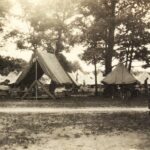
“Late in the afternoon of the next day, the ox teams loaded with the families’ goods, were seen wending their way towards the Five-Mile Grove. That night all the settlers met as agreed upon, each farmer bringing with him his stock and all that he possessed. Gathered together under a few oak trees just fifty years ago, were all the white people who had chosen this region as a location for their homes.
“Passing the night in camp, the emigrants parted in the morning on their journey. Six days later they reached Covington, where the different parties separated, each seeking a place of abode among the different neighborhoods.”
These hardy settlers spent the winter in Indiana, but when spring came, the once again made their way to Will County. We come from hard stock.
Sandy Vasko is Director of the Will County Historical Museum & Research Center and President of the Will County Historical Society.