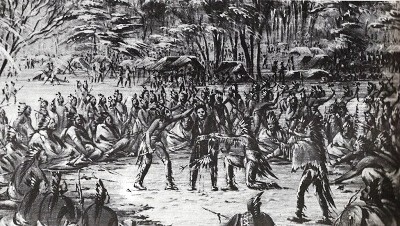
Wiped out, the peaceful Illinois Tribe
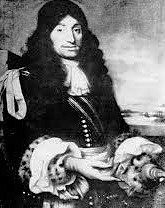
Henri de Tonti, an Italian-born French military man who lost a hand in a grenade explosion. He was one of the earliest fur traders.
By Sandy Vasko
The signs are all around us, “Pottawattamie camp ground” or “Indian Boundary Line” or “Wauponsie Glacial Trail.”
Those romantic Native American names are not just for show. Time was when white man did not live here, only tribes of warring Indians roamed the prairie. Set the way-back machine to the late 17th century for a look around.
The very state we live in, Illinois, is named for a tribe of Indians: The Illinois Confederation, or Illiniwek, were made up of 12 to 13 distinct bands including; Cahokia, Kaskaskia, Peoria, Tamaroa, and Michigamies. The last two lived north of Lake Peoria in our region. They were once the most numerous tribes in the Midwest.
They had many towns along the Illinois River, the principal one, La Vantum, was located at the present site of Utica. They were not a war-like tribe, preferring instead the peaceful life of hunting and fishing. At that time, herds of buffalo roamed Illinois prairies, deer were plentiful and wolves made the night sing with their song. The fur-bearing animals like beaver, muskrat, weasel, etc., were also easily procured.
But then came the French fur traders into our area from Canada. The trade goods and whiskey offered by the whites for fur pelts were impossible to resist. Soon what was plentiful became scarce.
As furs became scarce, there was more competition among the tribes. Neighboring tribes like the Iroquois from the east, jealous of the great abundance of game, frequently raided the towns of the Illinois, stealing furs, food, and women and children for slaves. According to lore, the Iroquois once carried away 800 women and children of the Illinois, only to burn them to death.
As the game and the Illinois tribes both began to lessen in numbers, other tribes like the Pottawattamie from Michigan became aggressors as well. When the French Jesuit priest, Father Marquette, arrived in 1673, the numbers of the Illinois had been reduced to a few pitiful bands, located mainly in the Starved Rock area.
The French recognized the Utica area as strategic and located their missions and trading posts there as well. Then came the hot day in August of 1680 when the whole world of the Illinois changed. That day, a scout arrived at La Vantum with his horse foaming, shouting at the top of his lungs. The Iroquois were coming!
Although peaceful, the Illinois warriors were brave. They caught up their weapons, painted their face for war and did the war dance around the fire to keep up their courage. The morning brought the sun and the Iroquois, too.
During the night, the women, children and elderly were canoed downstream to a marshy island for safety. About 60 warriors were left in the high reeds around the island to protect them.
At the time, there were only about 500 warriors around La Vantum because the chief, Chassagoac, was at Cahokia for a feast along with a great number of warriors. The Iroquois numbered five times that amount, never the less, the Illinois warriors advanced to meet the invaders.
The battle was engaged, and at first the Illinois fled in terror at the ferocity of the Iroquois, but finally held their ground. The French fur trader and explorer Henri de Tonti tried to mediate a settlement, but was attacked and only saved by an Iroquois chief who saw that he was white.
The outnumbered Illinois warriors were no match for their attackers and fled back to La Vantum on the banks of the river. La Vantum had been fortified with a stockade fence, but it did little good. The Iroquois burned the town and the wigwams with the Illinois warriors still in them.
The surviving Illinois warriors were tortured for the location of the squaws and children. Soon the hiding place was told, and the Iroquois attacked the island, murdering every single person they could find hiding there. The 60 warriors left to guard them had fled in fear.
Three months later, La Salle came down the river to check on the little settlement of La Vantum and found the scene of carnage. The scene is described like this:
“On the charred poles which had formed the framework of the lodges, were many human heads with flesh torn away by the buzzards. Wolves scattered at their approach, and bodies were strewn everywhere. On the island where the women and children hid, charred bodies standing upright, bound on poles where they had been burned stood everywhere.”
The Illinois as a tribe had been wiped out. The Iroquois would not stay, either. It was the Pottawattamie tribe that would move in next, but not for long. They and the remaining tribes living in northern part of what was to become the state of Illinois, like the Fox and Sauk, were attacked by another tribe. One with more members than they could count – the white man.
Sandy Vasko serves on the Board of Directors of the Will County Historical Museum and Research Center and is Collections and Research manager.