Joliet Data Center Plan Advances to City Council for March 16 Vote
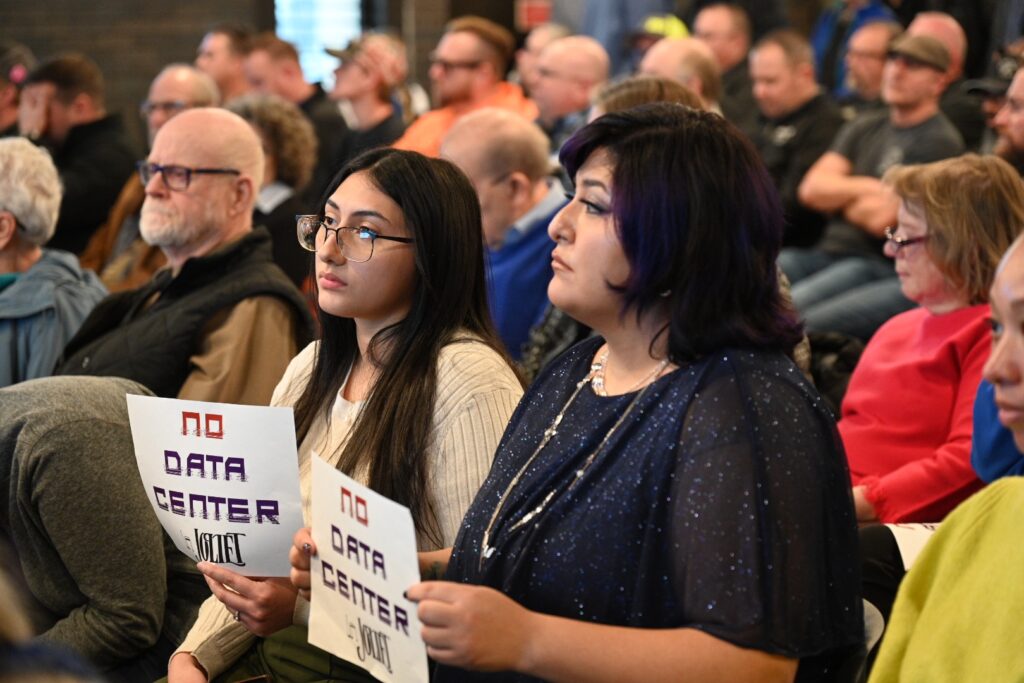
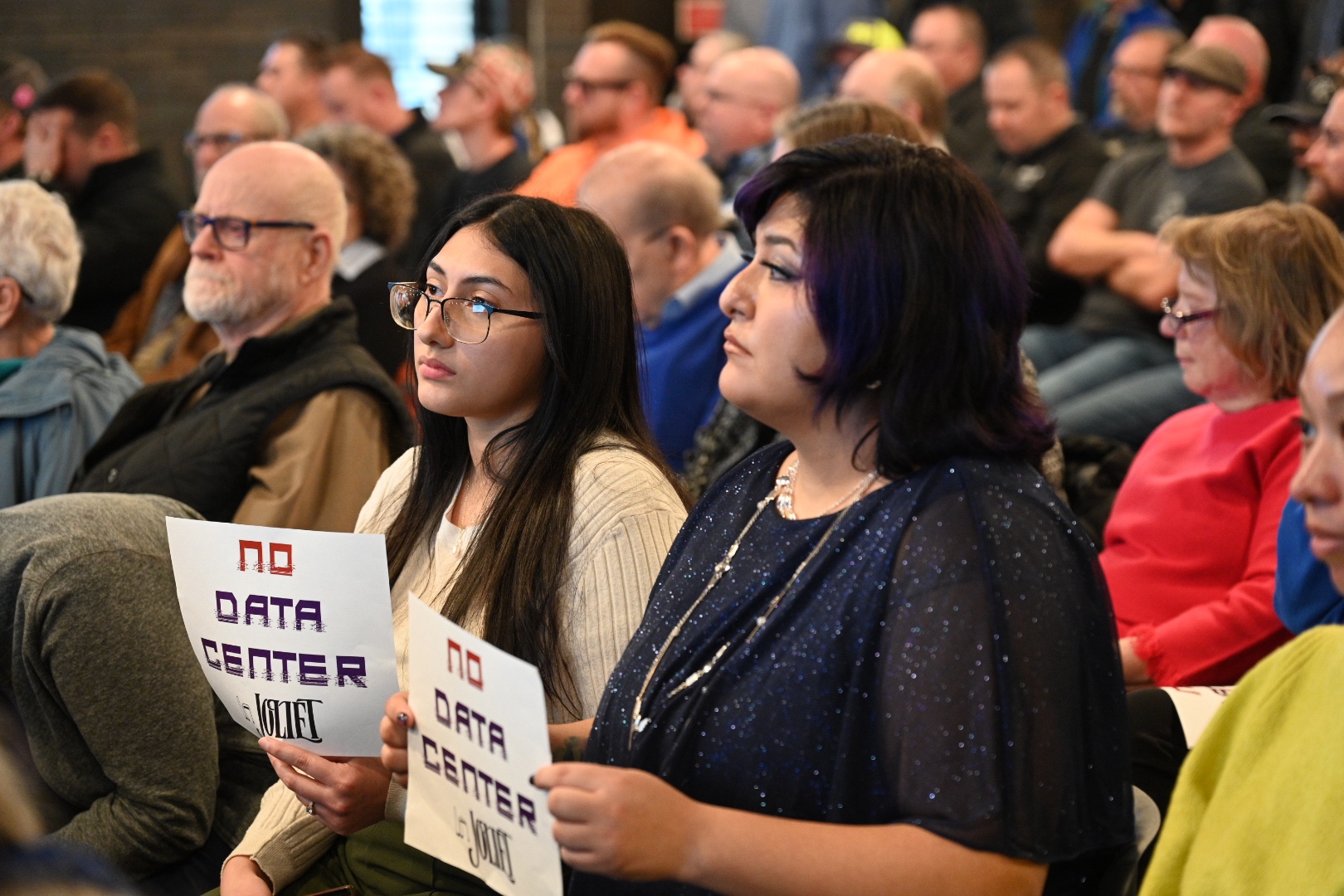
Lily Martinez and Isabel Gloria hold signs in opposition to the data center. Both spoke during public comment. (Photo by Stephanie Irvin)
By Stephanie Irvine
The controversial 795-acre data center proposed just south of the Chicagoland Speedway in Joliet was given the green light by the city’s Plan Commission at a special March 5 meeting.
The 7-1 vote recommends the project to the city council for approval. Chairman John Kella was the lone vote against.
“There’s just too many questions in the back of my mind,” Kella said of his vote.
The Joliet City Council will have the final say at a public hearing on the annexation and rezoning March 16 at 5:30 p.m. at City Hall. The March 17 meeting was cancelled because it conflicts with Primary Election Day.
On the 16th, Council will vote on the proposed project’s annexation agreement, zoning change from agricultural A-1 to light industrial I-1 and a preliminary planned unit development.
Hillwood, a Ross Perot Company, partnered with PowerHouse, a data center developer, to bring the project to Joliet. It was originally slated to go before the plan commission in October. An open house was held at Joliet Junior College in the beginning of February.
Attorney David Silverman represented the data center, but PowerHouse Hillwood came with an army of experts to address every component of the project, noise, water, traffic, environment, jobs, and more. Their comprehensive presentation followed the staff report and its recommendation.
“It meets your comprehensive plan,” Silverman said.
“It seems to be a great location with proper landscaping, lighting and sound controls. It can be compatible with the neighbors that are around there. It brings you a great deal of revenue to both the city and other taxing districts, and it does that without the truck traffic that I know the city has had enough of,” Silverman summarized at the presentation’s conclusion.
After the presentation, commissioners had questions for the developer.
Commissioner Debbie Radakovich inquired if they planned on digging any wells on the property, to which their water expert, Todd Czworniak of the Syska Hennessy Group, replied they would not and instead would rely on the municipal water source.
Commissioner Mike Turk had several questions about water usage and a spike in electricity, but said the developer had answered them in its presentation. He asked if there were any of their projects nearby, but the developer said there weren’t.
“Let’s say 20, 25, 30 years from now, something could come along with technology that we don’t even conceive or comprehend right now, and if that’s the case, the existing buildings that you’re proposing could be converted into other uses. Is that correct?’ Turk also inquired.
The developer’s answer to his final question made a significant impression on the crowd, with some even bringing it up during their comments later.
“Once you build these things, they’re almost impossible to get rid of,” Pat Pline of PowerHouse Data Centers said, drawing jeers and prompting the city’s interim corporate counsel, Todd Lenzie, to quiet those speaking out.
Pline clarified that it was the combination of the 15- to 20-year leases with billion-dollar-plus valuations that caused the permanency. They could be repurposed, but it would be unlikely given the cost.
Commissioner Jason Cox asked how frequently technology would be updated if the project were built. Pline said they change out the data house equipment every five years.
Community benefits were a concern for Commissioner Wendell Martin, but the developer explained they would work with the schools to provide job training and are working to establish a formal community benefit agreement with city staff.
Later, Lewis University Vice President Dr. Kip Kline spoke in favor of the project due to that plan.
The March 5 special meeting drew hundreds of attendees, filling up council chambers and spilling out into overflow areas. The meeting, which lasted more than five hours, had only Powerhouse Hillwood’s data center on the agenda.
Public comment alone lasted more than four hours, with 58 individuals signed up to speak. At least a dozen others lined up at the podium when the clerk asked if anyone else wanted to provide comment.
Overwhelmingly, public comment opposed the data center’s approval, with speakers citing myriad concerns related to electricity demands, water usage, AI and the environment.
Some raised transparency issues, stating they received multiple different answers to the same questions at the open house, leading to confusion and distrust.
The majority of those speaking at the public hearing were Joliet residents. Some came from neighboring communities, including Monee, Manhattan and Elwood. They were of all ages and backgrounds.
Guillermo Rodriguez drove to Joliet from Aurora to caution Joliet from the harm data centers can bring to a community. He told of how Aurora data center CyrusOne, has negatively impacted his community, so much so that Aurora now has a moratorium on data centers.
Commissioner Jeff Crompton asked about air quality, a major concern for many in attendance, especially regarding the development’s generators. Pline said they would comply with the stringent EPA standards.
The presentation indicated they couldn’t run for more than 12 hours per month.
However, some opponents raised the issue that some developers build noncompliance into their budgets, showing distrust in the corporation.
Sound was another major issue for residents, with some having done their own research, explaining that lower frequencies or “infrasound” cause just as many problems as higher decibels, but opponents say the company didn’t address it.
For Monee resident Jeff Becker, transparency was an issue. He said he submitted a FOIA request to learn more and received 1,300 pages of fully redacted documents with only seven pages of content.
In those seven pages, Becker said found emails that showed City Planning Director Jane Bernhard, a relative of the Bernhard family who contracted the land to PowerHouse Hillwood, was involved in the project after the city said she was supposed to be out due to the conflict of interest.
Becker’s brother, Tom Becker, Green Garden Watershed Commissioner, also spoke in opposition to the project. The Becker brothers have been staunch opponents to another controversial proposed project in Will County, Earthrise Energy’s Pride of the Prairie solar development.
Despite the opposition, multiple union representatives, including Will-Grundy Building Trades President Doc Gregory and the Three Rivers Construction Alliance’s Executive Director Tom White, championed the project and the 8,500 construction jobs it is said to bring.
Union members, current and retired, attended the hearing. Some spoke in favor; some spoke in opposition to the project.
Joliet resident Keith Lewis took issue with the way the project was being posed: That if an individual opposed the data center, it meant they opposed unions, which he said wasn’t true.
Several individuals urged the council to table the project until more concrete answers were available. Many of the unanswered questions stem from Hillwood PowerHouse not yet knowing who its end user would be.
Both Hillwood’s Executive Vice President Don Schoenheider, and PowerHouse’s Pline, at different points, said that they’ve been in talks with the major players in data usage, but they wouldn’t sign until zoning is approved.
Pline said when directly asked by Commissioner Radakovich, “They won’t engage in serious conversation until zoning is in place. That’s the way this industry works.”
Powerhouse Hillwood representatives affirmed during the public hearing they would not build on spec, meaning they’d have a user once the zoning was approved.
Joliet resident and environmental scientist Teresa Mullen applauded the developer’s presentation, but raised questions regarding the project and conflicting water numbers.
“Clarity is required regarding the closed-loop water system because the example stated in the presentation, where they will allegedly use less than 660 gallons of new water intake, comparable to the Olympic pool size, but simultaneously stating that the sites will not exceed 150 gallons of usage a day. These don’t make sense,” Mullen said.
Czworniak, the water expert from Sysko-Hennessy, listened closely as Mullen spoke, jotting down notes. At times, he, too, looked perplexed by the numbers posed, but he did not interject or respond to the concerns brought up.
James Scarpelli, a junior systems engineer and network operations L2 analyst who lives in Sugar Creek Hills in Joliet, about 3 miles from the proposed project, spoke in favor, but with a caveat:
“I say yes, but with very strong, enforceable oversight,” Scarpelli said, urging accountability.
Conversely, Lorrayyah Williams explained she has a master’s degree in data science and is pursuing a PhD in data science and AI. She said it’s the reason she could not support the project.
“I’m wondering how are they able to estimate the necessary power usage when they don’t even know what sort of equipment will be there and the power usage differs greatly,” Williams said.
The data center campus is projected to bring in $310 million in property taxes over
30 years, plus about $40 million in utility taxes, in addition to standard industrial water and sewer rate revenues.
Stephanie Irvine is a freelance reporter.
Joliet Planning and Zoning Commissioner Jason Cox listens to public comment on the data center.
(Photos by Stephanie Irvine)
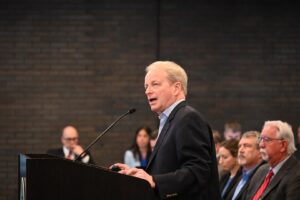
Hillwood Executive Vice President Don Schoenheider presents the data center to the Joliet Plan Commission on March 5.

Green Garden Watershed Committee Chairman Tom Becker listens to PowerHouse Hillwood’s presentation on their proposed data center.

James Scarpelli spoke in favor of the project but urged the city to have proper accountability and oversight.