Crete’s Very Own Claim to a Revolutionary War Patriot
By Karen Haave
William Hewes was a young American Patriot who fought in the Revolutionary War.
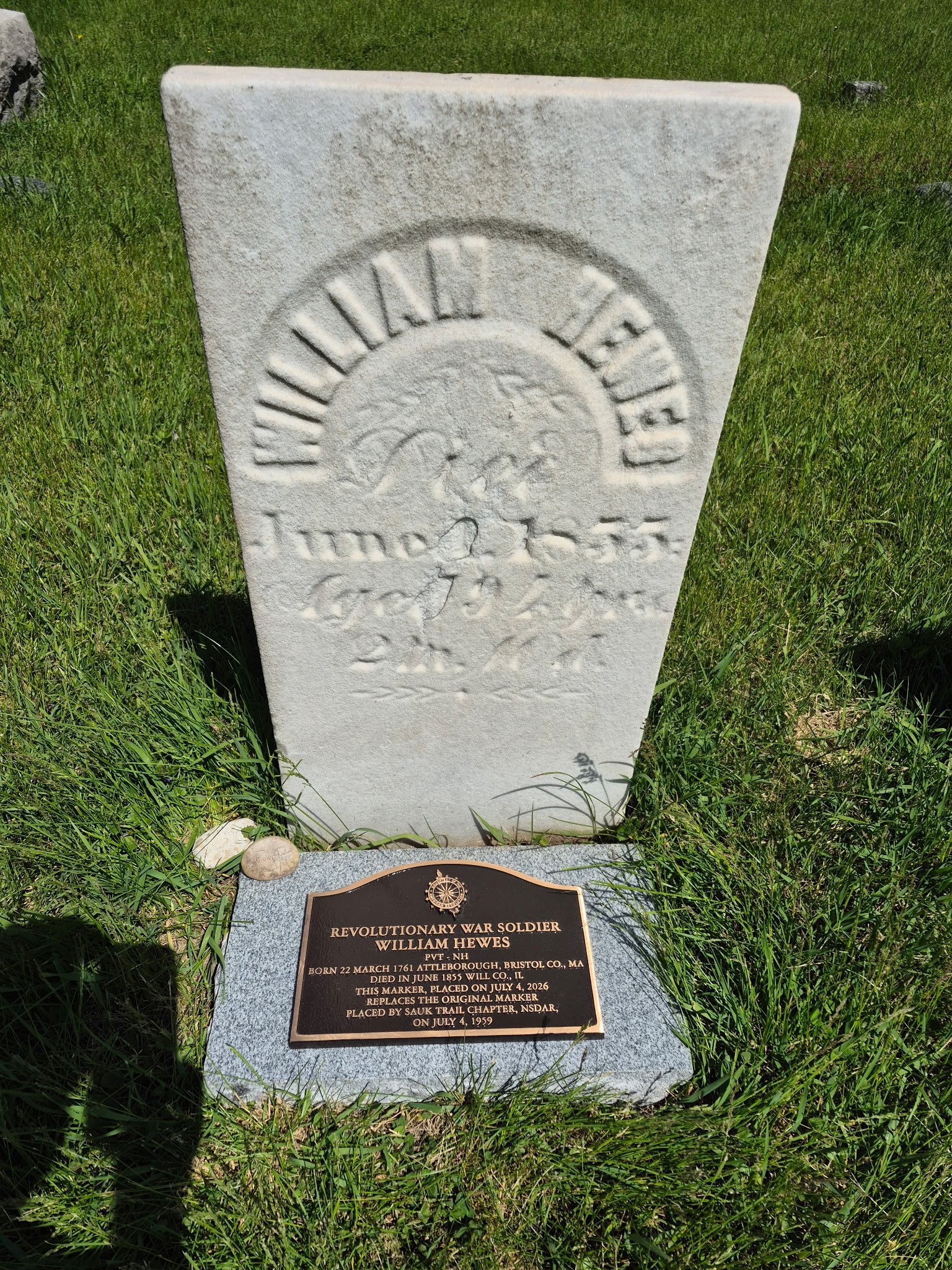
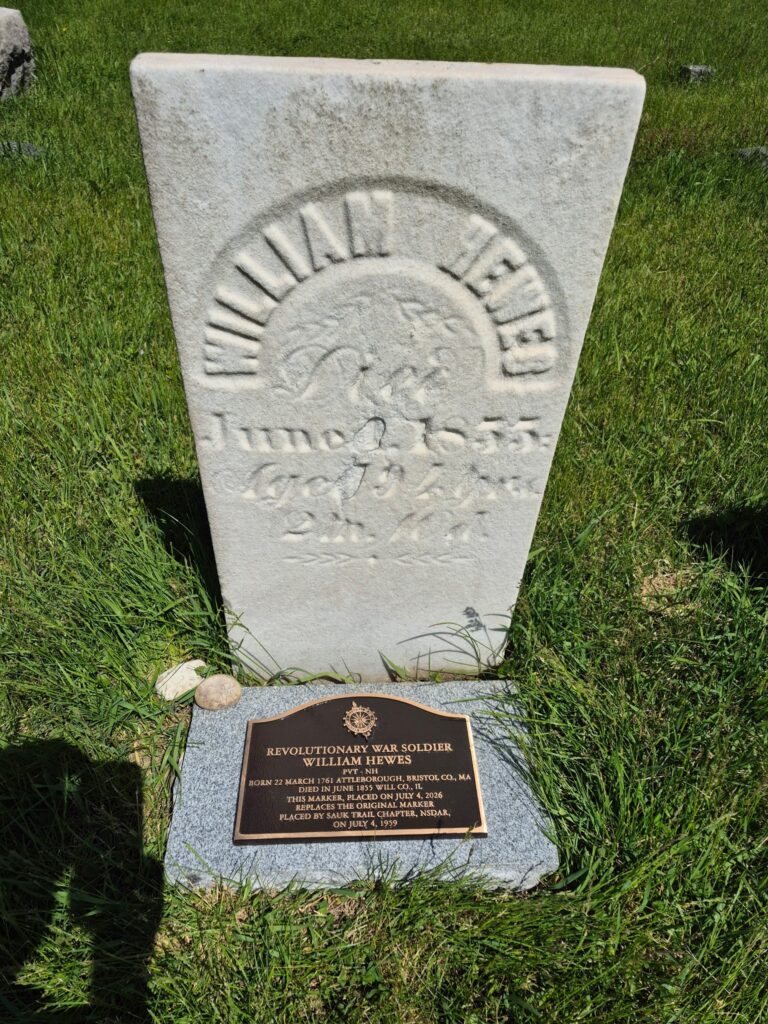
Earlier this month, a new marker on his grave in Crete Cemetery was dedicated to replace the one weather-worn in the decades since 1855.
The dedication ceremony was hosted by the Sauk Trail Chapter of the Daughters of the American Revolution and included posting of the Colors by the Crete-Monee High School NJROTC.
It also featured comments from DAR Regent Melody Rush and an account of the history of Hewes’ military service by Tim DeMuth, a descendant of Hewes and a member of the Crete Area Historical Society.
“You may be asking the question, ‘Is it possible that Crete Township had a resident that fought in the Revolutionary War?’” DeMuth said.
“Yes, William Hewes migrated here late in life to live with his son Lumen who had a farm on land that is now occupied by the former Balmoral Park Race Track. He is buried in the Crete Cemetery. I have been told that he is only one of six Revolutionary War soldiers buried in Will County.
“William was born 1761 in Attleboro Massachusetts, but grew up in Swanzey, New Hampshire. In 1780 at the age of 19 he enlisted in the army as a volunteer for six months,” DeMuth continued.
“He served in the Second New Hampshire Regiment, as a private, commanded by Col. George Reed. So, in June of that year, he traveled to West Point where he received Drill Instruction for two weeks. The next month after receiving training, his regiment traveled down the Hudson River to Orangetown in the State Of New Jersey where he remained for two weeks. Then he reached what was called the ‘English Neighborhood,’ where he spent the rest of the summer.
“In reality, the English Neighborhood was primarily a Dutch-settled region in New Jersey, but after General Washington had retreated from New York City, the area was occupied by the British Army.
“However, the Continental Army was able to maintain a presence in the area to observe the movements of the British across the Hudson River in New York. It would serve as a violent ‘No Man’s Land’ between the two armies, with many raids and skirmishes as foraging parties tried to obtain supplies for their respective armies.
“It became known as the Forage War.
“William eventually returned to Orangetown and was there on October 2, 1780, to witness the hanging of the British officer Major John Andre,” DeMuth said.
“The backstory on this event is well documented in American History books. Briefly, It was Major Andre who convinced General Benedict Arnold, a celebrated hero for the Patriot cause up to that moment, to desert the Continental Army for a promise of a higher rank and more money in the British Army.
“Arnold, disillusioned by the way he had been treated by the Continental Congress and his peers in the Continental Army, would desert after a face-to-face meeting with Andre. Arnold was able to escape successfully to New York City, but Andre was caught in civilian clothes by three militiamen who
recognized him. He was convicted of espionage and hung on George Washington’s orders.
“At this period of time, William was employed to repair the breeches at West Point that General
Arnold had created so that it would make it easier for the British to capture the fort.
“Later, he was sent to Fishkill, New York, to guard stores and prisoners for one month, after which he returned to winter quarters on the Heights overlooking the Hudson River. There he remained until he was discharged in December as a Private.
“He would return to New Hampshire and eventually live in Vermont for the majority of his life until circumstances changed that made it necessary for him to follow his son Luman to Crete in 1847 at about the age of 86. He would live eight more years and died in June of 1855.
“William Hewes’ story as a citizen soldier supporting the Patriot cause is just one of thousands of those who would answer the call to fight for what they all hoped would end in a government that would be governed by the consent of its citizens. A government that would ‘promote the general Welfare, and secure the Blessings of Liberty to themselves and their posterity.’
“So, as the celebrations and the fireworks to celebrate our nation’s 250th birthday begin, may we all reflect on the contributions made by those patriot soldiers like William Hewes.
“It is an honor to have that citizen soldier a part of Crete’s history,” DeMuth concluded.
In her comments, Rush noted that, in 1959, the Sauk Trail Chapter, NSDAR, completed the extensive research verifying Private Hewes’ Revolutionary War service and honored him with the placement of the first plaque. The DAR presented the original memorial plaque to the CAHS for their museum’s future exhibits.
“In honor of the Nation’s 250th Anniversary and recognition of Patriot William Hewes’ service in the Revolutionary War, we, the members of Sauk Trail Chapter, rededicate this marker in grateful recognition of his service to the cause of freedom and birth of the Nation,” Rush said during the ceremony.
“In Honoring William Hewes, we, the Sauk Trail Chapter, NSDAR, also pay tribute to all men and women who have served, or are serving our country with integrity and devotion.
“We, Daughters of the American Revolution, dedicate ourselves to faithful stewardship of the blessing we enjoy today.”
Rush also noted that “DOH Services / South Suburban Memorials has been instrumental and very generous with their time and labors to get this monument set for Sauk Trail. We can’t thank them enough for all their help.”
Karen Haave is a freelance reporter.
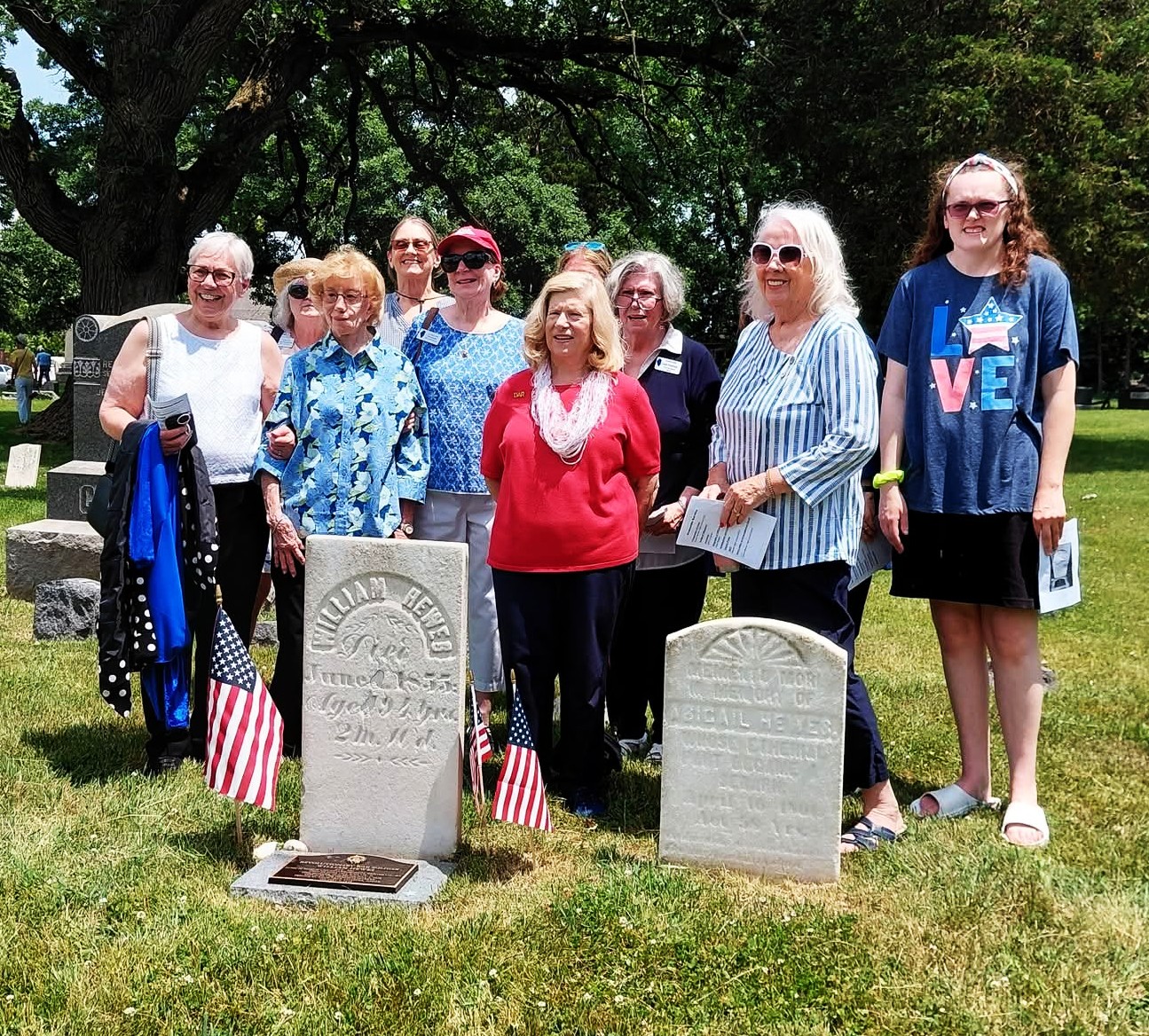
Members of the Sauk Trail Chapter of the Daughters of the American Revolution listen during the re-dedication of Revolutionary War Patriot William Hewes’ marker at Crete Cemetery. (Photo courtesy of the Crete Area Historical Society)