Will County P&Z Rejects Massive Earthrise Solar Proposal After Contentious Two-Night Hearing, Land Use Committee Hearing April 2
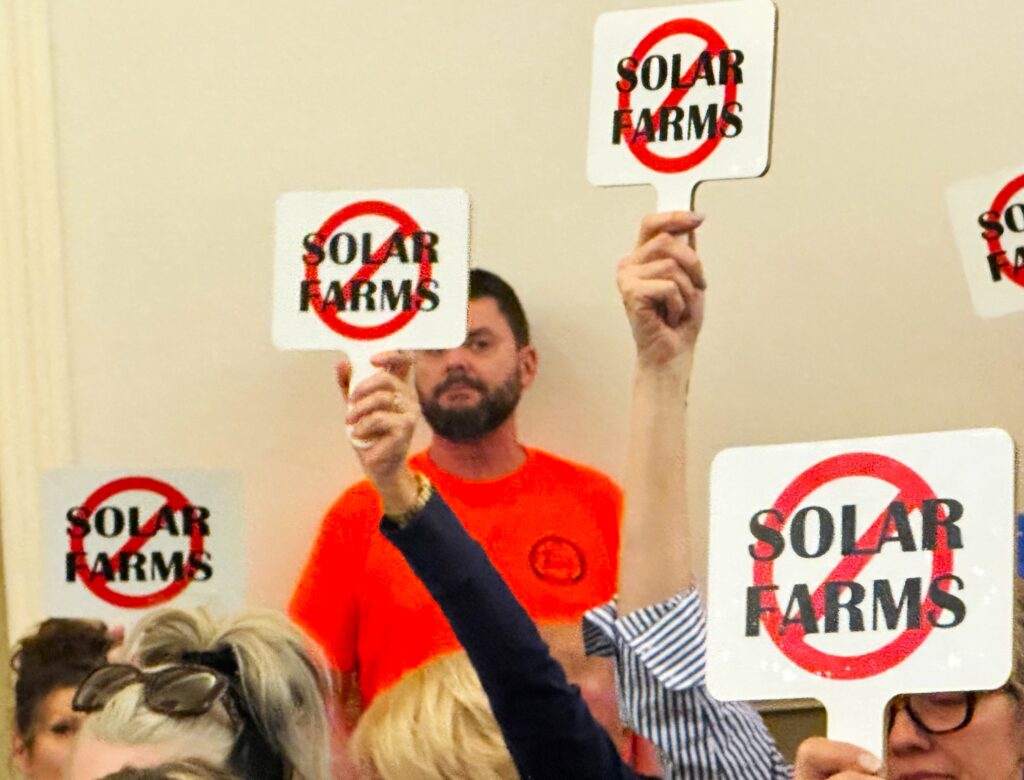
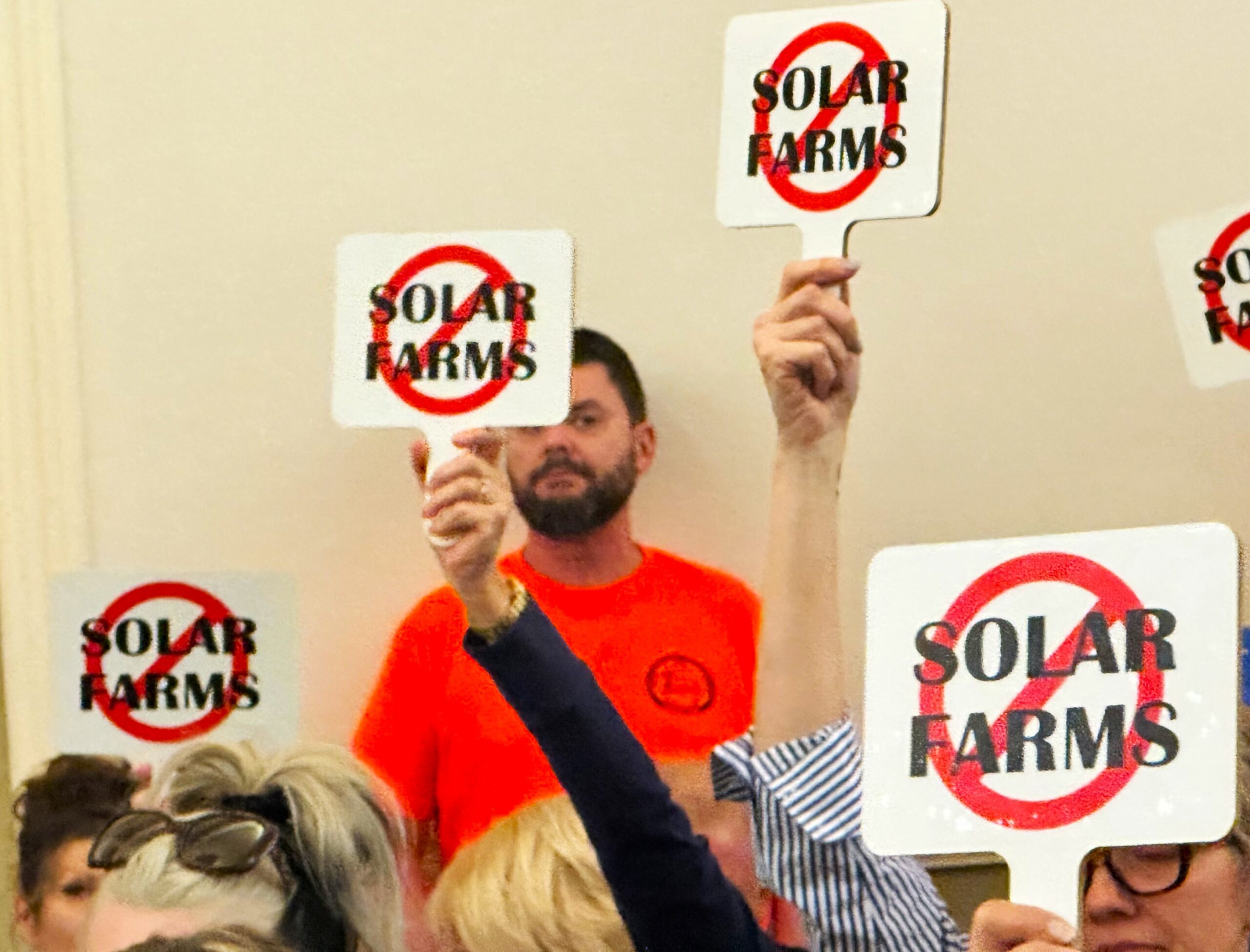
“No Solar Farms” signs were held up at Will County Planning and Zoning Commission hearings on Earthrise Energy’s nearly 6,100-acre Pride of the Prairie solar farm plan every time a union member wearing orange spoke. The commission voted 4-2 to reject the plan. (Photo by Andrea Arens)
By Andrea Arens
JOLIET — After more than eight hours of testimony across two nights, the Will County Planning and Zoning Commission voted to recommend denial of a controversial 6,099-acre solar project proposed by Earthrise Energy.
The “Pride of the Prairie” project spans 96 non-contiguous parcels across multiple townships and would generate up to 600 megawatts of power. The proposal required a single special use permit along with 195 variances.
The commission voted 4–2 against the project late March 31, sending the recommendation to the Will County Land Use Committee for further consideration.
Significantly Larger Project
Earthrise representatives opened the March 30 hearing with a 90-minute presentation outlining the scope and benefits of the project, which they said would include roughly 17,000 solar panels and generate $3.5 million in first-year tax revenue. Peotone School District 207U alone was projected to receive $1.8 million.
Attorney Ben Jacobi compared the proposal to Earthrise’s Plum Creek Solar project in Crete Township, which was approved by the Will County Planning and Zoning Commission, though acknowledged it is significantly larger. Plum Valley spans 2,400 acres and produces 260 megawatts.
Earthrise officials said about half of the energy generated would be used locally, depending on demand, and confirmed that 300 megawatts of the project are already contracted through Illinois Power Agency procurements in 2023 and 2024.
However, questions arose about long-term tax projections. The company’s estimates relied on the current statutory valuation of $218,000 per megawatt.
Grid Capacity and Infrastructure
Commissioners pressed Earthrise on whether the project would meaningfully increase grid capacity. Commissioner John Kiefner expressed skepticism, noting the project would rely in part on the Lincoln Generating Station, a peaker plant that operates only about 5 percent of the time.
“I can’t buy the argument that it’s adding capacity to the grid,” Kiefner said.
Earthrise Operations Manager Rob Kalbouss responded that market conditions dictate when the plant runs and confirmed the solar facility would be limited in how much power it can transmit at any given time.
The project also includes plans for a second substation in Manhattan, requiring additional approvals.
Public Pushback
More than 100 people signed up to speak, with public comment stretching late into both evenings. Written opposition outweighed support, with dozens of letters submitted against the project.
Many speakers in favor were union workers, environmental advocates, or representatives of organizations that had received donations from Earthrise. Several local residents and farmers spoke in support of property rights.
Opposition largely came from nearby residents and township officials, who raised concerns about land use, environmental impacts and the project’s scale.
Resident Laura Heidrich, whose property would be surrounded by solar panels, voiced concern about impacts on her dog breeding operation. She said she was warned by Earthrise representatives not to pursue legal action because Earthrise has “deep pockets.”
Union tensions also surfaced, as members of the carpenters union criticized being excluded from the project labor agreement, despite strong union presence at the hearing.
Environmental and Legal Concerns
A major point of contention involved whether the application was complete, particularly regarding wetlands and floodplain analysis.
Thomas Becker, chairman of the Green Garden Watershed Committee, argued the proposal lacks required environmental documentation.
Becker contended that Earthrise has not completed necessary wetland delineations or floodplain mapping and has not triggered required state and federal reviews, including from the Army Corps of Engineers.
“This is an incomplete application … until they trigger federal and state agencies, they cannot proceed,” Becker said.
Attorney Steven Becker echoed those concerns, calling the application “woefully incomplete” and arguing that combining nearly 100 non-contiguous parcels under a single permit could violate due process. His remarks drew loud applause from the audience.
Township Opposition
Local township officials repeatedly asked for delays, saying they were not adequately consulted.
Green Garden Township Supervisor Dean Christofilos urged the commission to reject the proposal outright.
Christofilos said the project conflicts with the township’s comprehensive land use plan, which designates specific areas for solar development that do not include the proposed sites.
“This is not a done deal … it’s a deal that could be denied,” Christofilos said. “It’s not compliant with our land use map.”
Manhattan Township Supervisor Jim Walsh added the township is not opposed to solar energy, but described the project as “too darn big.”
Property Value and Quality of Life
Earthrise consultants presented data suggesting nearby property values could increase by about 2 percent, a claim that drew audible pushback from the crowd.
Local real estate agent Gregory Clark disputed that conclusion.
“Buyers don’t want to live near solar,” Clark said, arguing the project could hinder growth in nearby communities like Frankfort.
Other residents raised concerns about aesthetics, noise, and quality of life. Claims about health and environmental risks — such as chemical leaching or interference with medical devices — were rejected by Earthrise officials.
Final Vote and Next Steps
The second night of hearings included additional rebuttals from Earthrise, which said some environmental reviews would occur later in the permitting process, and coordination with agencies like FEMA and the Army Corps of Engineers is planned.
Commissioners remained divided. Kiefner and Luis Navarrete voted in favor of the project, while Matt Garland, Hugh Stipan, Karen Warrick and Julie Mitchell voted against it.
The proposal for both Earthrise solar plans now moves to the Will County Land Use Committee, which is scheduled to meet April 2 at 11 a.m. at the Renaissance Center in Joliet. The full County Board then will consider the issue at its April 16 meeting.
Andrea Arens is a freelance reporter.