Earthrise Energy: County, Local Officials Still Awaiting Details of 5,400-Acre Solar Development
Earthrise Energy
County, Local Officials Still Awaiting
Details of 5,400-Acre Solar Development
Hundreds of residents attended Earthrise Energy’s recent open house in Manhattan, detailing its proposed 5,400-acre solar development project. And many didn’t like it.
Now, Will County officials will hear the plan once Earthrise Energy submits it to the Land Use Department.
No plans were submitted as of October 15, said Michael Theodore, spokesman for Will County Executive Jennifer Bertino-Tarrant. But County Board Speaker Joe Van Duyne met with Earthrise Energy representatives a couple weeks ago.
Van Duyne told Farmers Weekly Review they wanted to give county officials a heads-up as to what was coming when they submit the plan in a few weeks.
“They said they would be reaching out to the other County Board members as well,” said Van Duyne, D-Wilmington. He said there weren’t many specifics, other than to say this plan was separate from another they have in the works for the Crete area.
One County Board member who reached out to them at the open house was Judy Ogalla, R-Monee, former board leader and a staunch opponent of solar farms.
Several years ago, as solar farm plans were beginning to crop up, Ogalla and the Will County Farm Bureau had worked diligently on a comprehensive solar ordinance for counties, including Will, only to see the state take over much of the process.
At the open house, she said, “I asked them about absolutely everything, and they didn’t have any answers. I asked them how much of the land in the plan is leased versus owned, and they didn’t know that, either.
“If a farmer or other landowner wants to sell, I have no problem with that. But their neighbors shouldn’t have to suffer for their decisions.”
Lack of notice
Ogalla said she hadn’t heard about the open house until the day before on Facebook. The company did not inform her or her fellow District 2 colleague, Frankie Pretzel, R-New Lenox, who chairs the board’s Land Use Committee.
Others had the same experience.
Word had begun spreading online in early September that a huge solar project was coming after Green Garden Township Watershed Committee member Tom Becker made a post that began circulating on Facebook, though no one knew the exact details.
That’s how Dr. John Tricou of Green Garden found out. He’s a radiologist and also owns Sojourn Therapeutic Riding Center, which would be near the proposed solar development. He was posted at the entrance collecting petition signatures against the project.
“It’s inefficient, and there’s more energy in a power plant,” Tricou said, expressing that he wanted the “prime farmland” to stay farmland and felt the development was short-sighted.
In the weeks leading up to the open house, crews were spotted pulling core samples, heightening concerns among neighbors who posted pictures online. Despite the recent action that garnered the attention of locals, Earthrise’s Talya Tavor said the land campaign began shortly after they acquired the Lincoln Generating Facility in 2019.
On October 2, roughly a month following Becker’s Facebook warning, the Village of Manhattan shared an event flier for the open house online on October 2. Earthrise representatives had also gone door-to-door to notify residents near the project in the days preceding the open house.
The Village of Manhattan, however, did not have much advanced notice, Mayor Mike Adrieansen said. Adrieansen, Development Director Marc Nelson, and Village Administrator Jeff Wold, were invited to a meeting called by Earthrise at 2:30 p.m. the day before the open house.
They were able to view the map as part of a very brief presentation, but were not provided any hard copies, nor given any logistics information, Adrieansen said. At that time, they were also given the flier for the open house scheduled for the following evening. The village shared it online.
Invited and shut out
Though the project spans 5,400 acres, only about 100 of those acres are in the Village of Manhattan, which is in an industrially-zoned area next to the Lincoln Generating plant owned by Earthrise.
“After reviewing the project maps and hearing from residents, I will be scheduling a meeting not only with Manhattan Township officials, but also with representatives from Green Garden and Wilton townships,” Adrieansen said.
“As I have stated previously, the village receives very little benefit from large-scale solar projects. In my view, this should be a regional discussion, as the recent open house did not provide residents with enough clear or detailed information,” Adrieansen said.
Adrieansen said he attended the open house to get a better idea of what Earthrise was planning and actually inspect the map. Several other Village of Manhattan board members and area township members were seen in the large crowd of residents.
“I was very disappointed in meeting with Earthrise, because I was talking to the gentleman and explaining our resolution and ordinance and [the township] want you to be 500 feet from residents and 100 feet from roadway,” Manhattan Township Clerk Kelly Baltas said.
“His response was they’re not interested in what our ordinances are, because they have to follow Will County guidelines, but county guidelines are a lot more lax than ours.”
Baltas’ claims were echoed by Earthrise representatives who frankly said that they would meet with those who had discretionary entitlement, like the road commissioner.
Manhattan township did not meet with Earthrise before the open house, though Earthrise contends that they had reached out to the townships. Manhattan Township officials said that they preferred to meet once they had maps and more information, but never heard back until the open house was scheduled.
Big crowd, few answers
The packed event, held at the Hansen Community Center in Manhattan on October 8, was intended to provide information to the public and answer questions. Another one would be held the following day in Crete.
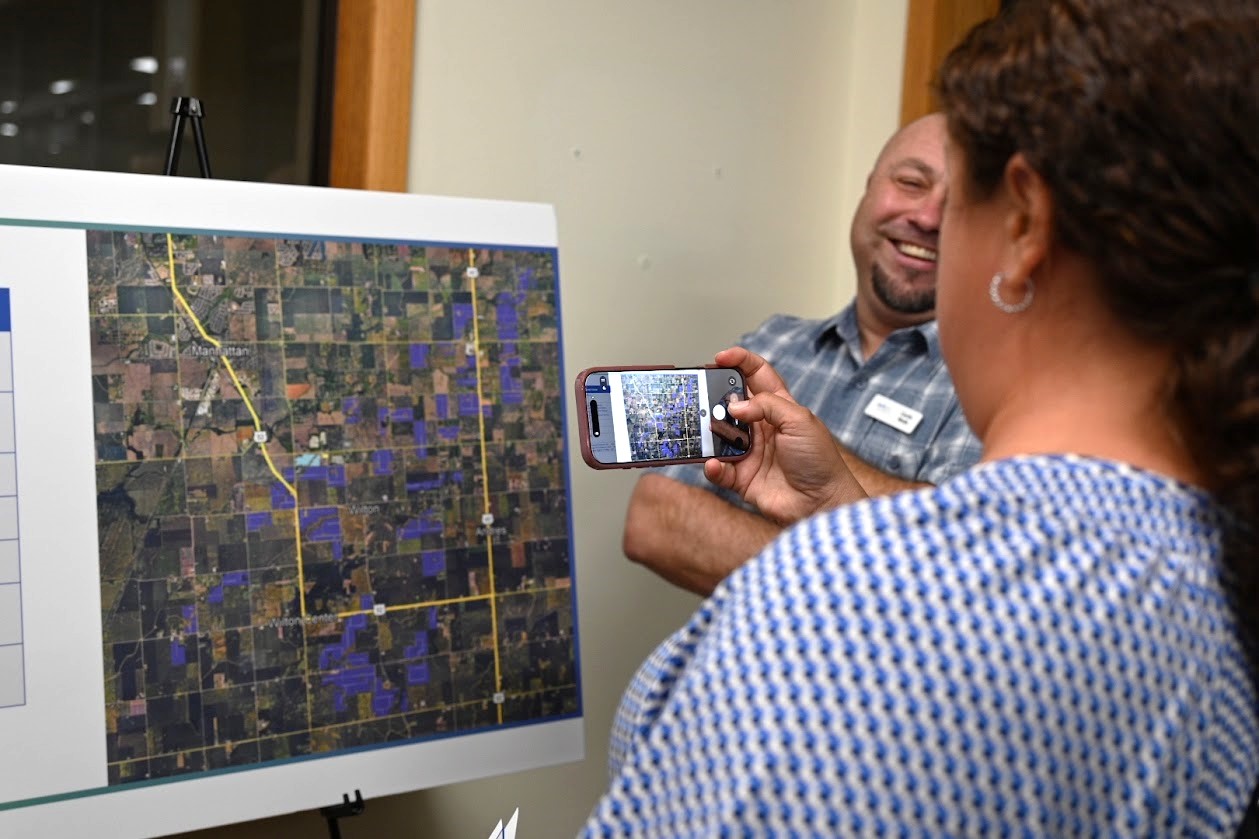
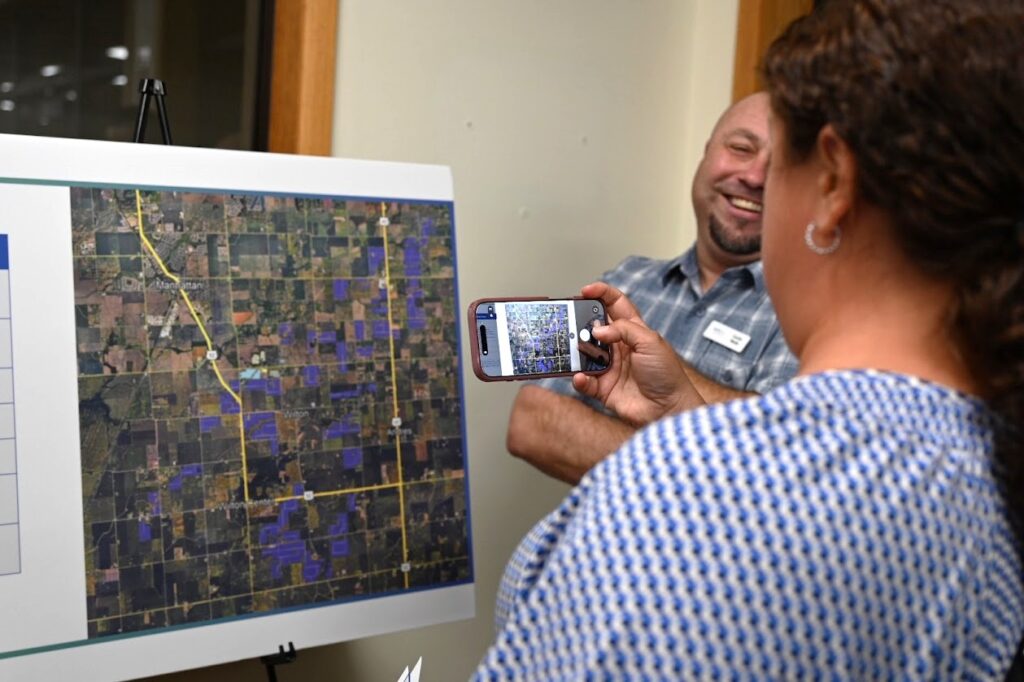
At times, three to four rows of people clamored to view the single map of the project located in the back corner of the room, many drawing ire from the lack of accessibility to the one thing nearly everyone came to see.
“Everybody walked into a room and had to file in the back of a corner room to be able to see a little map that shows us losing the farmland,” Kathleen Roemer said.
Her generational homestead sits between two parcels of solar panels, colored purple on the map. She and her husband moved from Oak Lawn into the home her parents built nearly 30 years ago, wanting to be surrounded by farm fields and enjoy rural life.
Roemer fears the noise from the inverters will be a nuisance, and she’s worried about whether they’ll stand by their word if the panels are destroyed or need to be decommissioned.
Like Roemer, Manhattan Township resident John Kieken shared the concerns about the noise generated from inverters.
Earthrise representative Talya Tavor said the inverters generated about as much noise as an air conditioning unit. Though when asked, she did not know how many inverters would be spread throughout the project.
“I left the open house with more questions than I started with,” Kieken said.
Kieken wasn’t alone. Many who left the open house were dissatisfied with the responses given by Earthrise representatives.
Kieken inquired about the total cost of the project and says an Earthrise representative told him they didn’t know.
“How can they be in the approval and land acquisition stage of the project and not know how much this is going to cost? This is truly unbelievable,” Kieken said.
Another concern was the presence of lithium battery storage, which Kalbouss and Tavor both denied was part of the project.
Instead, they focus on doing solar a little bit differently by connecting to existing power plants.
“We’re the only developer who builds the way we do. We connect to the grid through the (peaker plants),” Kalbouss said.
“We have more certainty on interconnection when we already own the infrastructure. We know the ATC, when other developers bet on it,”
He added they started out paying taxes immediately because they came to this larger project already owning the Lincoln Generating Facility peaker plant.
“The company currently owns 1.7 GW of natural gas-fired power plants and is planning 1.5 GW of complementary solar projects across the Midwest,” the flier read.
Ryan Dunfree, another Earthrise representative, added that the panels can sustain up to 106 mph winds and have a flat mode for inclement weather.
“We only use solar panels made in the United States, and our panels are made from silicon, aluminum and glass. There is no risk of these materials leaching into the groundwater,” Tavor said.
She went on to say there was an older type of panel made from cadmium and other toxic materials that would leak, but was emphatic they don’t use those. She also said they don’t use pesticides and are invested in creating a natural habitat for native plants in and around the solar panels.
Earthrise is big on agrovoltaic plans, where agriculture and solar uses are combined, Tavor added. She gave the example of using a herd of sheep to keep grass low, but followed that up by saying there is a “surprising shortage of sheep,” to do the work.
Tavor explained they won’t build on wetlands, for example, so they have more land than what they’ll be using.
However, neither Tavor, Kalbouss, nor other representatives could reveal how many acres of the 5,400 acres would have panels, how many inverters there would be or where (outside of being installed in the center of the panels) or if there were other exclusions.
Kalbouss and Tavor both emphasized their business model is a PBLLC, a subset of limited liability corporations dedicated to offering public benefits.
Tavor said while they plan to continue to generate funds for the community through tax generation, pointing to a map highlighting the breakdown, they’re more focused on finding out specific projects and community needs, like the dog park and firefighting gear recently donated through RISE grants the company offers.
“I call them bribes,” Ogalla told Farmers Weekly Review.
The map Tavor pointed to illustrates exactly how its $3.9 million tax benefit would be split among taxing bodies.
Manhattan Tax Assessor Joe Oldani couldn’t determine how they arrived at the figures they displayed. When he used the state’s solar energy valuations and calculation formula, he came up with a much lower amount.
The open house drew significant criticism from many who attended, but the room was not solely filled with opponents. As is common with any project that could generate a union job, there were supporters among the attendees.
Some left the open house without signing the petition against (whether they didn’t want to sign any petition, hadn’t made up their minds, or were proponents of the project was unknown), and a few people were engaged in healthy debate about the pros and cons.
Regardless of the answers the open house provided, or lack thereof, Earthrise says they will begin the permitting process with Will County within a couple of weeks and intend to begin construction in 2026.
Van Duyne said they would be keeping an eye out for it, as well as on a ruling from a Will County Court judge on four solar farm cases the board already has denied: Wilmington, Green Garden, Shorewood and Channahon.
The outcome could be significant for Will and other Illinois counties where officials feel hamstrung by the state’s restrictions on solar farm siting.
“They (the state) wants us to do their work, conduct the hearings and listen to the voters,” he said. “They have given us a strict set of regulations to abide by. And I hear they want to make them even more strict.”
Freelance reporter Stephanie Irvine and Farmers Weekly Review Editor Nick Reiher contributed to this story.